
GE Intelligent Platforms: Legacy Hardware Guide for 2026
GE Intelligent Platforms is defined as the former General Electric division that produced industrial automation hardware, including programmable logic controllers, embedded computing systems, and I/O modules for manufacturing and process control. Acquired by Emerson Electric on february 1, 2019, the division became part of Emerson’s Discrete Automation business unit. That transition changed where you source parts, who supports the hardware, and how you plan upgrades. For plant engineers and maintenance teams running Series 90-30, PACSystems RXi, or Genius I/O systems, understanding this history is not optional. It directly affects procurement, firmware support, and migration decisions in 2026.
What products defined GE Intelligent Platforms’ hardware portfolio?
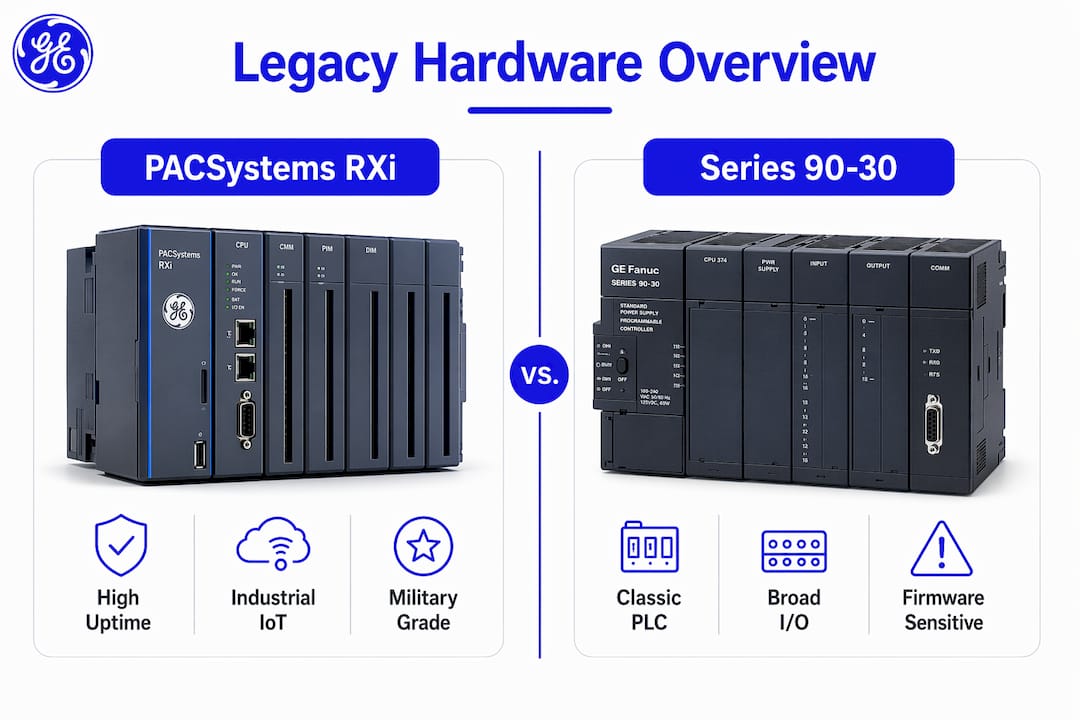
The PACSystems RXi and 3U VPX series were the flagship platforms of GE Intelligent Platforms. Both were built for harsh environments, including high-vibration factory floors and military-grade applications. They supported open standards like VITA 48 (REDI) for ruggedization and PROFINET for network interoperability. Those standards made the hardware attractive to plant engineers who needed long-term compatibility across mixed-vendor environments.
The broader product line covered a wide range of control and I/O hardware. The Series 90-30, such as the IC693CPU364 controller, became a workhorse in discrete manufacturing. The Series 90-70 handled more demanding process control applications. Genius I/O modules, like the IC660ELB906, provided distributed I/O across large plant networks. QuickPanel HMIs gave operators a local interface without requiring a separate PC.
| Product Line | Primary Use | Key Standard |
|---|---|---|
| PACSystems RXi | High-uptime industrial and military control | VITA 48 (REDI), PROFINET |
| Series 90-30 | Discrete manufacturing PLC control | Ladder logic, Modbus |
| Series 90-70 | Process and batch control | High-speed I/O, redundancy |
| Genius I/O | Distributed field I/O networking | Genius Bus protocol |
| QuickPanel HMI | Operator interface and visualization | Windows CE, Ethernet |
| VersaMax | Modular I/O for smaller applications | Profibus, DeviceNet |
The RXi platform was an early attempt to connect PLC-based control with Industrial IoT concepts. The vision was sound, but firmware compatibility challenges in real plant environments slowed adoption. Plants that deployed RXi systems early often found that integrating them with older Series 90-30 racks required careful firmware version matching.
Pro Tip: Before ordering any replacement module for a Series 90-30 or RXi rack, document the exact firmware revision running on your CPU. Mismatched firmware between a new module and an existing CPU is the most common cause of startup failures on legacy GE hardware.
How has the corporate landscape changed since Emerson’s acquisition?
GE Intelligent Platforms ceased as an independent entity on february 1, 2019. Emerson Electric absorbed the division into its Discrete Automation business unit, which also includes brands like ASCO and Aventics. The GE branding on automation hardware was phased out over time, though many products continued under the Emerson name.
One point that confuses many plant engineers is the relationship between the legacy hardware business and GE’s current digital operations. GE Vernova is now GE’s modern digital unit, focused on cloud-based software for grid modernization and industrial applications. GE Vernova has no connection to the PACSystems or Series 90-30 hardware lines. Treating them as the same entity leads to wasted time when searching for parts or support.
The practical impact of the acquisition on parts availability is significant:
- OEM direct sales ended. Emerson does not actively market or sell most legacy GE Intelligent Platforms hardware through standard distribution channels.
- Documentation is harder to find. Original GE programming manuals and firmware files are not always accessible through Emerson’s current support portals.
- Aftermarket channels now carry the load. Legacy parts availability relies on surplus markets, specialized resellers, and third-party repair shops.
- Support contracts have changed. Plants that held GE service agreements needed to renegotiate terms with Emerson after the transition.
- End-of-life timelines accelerated. Some product lines that GE had kept active were discontinued faster under Emerson’s portfolio rationalization.
Pro Tip: When searching for legacy GE Intelligent Platforms documentation, check the Emerson support portal under the “GE Automation and Controls” product category. Some manuals were migrated there, though coverage is incomplete.
How does modern intelligent automation differ from legacy GE hardware?
Intelligent automation integrates AI, machine learning, robotic process automation, and business process management to orchestrate complex workflows. That definition is fundamentally different from what a Series 90-30 PLC does. A PLC executes deterministic ladder logic to control physical outputs. Intelligent automation software makes decisions across enterprise systems, learns from data, and adapts without reprogramming.
The shift from hardware-centric control to AI-powered, cloud-first software is the defining trend in manufacturing automation right now. GE Vernova’s software business targets grid-edge applications and industrial cloud deployments, not factory floor PLCs. That gap between legacy hardware and modern software platforms is where most plant engineers find themselves in 2026.
The key differences between legacy GE platforms and modern intelligent automation systems include:
- Architecture. Legacy GE hardware uses fixed, embedded control logic. Modern platforms use composable, software-defined architectures that update without hardware changes.
- Connectivity. Series 90-30 systems communicate over Genius Bus or Modbus. Industrial IoT platforms connect over MQTT, OPC-UA, and cloud APIs.
- Data use. Legacy PLCs log data locally or to a historian. Modern systems send data to cloud analytics engines that generate predictions and recommendations.
- Update cycles. Firmware updates for legacy hardware are infrequent and risky. Cloud-based industrial platforms update continuously with minimal downtime.
- Skill requirements. Legacy systems require specialists in GE programming environments like Proficy Machine Edition. Modern platforms require software engineers and data scientists alongside traditional controls engineers.
Modern automation investments prioritize software orchestration layers that integrate AI, robotic process automation, and business process management to automate end-to-end workflows. That is a different problem than keeping a Series 90-30 rack running on a 1990s-era production line. Both problems are real. They just require completely different solutions.
What strategies should you follow when maintaining or upgrading legacy GE systems?
A structured approach to lifecycle management prevents unplanned downtime and avoids costly emergency sourcing. The steps below apply whether you are maintaining existing GE hardware or planning a phased migration to modern controls.
-
Audit your installed base. List every GE Intelligent Platforms module by part number, firmware version, and rack position. Include CPU modules like the IC693CPU350 and chassis units like the IC693CHS397. Without this inventory, you cannot plan replacements or migrations accurately.
-
Identify critical single points of failure. Flag any module with no spare on hand and no readily available replacement. CPU modules and communication cards carry the highest risk. A failed CPU with a six-week lead time shuts down production.
-
Source surplus parts before you need them. Legacy GE parts are now primarily available through surplus and aftermarket channels. Waiting until a failure occurs means paying premium prices and accepting longer lead times. Build a small buffer stock of your highest-risk modules.
-
Verify firmware compatibility before installing any replacement. The RXi platform requires precise firmware matching for successful integration with legacy plant architectures. The same principle applies to Series 90-30 and 90-70 systems. Always test a replacement module in a non-production environment first.
-
Plan migration in phases, not all at once. Replacing an entire GE control system in a single project carries enormous risk. A phased approach replaces one subsystem at a time, validates performance, and preserves production continuity. Start with the highest-risk or most obsolete sections first.
-
Evaluate integration middleware. Modern industrial IoT platforms can connect to legacy PLCs through OPC-UA gateways. This lets you add cloud analytics and remote monitoring without replacing the underlying GE hardware immediately. It buys time and generates data to justify the full migration business case.
-
Document everything you change. Every firmware update, module swap, or wiring modification must be recorded. Legacy systems often have no version control. A single undocumented change can make future troubleshooting nearly impossible.
Pro Tip: Use a PLC maintenance schedule to track inspection intervals, firmware versions, and spare part levels for every GE module in your plant. Reactive maintenance on legacy hardware costs far more than preventive care.
Key Takeaways
Understanding the corporate and technical history of GE Intelligent Platforms is the foundation for every smart decision about legacy system maintenance, parts sourcing, and migration planning in 2026.
| Point | Details |
|---|---|
| Emerson acquired GE Intelligent Platforms | The acquisition closed february 1, 2019; legacy hardware now falls under Emerson’s Discrete Automation unit. |
| Legacy parts require aftermarket sourcing | OEM direct sales ended; surplus channels and specialized resellers are the primary source for Series 90-30 and RXi components. |
| GE Vernova is not the same as legacy GE hardware | GE Vernova focuses on cloud software for grid modernization and has no connection to PACSystems or Series 90-30 products. |
| Firmware compatibility is non-negotiable | Always verify firmware versions before installing replacement modules on RXi, Series 90-30, or Series 90-70 systems. |
| Phased migration reduces risk | Replacing one subsystem at a time preserves production continuity and allows validation before full cutover. |
What I’ve learned from watching plants misread the GE transition
The most expensive mistake I see plant engineers make is conflating the GE brand with a single, unified support structure. GE Intelligent Platforms, GE Vernova, and GE Healthcare are three completely separate entities with no shared parts catalog, support portal, or sales channel. When a maintenance manager calls “GE” looking for a Series 90-30 CPU, they are calling the wrong company. That confusion costs real money in wasted time and misdirected procurement efforts.
The second mistake is treating legacy hardware as either fully supported or completely dead. The truth sits in the middle. A well-maintained Series 90-30 system with a solid spare parts buffer and a documented system audit checklist can run reliably for years. The hardware itself does not fail because it is old. It fails because spare parts run out, firmware expertise disappears, or a single undocumented change breaks something nobody understands anymore.
The third mistake is rushing migration. I have watched plants spend enormous budgets replacing GE hardware with modern PLCs or cloud-connected controllers, only to discover that the new system cannot replicate a specific control sequence the old GE program handled natively. Legacy code carries institutional knowledge. Before you migrate, you need to fully understand what the existing program does, not just what it is supposed to do.
The process automation evolution from hardware-centric GE platforms to software-driven intelligent automation is real and accelerating. But the plants that handle it best are the ones that treat the transition as a managed engineering project, not a product swap.
— Monica
Industrialpartsusa: your source for legacy GE automation parts
Industrialpartsusa stocks surplus, used, and remanufactured GE Fanuc and GE Emerson automation hardware, including Series 90-30, Series 90-70, Genius I/O, RXi, QuickPanel, and VersaMax components. Every part is tested, cleaned, and backed by a one-year warranty from Industrialpartsusa, not the original manufacturer.

For plant engineers sourcing hard-to-find GE modules or planning a migration from obsolete controls, Industrialpartsusa ships in-stock items the same day. The team supports worldwide clients across manufacturing and process industries. If you need a verified alternative source for legacy GE Intelligent Platforms parts, Industrialpartsusa is a reliable option compared to other legacy part suppliers with long lead times or unverified inventory.
FAQ
What was GE Intelligent Platforms?
GE Intelligent Platforms was a General Electric division that produced industrial automation hardware, including PLCs, embedded computers, and I/O systems. It was acquired by Emerson Electric in february 2019 and integrated into Emerson’s Discrete Automation business unit.
Where can I find replacement parts for Series 90-30 or RXi systems?
Legacy GE Intelligent Platforms parts are no longer sold through OEM direct channels. Surplus resellers and aftermarket specialists like Industrialpartsusa are the primary sources for tested, warranted replacement modules.
Is GE Vernova related to GE Intelligent Platforms hardware?
No. GE Vernova is GE’s current digital software unit focused on grid modernization and cloud applications. It has no connection to the PACSystems, Series 90-30, or Genius I/O product lines.
What is intelligent automation, and how does it differ from a GE PLC?
Intelligent automation combines AI, machine learning, robotic process automation, and business process management to orchestrate complex workflows. A GE PLC executes fixed ladder logic to control physical outputs. The two serve different functions and operate at different layers of an industrial system.
How do I migrate from a legacy GE control system to a modern platform?
Start with a full hardware and firmware audit, identify critical failure points, and source spare parts before beginning any migration work. A phased approach that replaces one subsystem at a time reduces production risk and allows validation at each step.