
Secondary Market Automation Parts: A Buyer’s Guide
Secondary market automation parts are previously used, surplus, or decommissioned industrial automation components sold as cost-effective alternatives to original manufacturer parts for legacy manufacturing systems. The industry term for this category is “used and surplus industrial automation components,” though maintenance teams commonly search for it as secondary market automation parts. For operations teams keeping GE Fanuc Series 90-30 PLCs, Allen-Bradley drives, or Omron sensors running past their OEM support window, this market is not a fallback. It is a primary sourcing strategy. Secondary market parts often sell for 10–30% of original OEM list value, meaning a $4,000 PLC module may cost $1,500–$2,200 from a reputable reseller. That gap funds other maintenance priorities.
What is a secondary market automation parts source?
The secondary market for automation parts operates through a defined supply chain. Parts enter the market from three main sources: decommissioned production lines, plant upgrades where newer equipment replaces functional older units, and surplus inventories from manufacturers or distributors who over-ordered. Each source produces components in varying condition, from lightly used to fully tested and remanufactured.
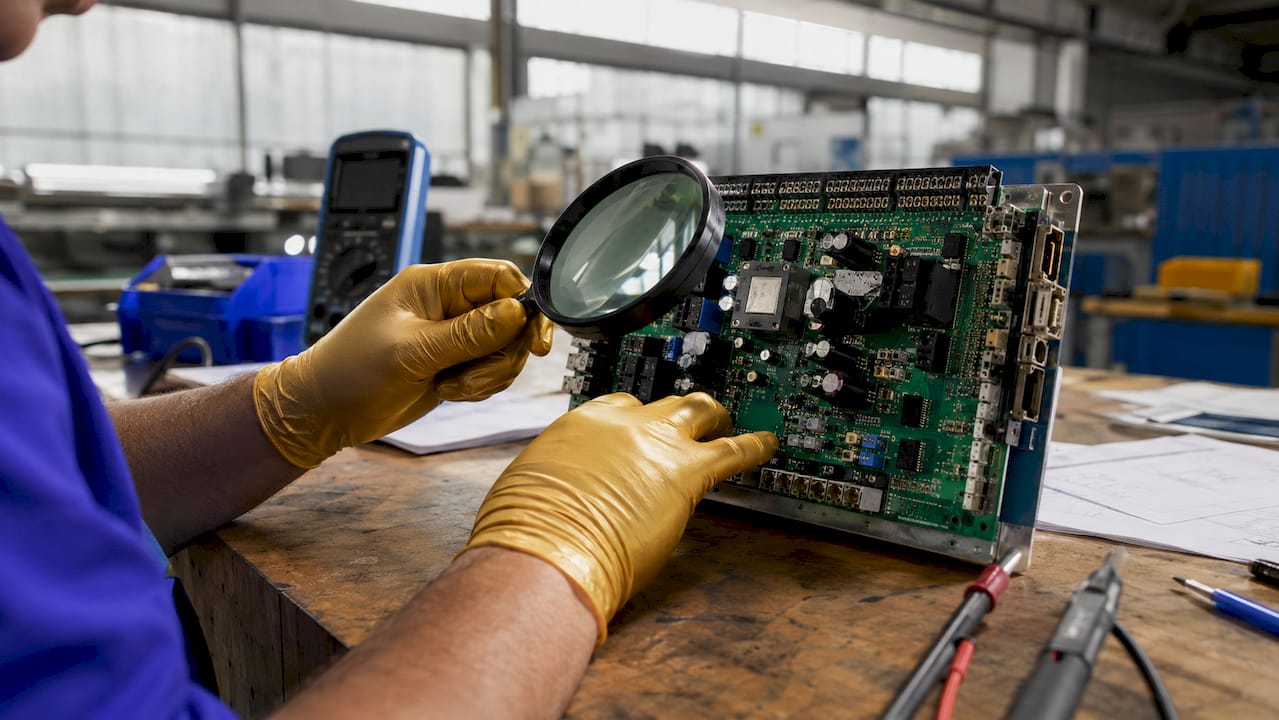
Once parts are acquired, reputable automation parts suppliers inspect, clean, catalog, and test them before listing. The best suppliers assign condition grades, document serial numbers, and cross-reference part numbers against compatibility databases. This process transforms a pulled component into a verified, sellable unit.
Industrial buyers search by exact part number, which tells you something important about how this market works. Purchasing decisions are driven by immediate operational need and precise specifications, not browsing. That transactional behavior means the automation parts marketplace rewards suppliers who maintain accurate, searchable inventory over those who simply list whatever they have on hand.
Geographic reach is broad. Maintenance teams source parts nationally and internationally, particularly when a legacy component is no longer stocked domestically. Online platforms have made cross-border sourcing routine, and same-day shipping from domestic suppliers like Industrialpartsusa has raised the bar for response time.
Pro Tip: Before contacting any supplier, confirm your exact part number from the equipment nameplate or documentation. Suppliers can locate parts faster and verify compatibility when you provide the full model number rather than a description.
What types of automation parts are available?
Secondary market components cover the full range of legacy automation hardware. The most commonly sourced categories include:
- PLC systems and modules: GE Fanuc Series 90-30, Series 90-70, RX3i, RX7i, and Versamax; Allen-Bradley MicroLogix and ControlLogix families
- Variable frequency drives (VFDs): Used in motor control across food processing, HVAC, and conveyor systems
- Human-machine interfaces (HMIs): GE QuickPanel, Beijer HMIs, and Mitsubishi GOT series
- Servo motors and motion controllers: Common in precision manufacturing and packaging lines
- Communication and I/O modules: GE Fanuc Genius I/O, Allen-Bradley DeviceNet, and Profibus modules
- Sensors and specialty components: Proximity sensors, encoders, and vision systems from DVT/Cognex
The table below compares typical OEM new pricing against secondary market pricing for representative parts. These figures reflect general market ranges, not guaranteed prices.
| Part | OEM New (Approx.) | Secondary Market (Approx.) | Notes |
|---|---|---|---|
| GE Fanuc Series 90-30 CPU module | $3,500–$5,000 | $1,200–$2,200 | Often discontinued by OEM |
| Allen-Bradley MicroLogix 1100 | $800–$1,200 | $300–$600 | Wide availability |
| GE Fanuc Genius I/O block | $1,500–$2,500 | $500–$1,100 | Legacy, limited OEM stock |
| Servo motor (mid-range) | $2,000–$4,000 | $700–$1,800 | Condition-dependent pricing |
| VFD (5 HP class) | $600–$1,000 | $200–$450 | Test reports recommended |
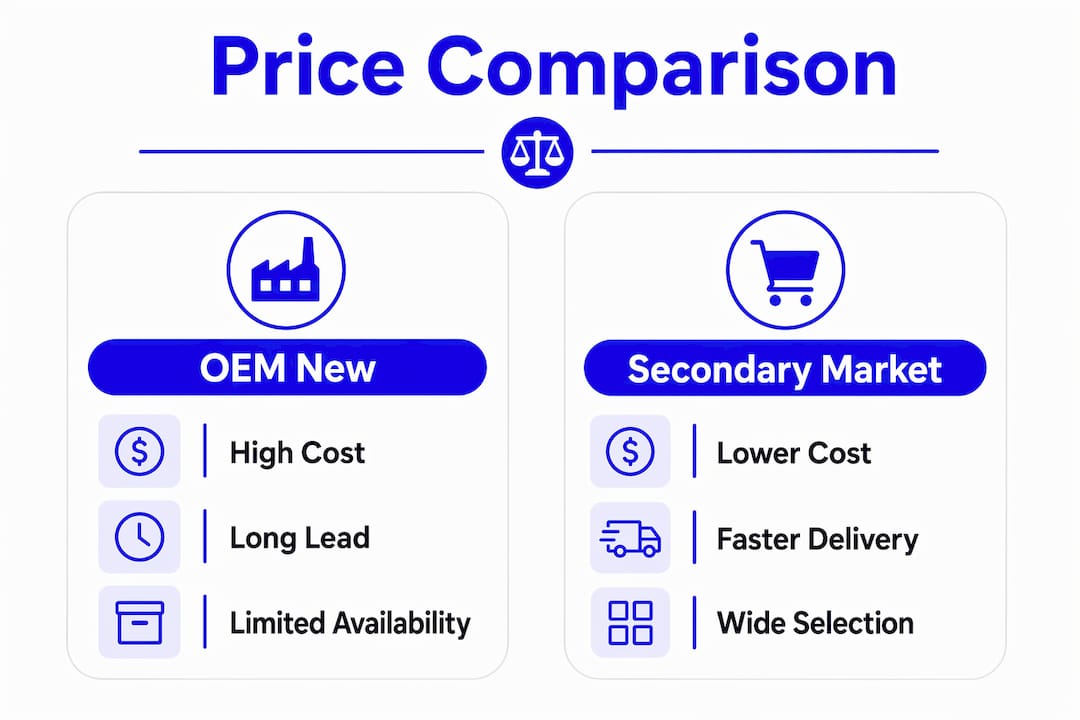
The secondary market fills a specific gap: parts that OEMs have discontinued or placed on extended lead times. When GE Emerson ends production support for a Series 90-30 module, the secondary market becomes the only practical source. Warranties from secondary suppliers are not manufacturer warranties. Industrialpartsusa, for example, backs its parts with a one-year in-house warranty covering tested and remanufactured units.
What are the cost and time advantages?
Cost savings are real, but speed is the more critical advantage for most maintenance teams. When legacy machines break down, OEM lead times can stretch weeks or months. A secondary market supplier with the part in stock can ship the same day. Every hour of unplanned downtime in a manufacturing environment carries a measurable cost, and that cost typically dwarfs any price difference between a new and used part.
Industries that rely most heavily on secondary market sourcing include:
- Food and beverage processing: Legacy PLCs control mixing, filling, and packaging lines that cannot be easily retooled
- Oil and gas: Older SCADA and control systems run on hardware that OEMs stopped producing years ago
- Automotive manufacturing: High-volume lines use mature automation platforms that are deeply integrated into production logic
- Warehousing and logistics: Conveyor and sortation systems often run on Allen-Bradley or GE Fanuc hardware from the 1990s and 2000s
“Speed of availability often matters more than price for operational necessities.” The used industrial parts market is recession-proof precisely because these parts are not discretionary purchases. Production cannot wait.
Recurring buyer behavior reinforces this point. Maintenance teams that find a reliable supplier tend to return for every subsequent repair. That loyalty is earned through consistent stock, accurate listings, and fast fulfillment, not just low prices.
Pro Tip: Keep a short list of two or three verified secondary market suppliers for your most critical legacy platforms. When a failure happens at 2 a.m., you need a supplier you already trust, not a search engine.
How does digital technology improve part quality and traceability?
AI and digital inventory management tools now allow suppliers to track parts from the moment of dismantling through testing, cataloging, and final sale. Buyers can verify part condition, serial numbers, and compatibility using AI-powered diagnostics and supplier databases. This is a significant shift from the manual, spreadsheet-based processes that still characterize smaller secondary market sellers.
The practical benefits for maintenance teams include:
- Serial number traceability: Parts are linked to their original equipment, giving buyers a service history reference
- AI-assisted identification: Reduces misidentification errors when part labels are worn or missing
- Condition grading: Standardized grades (new, tested, remanufactured) replace vague descriptions
- E-commerce integration: Transparent listings with photos, test reports, and compatibility notes
Technological adoption varies significantly across the secondary market. Top suppliers invest in advanced IT and AI solutions. Smaller operators may still rely on spreadsheets and manual inspection. That gap in capability directly affects buyer risk. A supplier using AI diagnostics to verify a GE Fanuc IC693CPU341 CPU module before shipping it is a fundamentally different risk profile than one who lists it based on visual inspection alone.
Buyers should ask suppliers directly about their testing and documentation processes. The answer reveals more about reliability than any marketing claim. For a deeper look at what quality evaluation should cover, Industrialpartsusa’s guide on evaluating parts for resale quality is a practical reference.
Pro Tip: Request a test report or condition certificate for any high-value part before purchase. Reputable suppliers provide this as standard. If a supplier cannot produce documentation, treat that as a red flag.
How should maintenance teams buy secondary market parts?
A structured approach to buying automation parts on the secondary market reduces risk and speeds up the sourcing process. Follow these steps:
- Identify the exact part number. Pull it from the equipment nameplate, wiring diagram, or original documentation. Partial numbers lead to wrong parts and wasted time.
- Confirm compatibility with your system. Check firmware version requirements, rack slot compatibility, and communication protocol. A GE Fanuc Series 90-30 module must match your CPU revision.
- Evaluate supplier reputation. Look for documented warranty terms, a return policy, and verifiable customer references. Avoid suppliers who cannot explain their testing process.
- Request condition documentation. Ask for test reports, photos, and any available service history. This is standard practice with professional automation parts suppliers.
- Check lead time and shipping options. For urgent repairs, confirm same-day or next-day shipping availability before committing.
- Audit your aging systems proactively. Plant managers use aging automation system audits to identify which parts are at highest failure risk, so sourcing can happen before a crisis.
- Document your purchase. Record the supplier, part number, condition grade, and warranty terms. This creates a reference for future repairs and helps track part performance over time.
For teams dealing with discontinued components, Industrialpartsusa’s resource on sourcing discontinued parts fast covers additional strategies for hard-to-find legacy hardware.
Key takeaways
The secondary market for automation parts is the most practical sourcing channel for legacy manufacturing equipment, combining cost savings with faster availability than OEM channels.
| Point | Details |
|---|---|
| Cost savings are substantial | Secondary market parts sell for 10–30% of OEM list price, freeing budget for other maintenance needs. |
| Speed beats price in downtime situations | OEM lead times can stretch weeks; secondary suppliers with stock can ship the same day. |
| Digital tools reduce buyer risk | AI diagnostics and serial number traceability let buyers verify condition before purchase. |
| Supplier quality varies widely | Choose suppliers who provide test reports, condition grades, and documented warranty terms. |
| Proactive auditing prevents crises | Regular audits of aging automation systems let you source parts before failures occur. |
Why the secondary market deserves a permanent place in your maintenance strategy
I have spent years watching maintenance teams treat the secondary market as a last resort. They call a reseller only after the OEM quotes a 14-week lead time and the production line is already down. That reactive posture costs far more than the parts themselves.
The teams that manage legacy automation well do the opposite. They build supplier relationships before failures happen. They audit their GE Fanuc and Allen-Bradley systems annually, identify the five or ten components most likely to fail, and confirm secondary market availability in advance. When something breaks at midnight on a Friday, they already know who to call and what it will cost.
The counterintuitive truth about the secondary market is that quality has improved faster than reputation. AI diagnostics, standardized condition grading, and professional testing protocols have made reputable resellers more reliable than many buyers expect. The risk is not the secondary market itself. The risk is choosing a supplier who has not invested in those tools.
My honest advice: treat your secondary market suppliers the same way you treat any critical vendor. Qualify them, document their processes, and test them on a low-stakes purchase before you need them for an emergency. The secondary market is not a compromise. For legacy automation, it is often the only option that keeps production running.
— Monica
Where to find trusted secondary market automation parts
Industrialpartsusa stocks new, used, surplus, and remanufactured automation parts with a focus on legacy and hard-to-find components. Their inventory covers GE Fanuc Series 90-30, Genius I/O, RX3i, and RX7i platforms, along with Allen-Bradley PLCs, Mitsubishi, Omron, ABB Taylor Mod 300, and more. Every part goes through in-house testing and cleaning before shipping, and in-stock orders ship the same day. Industrialpartsusa backs its parts with a one-year warranty and supports customers worldwide. If your production line depends on legacy automation hardware, explore their full automation parts inventory to find what you need without the OEM wait.
FAQ
What is a secondary market automation part?
A secondary market automation part is a used, surplus, or remanufactured industrial automation component sold after its initial deployment. These parts are sourced from decommissioned equipment, plant upgrades, or excess inventory and resold, often at 10–30% of original OEM list price.
Are secondary market automation parts reliable?
Yes, when purchased from suppliers who test, grade, and document their inventory. Reputable suppliers use AI diagnostics and serial number traceability to verify condition, and many offer one-year warranties on tested parts.
Why can’t i just buy from the original manufacturer?
Many legacy automation components, particularly GE Fanuc Series 90-30 and older Allen-Bradley platforms, are discontinued by their OEMs. When original manufacturers stop producing a part, the secondary market becomes the primary source for replacements.
How do i verify a secondary market part will work in my system?
Confirm the exact part number, firmware compatibility, and rack or slot requirements before purchasing. Ask the supplier for a test report and condition certificate, and verify their return policy in case of compatibility issues.
Which industries use secondary market automation parts most?
Food and beverage processing, oil and gas, automotive manufacturing, and warehousing rely heavily on secondary market components because their production lines run on legacy automation platforms that OEMs no longer actively support.