
Motion Controller Types Explained for Industrial Engineers
A motion controller is a dedicated device that generates command signals to regulate the position, velocity, and torque of actuators in industrial machines. Understanding the differences in motion controllers is not optional for engineers designing automation systems. The wrong controller type causes positioning errors, mechanical stress, and costly redesigns. This guide covers motion controller types explained through three primary lenses: control loop architecture, axis capability, and actuator technology, with practical selection criteria for manufacturing, robotics, and packaging applications.
1. Motion controller types explained: open-loop vs. closed-loop architecture
The most fundamental classification in any motion control overview is whether the system uses feedback. This single design decision determines achievable precision, cost, and how the controller handles real-world disturbances.
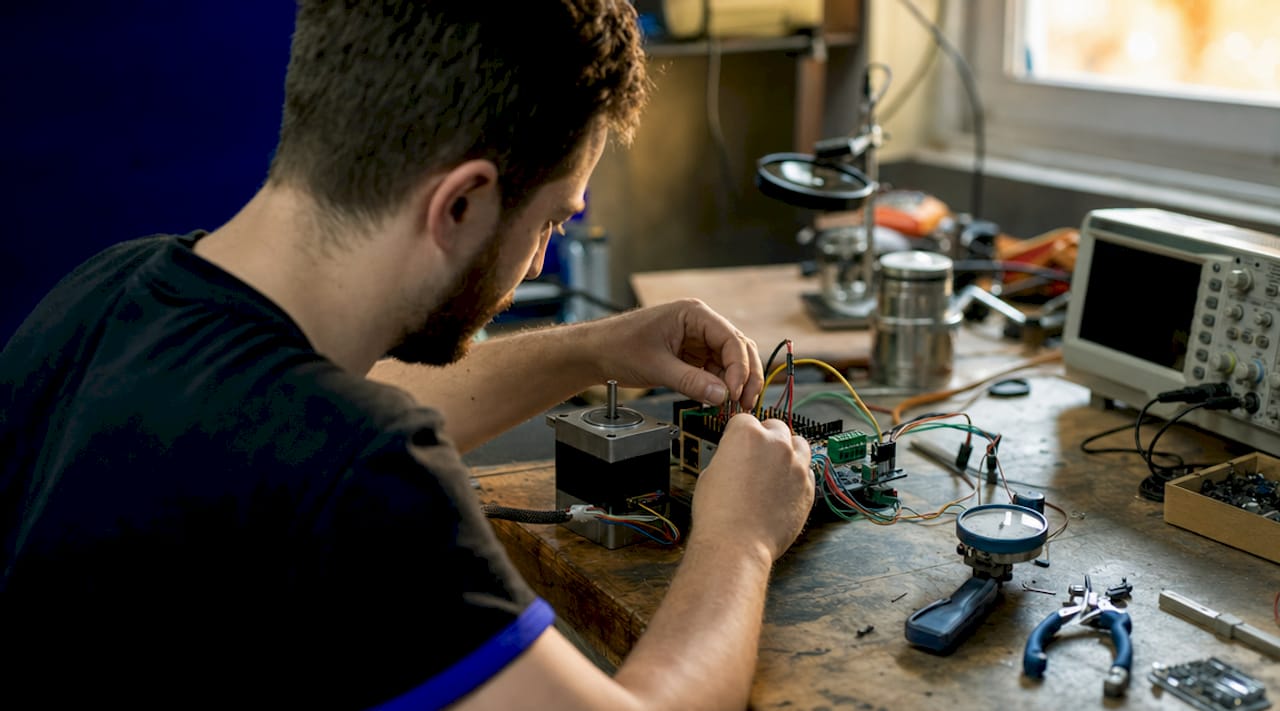
Open-loop systems are typically stepper-based and suited for low-cost, low-load applications where positioning tolerance exceeds ±0.1 mm. They send a fixed number of pulses to a stepper motor and assume the motor executes every step. No encoder confirms the result. This works well for label dispensers, simple conveyor indexers, and 3D printer axes where loads are predictable and light.
Closed-loop systems utilize feedback from encoders or resolvers to continuously adjust motor output and achieve positioning tolerances below ±0.1 mm. The controller runs PID or advanced algorithms at feedback rates between 4 kHz and 32 kHz, comparing commanded position against actual position and correcting in real time. Servo drives from Allen-Bradley, Mitsubishi, and Omron all operate on this principle.
| Criterion | Open-loop | Closed-loop |
|---|---|---|
| Typical actuator | Stepper motor | Servo motor |
| Positioning tolerance | Greater than ±0.1 mm | Below ±0.1 mm |
| Feedback device required | No | Yes (encoder or resolver) |
| Load disturbance handling | Poor | Excellent |
| Relative cost | Lower | Higher |
Pro Tip: Choose closed-loop architecture any time your application involves variable loads, shock loads, or acceleration profiles that change during a cycle. Open-loop systems lose steps under these conditions and provide no indication that an error occurred.
2. Single-axis vs. multi-axis motion controllers
Axis count is the second major classification in any types of motion controllers discussion. It determines coordination complexity and the processing demands placed on the controller hardware.
Single-axis controllers manage basic positioning along one axis, which covers a large share of industrial tasks: linear slides, rotary indexers, and simple pick-and-place units. The GE Emerson IC693DSM302 is a two-axis motion control module for the Series 90-30 PLC platform, illustrating how even modest controllers can handle coordinated dual-axis tasks within a familiar PLC environment.
Multi-axis controllers synchronize motion across several axes simultaneously using interpolation algorithms. The key capabilities include:
- Linear interpolation: coordinates two or more axes to produce straight-line tool paths at precise feed rates
- Circular interpolation: generates arcs and circles by continuously adjusting axis velocities in real time
- Five-axis simultaneous interpolation: used in aerospace and mold machining where the tool must maintain a specific orientation relative to a curved surface
- Electronic gearing and camming: replaces mechanical gearboxes and cam plates with software-defined motion profiles
High-end CNC controllers perform five-axis simultaneous interpolation with microsecond update intervals to maintain path accuracy. That update rate matters more than most engineers expect. A controller with a 10 ms cycle time introduces tracking errors on curved paths that no amount of motor tuning can eliminate.
Pro Tip: Verify the controller’s minimum update cycle time before committing to a multi-axis design. For CNC contouring or coordinated robotics, anything slower than 1 ms per cycle will produce measurable path deviation at production feed rates.
3. Motion controllers categorized by actuator technology
Actuator type shapes controller architecture because each energy source, electric, pneumatic, or hydraulic, requires a different control signal and feedback strategy. This is one of the most practical dimensions of motion control technology explained for working engineers.
Electric actuators: servo and stepper
Servo and stepper motors represent the dominant electric actuator category. Servo controllers regulate current, velocity, and position through a cascaded loop structure. Stepper controllers count pulses and rely on motor detent torque to hold position. Servo systems from Mitsubishi, Omron, and Allen-Bradley deliver dynamic adjustment through closed-loop control, making them the default choice for high-cycle, high-precision tasks. For more on how feedback reaches the drive, the explanation of servo position feedback covers encoder signal types and wiring in detail.
Pneumatic actuators
Pneumatic actuators prioritize speed and cost over precision. A standard pneumatic cylinder with a solenoid valve and end-of-travel sensors is a binary motion system: fully extended or fully retracted. Proportional pneumatic valves allow intermediate positioning, but tolerance rarely reaches below ±0.5 mm without additional feedback hardware. Pneumatic systems work well in high-speed part ejection, clamping, and stamping applications where exact intermediate positions are not required.
Hydraulic actuators
Hydraulic actuators deliver the highest force density of any actuator technology, which is why they remain standard in metal forming presses, injection molding machines, and heavy construction equipment. The controller manages proportional or servo hydraulic valves, and the feedback loop must account for fluid compressibility and temperature-dependent viscosity changes. This adds complexity that electric servo systems avoid entirely.
| Actuator type | Control signal | Typical precision | Best application |
|---|---|---|---|
| Servo motor | Analog or digital (EtherCAT, SERCOS) | Below ±0.01 mm | CNC, robotics, packaging |
| Stepper motor | Pulse and direction | ±0.1 mm to ±0.5 mm | Light-duty indexing, 3D printing |
| Pneumatic | Solenoid or proportional valve | ±0.5 mm or greater | Clamping, ejection, stamping |
| Hydraulic | Proportional or servo valve | ±0.1 mm with feedback | Presses, forming, heavy machinery |
4. Programmable, PC-based, and distributed EtherCAT controllers
The motion controller market in 2026 has moved well beyond dedicated single-function hardware. Three controller architectures now define the upper tier of motion control systems for complex industrial applications.
Programmable standalone controllers combine a real-time processor, motion engine, and I/O interface in a single module. They run structured motion programs independently of a host PLC, which reduces scan-time latency. Systems like Servotronix softMC support up to 64 axes with open modular software and real-time Linux environments, demonstrating the scalability available in current standalone platforms.
PC-based motion controllers use a standard industrial PC running a real-time operating system as the motion engine. Software environments from Beckhoff TwinCAT and similar platforms allow engineers to program motion, PLC logic, and HMI functions in one development environment. The tradeoff is that PC hardware requires more careful environmental protection and has a shorter service life than purpose-built industrial controllers.
Distributed EtherCAT systems place drive intelligence at each axis node and use a high-speed deterministic network to synchronize all axes from a central master. EtherCAT cycle times reach 250 microseconds across dozens of axes, which makes it the preferred architecture for large-scale robotics cells and flexible manufacturing systems.
Software functions like electronic camming and electronic gearing now replace mechanical transmission components in many packaging and printing machines. This reduces maintenance and allows recipe-based changeovers that would require physical hardware swaps on older machines.
Pro Tip: Environmental factors like vibration and temperature directly impact feedback device performance and controller accuracy. Specify your operating environment before selecting encoder type and controller enclosure rating, not after the panel is built.
5. How to select the right motion controller type
Selecting among the best motion controllers for a given application requires evaluating several interdependent factors simultaneously. No single specification determines the right choice.
The primary selection criteria are:
- Precision requirement: tolerances below ±0.1 mm mandate closed-loop servo control; tolerances above that threshold may allow open-loop stepper systems
- Load variability: variable or shock loads require closed-loop feedback; feedback enables continuous correction for disturbances that open-loop systems cannot detect
- Axis count and coordination: any application requiring synchronized multi-axis motion needs a controller with proven interpolation capability and a cycle time below 1 ms
- Actuator compatibility: the controller must match the drive interface of the chosen actuator, whether that is pulse-and-direction for steppers or a fieldbus protocol like EtherCAT for servo drives
- Budget and lifecycle: open-loop stepper systems cost less upfront but carry hidden costs when positioning errors cause scrap or downtime
Consulting drive system engineers to assess application conditions before finalizing hardware choices reduces the risk of costly redesign. This is not a suggestion for large projects only. Even a single-axis retrofit on a packaging line can require a complete drive swap if the controller bandwidth does not match the mechanical resonance frequency of the load.
For a broader view of how motion controllers fit into the full automation stack, the guide on motion control system design covers hardware and software integration for manufacturing environments. For retrofit-specific decisions, the article on motion controllers in retrofit projects addresses how to match new controllers to existing mechanical assemblies and motor specifications.
A practical scenario summary: a high-speed packaging line running 300 cycles per minute needs a closed-loop servo controller with EtherCAT communication and sub-millisecond update rates. A simple rotary indexer on a manual assembly station can use an open-loop stepper controller at a fraction of the cost. A hydraulic press forming structural steel needs a controller with proportional valve outputs and pressure feedback. The application defines the architecture, not the other way around.
Key takeaways
Motion controller selection is determined by control loop architecture, axis count, and actuator technology working together, not by any single specification in isolation.
| Point | Details |
|---|---|
| Open-loop vs. closed-loop | Closed-loop is mandatory for tolerances below ±0.1 mm or variable load conditions. |
| Axis count drives complexity | Multi-axis applications require interpolation capability and cycle times below 1 ms. |
| Actuator type shapes controller choice | Servo, stepper, pneumatic, and hydraulic actuators each require different control signal architectures. |
| Advanced controllers offer scalability | PC-based and EtherCAT distributed systems support 64-plus axes with software-defined motion profiles. |
| Selection is a system-level decision | Controller bandwidth must match mechanical resonance frequency to avoid instability. |
What I’ve learned from watching engineers pick the wrong controller
The most common mistake I see in motion control projects is treating controller selection as a purchasing decision rather than a systems engineering decision. An engineer specifies a servo drive based on motor current rating, orders it, and then discovers the controller’s bandwidth is too narrow to stabilize the load inertia ratio of the mechanical assembly. The result is oscillation, tuning loops that never converge, and eventually a hardware swap after commissioning.
According to maxon engineer Ronak Samani, motion controller selection should not be isolated but linked integrally with motor and mechanical design for optimal performance. That principle sounds obvious, but it gets violated on nearly every project where the mechanical team and the controls team work in parallel rather than in sequence.
Mechanical resonance and insufficient feedback bandwidth frequently cause motion control instability, and a detailed mechanical analysis at the design phase prevents the oscillations that plague commissioning. The fix is not a better controller. The fix is doing the inertia analysis before selecting the controller.
My other consistent observation is that engineers underestimate the value of interpolation algorithm quality in multi-axis systems. Two controllers can have identical cycle times on paper and produce very different path accuracy results because one uses a higher-order trajectory generator. Benchmark the actual path error on a representative test profile before committing to a platform for a precision application.
— Monica
Source your motion controllers with confidence from Industrialpartsusa
Industrialpartsusa stocks new, surplus, and remanufactured motion controllers and automation components for engineers who need the right part without waiting weeks for an OEM delivery. From GE Emerson Series 90-30 motion modules to Allen-Bradley servo drives, the inventory covers both current and legacy platforms. Every unit ships with a one-year warranty backed by in-house testing and repair capabilities. If you are sourcing automation components for your production line or need a hard-to-find controller for a retrofit project, Industrialpartsusa provides same-day shipping on in-stock items to customers worldwide.
FAQ
What is the difference between open-loop and closed-loop motion controllers?
Open-loop controllers send commands without verifying the result, making them suitable for stable, low-precision tasks above ±0.1 mm tolerance. Closed-loop controllers use encoder or resolver feedback running at 4 kHz to 32 kHz to correct positioning errors in real time.
How do motion controllers work with servo motors?
A servo motion controller generates a position or velocity command, compares it against encoder feedback, and adjusts drive current through a PID or advanced algorithm to minimize the error continuously. This feedback loop runs at rates between 4 kHz and 32 kHz depending on the controller platform.
When do you need a multi-axis motion controller?
Any application requiring coordinated movement across two or more axes, such as CNC machining, robotic arms, or pick-and-place gantries, requires a multi-axis controller with interpolation capability and cycle times below 1 ms for accurate path following.
What is EtherCAT and why does it matter for motion control?
EtherCAT is a deterministic industrial Ethernet protocol that synchronizes distributed drive nodes with cycle times as low as 250 microseconds, enabling precise coordination across dozens of axes in large robotics and flexible manufacturing systems.
Can I use a stepper-based open-loop controller for a packaging machine?
A stepper-based open-loop controller works for low-speed, light-load packaging tasks with tolerances above ±0.1 mm. High-speed packaging lines running hundreds of cycles per minute require closed-loop servo controllers to handle the dynamic load changes without losing position.