
Why Automation Systems Use Redundancy for Reliability
Redundancy in automation systems is defined as the deliberate duplication of critical components, control paths, or communication networks so that a backup automatically takes control when the primary element fails. Engineers across oil and gas, chemical processing, automotive manufacturing, and power generation rely on this principle to eliminate single points of failure and maintain uninterrupted production. Understanding why automation systems use redundancy requires examining not just the hardware involved, but the failover logic, safety standards, and architectural decisions that determine whether a backup system actually performs when it matters. This article covers all of it.
Why automation systems use redundancy: the core principle
Redundancy eliminates single points of failure by building backup capability that automatically takes control when the primary component fails. Without this architecture, a single failed PLC CPU, power supply, or network switch can halt an entire production line. In high-throughput manufacturing, that translates directly to lost revenue, damaged equipment, and in safety-critical processes, potential harm to personnel.
The goal is operational continuity, not just fault tolerance. Redundancy counters the most common disruption categories in industrial automation: power interruptions, PLC failures, drive trips, and network disruptions by enabling automatic backup control paths. The result is rapid recovery without operator intervention, which is the defining advantage over manual failover procedures. Components most frequently protected by redundancy include PLC CPUs, power supplies, industrial Ethernet networks, variable frequency drives (VFDs), and human machine interfaces (HMIs).
How redundancy mechanisms work in automation systems
Redundant architectures operate on a primary and standby model. The primary component handles all active control tasks while the standby component remains synchronized and ready to assume control. The transition between them, called failover, can be automatic and nearly instantaneous depending on the standby mode selected.
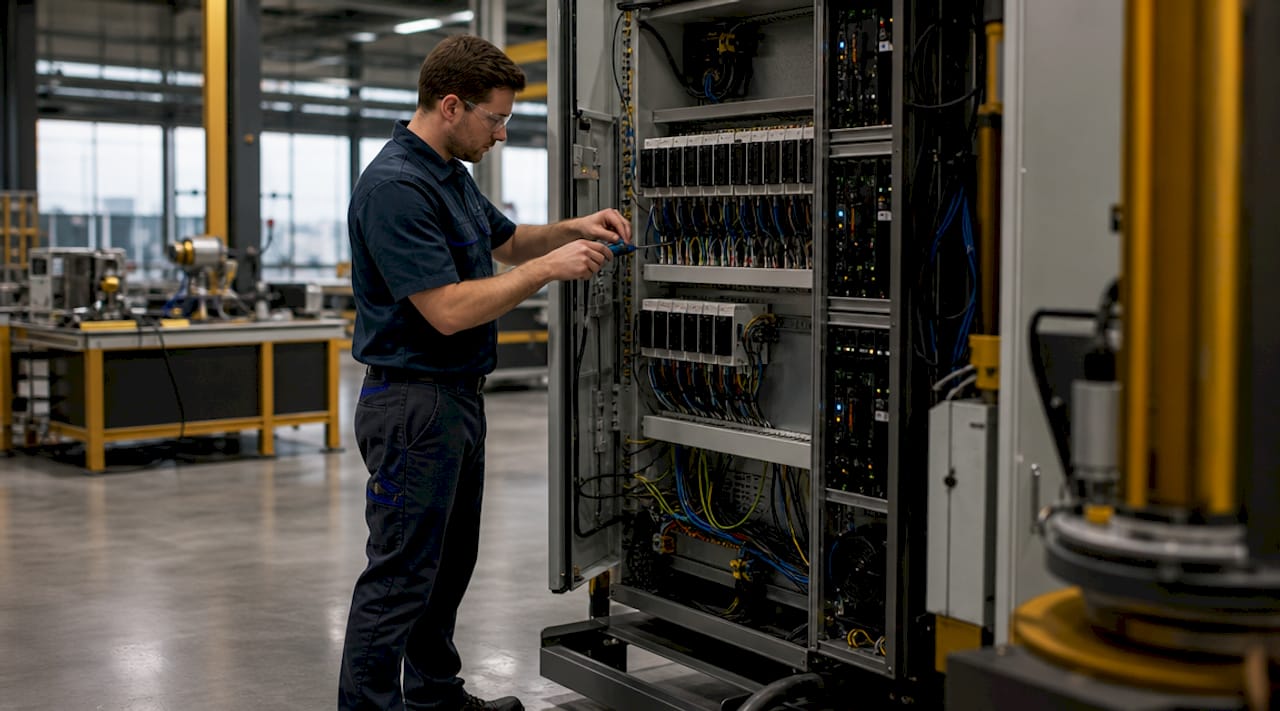
Failover speed is the most critical performance variable. Hot standby achieves 0 to 2 milliseconds, warm standby achieves 10 to 50 milliseconds, and cold standby causes seconds of downtime during the switch. Hot standby is mandatory for continuous processes like chemical reactors or turbine controls where even a 50-millisecond gap causes process upsets. Cold standby is acceptable for non-critical auxiliary systems where a brief interruption carries no safety or production consequence.
The four key mechanisms that make redundancy function correctly are:
- Continuous synchronization. Redundant PLC CPUs run identical programs and share real-time data so the standby unit mirrors the primary state at all times. A standby that is even one scan cycle behind can cause a control bump on failover.
- Automatic failure detection. Watchdog timers, heartbeat signals, and diagnostic routines monitor primary component health. Detection latency directly determines how quickly failover initiates.
- Automatic failover switching. Once a fault is confirmed, the standby component assumes the primary role without operator input. Automatic failover removes dependency on manual recovery, creating continuity that operators may not even notice.
- Post-failover restoration. After the failed component is repaired or replaced, the system must safely restore redundancy without disrupting the now-active backup.
Pro Tip: When commissioning a redundant PLC system such as a GE Fanuc RX7i or Allen-Bradley ControlLogix redundancy chassis, always test forced failover under live process conditions during commissioning, not just during factory acceptance testing. Process behavior during switchover often reveals synchronization gaps that bench testing never exposes.
Critical components and failure points where redundancy is applied
Not every component in an automation system warrants redundancy. The decision is risk-based, targeting components whose failure would cause the greatest operational or safety impact. The following are the most common failure points where redundancy is applied in industrial automation:
- PLC CPUs and racks. The controller is the brain of any automation system. Platforms like the GE Fanuc RX7i, GE RX3i, and Allen-Bradley ControlLogix all support redundant CPU configurations with dedicated synchronization backplanes.
- Power supplies. Dual power supplies in a 1+1 configuration protect against the most statistically common hardware failure mode. Uninterruptible power supply (UPS) systems add a further layer for complete power interruption events.
- Industrial Ethernet and fieldbus networks. Ring topologies using protocols like PROFINET MRP or EtherNet/IP Device Level Ring (DLR) provide automatic network path recovery. A single cable break in a ring heals in milliseconds rather than requiring manual re-patching.
- Variable frequency drives (VFDs). In critical pump or compressor applications, a bypass contactor or a fully redundant drive in standby prevents process shutdown from a single drive fault.
- Human machine interfaces (HMIs). Redundant HMI servers, common in SCADA architectures from platforms like Wonderware or iFIX, prevent operators from losing process visibility during a server failure.
The table below compares the failure impact and typical redundancy approach for each component type:
| Component | Failure impact | Typical redundancy approach |
|---|---|---|
| PLC CPU | Complete loss of control | Hot standby redundant CPU pair |
| Power supply | System-wide shutdown | Dual PSU with automatic transfer |
| Network switch/path | Loss of I/O communication | Ring topology with automatic healing |
| VFD | Motor and driven load stops | Bypass contactor or standby drive |
| HMI server | Operator visibility loss | Redundant server with automatic client reconnect |
Understanding how redundancy helps avoid downtime at each of these failure points is the foundation of any reliability improvement project.
How redundancy supports industrial safety standards and reliability metrics
Redundancy is not optional in safety-instrumented systems. IEC 61508 functional safety standards require hardware fault tolerance to reach Safety Integrity Level (SIL) targets, using metrics such as PFDavg (average probability of failure on demand) and PFH (probability of dangerous failure per hour) to quantify dangerous failure probabilities. This means redundancy is a compliance requirement, not just a reliability preference, in any system with a SIL claim.
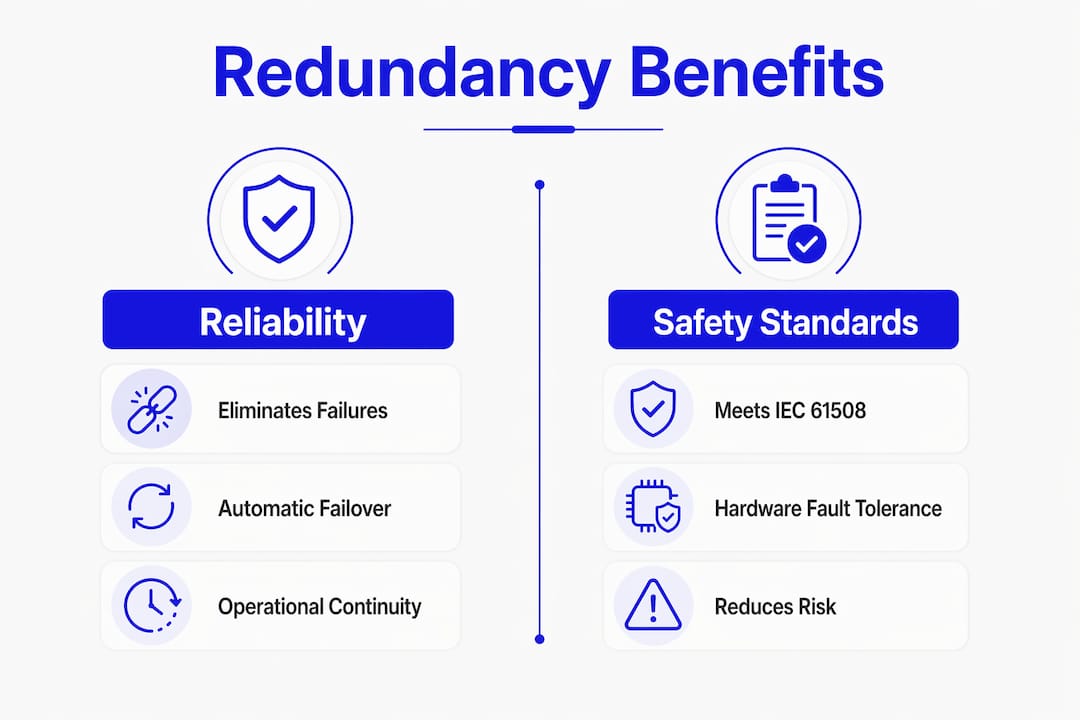
Three metrics define how redundancy contributes to safety architecture:
| Metric | Definition | Redundancy impact |
|---|---|---|
| PFDavg | Average probability of dangerous failure on demand | Lower with redundant channels; reduced by proof test intervals |
| PFH | Probability of dangerous failure per hour | Reduced by hardware fault tolerance (HFT) architecture |
| SFF | Safe Failure Fraction | Higher SFF allows lower HFT requirement for a given SIL |
Hardware Fault Tolerance (HFT) defines how many hardware failures a system can sustain and still perform its safety function. An HFT of 1 means the system tolerates one failure, which requires at least a 1oo2 (one-out-of-two) voting architecture. A 2oo3 (two-out-of-three) architecture provides HFT of 1 with better spurious trip resistance than 1oo2.
Common-cause failures and shared dependencies such as shared power backplanes or common network equipment can undermine redundancy benefits if not properly addressed. Physical and logical separation of redundant channels is not optional in SIL-rated architectures. It is the primary defense against common-cause failure, which dominates the failure budget in well-designed redundant systems.
Pro Tip: When calculating PFH for a 1oo2 architecture, the common-cause failure factor often contributes more to the total dangerous failure rate than the independent failure rate of each channel. Treat beta factor estimation as a design task, not an afterthought.
Designing and implementing redundancy strategically
Effective redundancy design starts with a risk assessment, not a parts list. Redundancy design must be risk-focused and architecture-driven, using voting schemes and sensor arrangements that align with risk analysis and relevant safety standards. The following principles guide sound implementation:
- Identify true single points of failure first. Use a Failure Mode and Effects Analysis (FMEA) or fault tree analysis to rank components by failure consequence before specifying redundancy. Not every component needs a backup.
- Match standby mode to process tolerance. Hot standby for continuous processes, warm standby for batch processes with short recovery windows, cold standby for non-critical auxiliary systems. Mismatching standby mode to process requirements wastes cost or creates unacceptable risk.
- Select the right voting architecture. A 1oo2 architecture maximizes availability but increases spurious trip risk. A 2oo3 architecture balances availability and safety, making it the preferred choice for safety instrumented functions in oil and gas and chemical processing.
- Separate redundant paths physically and logically. Route redundant network cables through different conduit paths. Power redundant controllers from separate distribution panels. Shared dependencies undermine redundancy and reduce reliability gains nonlinearly.
- Build in monitoring and failover validation. A redundant system that fails silently provides no protection. Continuous diagnostics, alarm annunciation on standby faults, and scheduled proof tests are mandatory. Redundant components can fail silently and fail to protect properly without active monitoring.
- Avoid over-engineering. Adding parallel hardware improves reliability but with diminishing returns, especially when failure modes are correlated. A third redundant path rarely justifies its cost if the first two are already physically separated and independently powered.
For legacy systems, integrating redundancy often means working with platforms like the GE Fanuc Series 90-70 or Allen-Bradley PLC-5, where native redundancy options are limited. In these cases, network-level redundancy and external UPS protection often deliver the best reliability improvement per dollar spent. Reviewing your aging automation system audit before specifying redundancy upgrades prevents over-investment in systems approaching end of life.
Key takeaways
Redundancy in automation systems works because it replaces manual failure recovery with automatic architectural failover, eliminating single points of failure across PLCs, networks, power supplies, and drives.
| Point | Details |
|---|---|
| Core purpose of redundancy | Eliminates single points of failure by switching control to a backup component automatically on primary failure. |
| Failover speed determines suitability | Hot standby (0 to 2 ms) suits continuous processes; cold standby is only acceptable for non-critical systems. |
| Safety standards require it | IEC 61508 mandates hardware fault tolerance to achieve SIL targets, making redundancy a compliance requirement. |
| Common-cause failure is the main risk | Physical and logical separation of redundant channels is mandatory to prevent shared dependencies from negating redundancy benefits. |
| Design starts with risk assessment | Use FMEA or fault tree analysis to identify true single points of failure before specifying any redundant hardware. |
The part engineers consistently underestimate
After working with redundant automation architectures across dozens of plant environments, the pattern I see most often is not a failure to implement redundancy. It is a failure to validate it. Teams install redundant PLC CPUs, dual power supplies, and ring network topologies, then never test forced failover under live conditions. The standby unit sits there for years, and no one knows whether synchronization is actually current or whether the failover logic has drifted since the last firmware update.
The second consistent gap is common-cause failure. I have seen redundant systems share a single 24V DC power backplane, a single network switch, or a single cable tray routed through the same area as a heat source. The redundancy looked correct on paper and failed completely in practice because the shared dependency was never mapped. Physical separation is not a suggestion in IEC 61508 compliant architectures. It is the architecture.
My advice for legacy system upgrades is specific: do not try to retrofit full CPU redundancy onto a GE Fanuc Series 90-30 or an older Allen-Bradley SLC 500 platform. The cost and complexity rarely justify the outcome. Instead, focus redundancy investment on the network layer and power supply layer, where the failure rate is higher and the retrofit is cleaner. Then plan a controlled migration to a platform that supports native redundancy, such as the GE RX3i or RX7i, when the process window allows.
The mindset shift that matters most is moving from “we have a spare on the shelf” to “the system automatically recovers without us.” Those are fundamentally different reliability postures, and only one of them protects you at 2 AM on a Sunday.
— Monica
Source redundant automation parts from Industrialpartsusa
When a redundant system needs a replacement CPU, a spare power supply module, or a hard-to-find I/O card, lead time is the enemy. Industrialpartsusa stocks new, surplus, and remanufactured automation components with same-day shipping on in-stock items, specifically for situations where waiting weeks for an OEM order is not an option.

The inventory includes GE Fanuc redundant CPU modules such as the IC693CPU374, Genius I/O components, Allen-Bradley ControlLogix modules, and a broad range of legacy parts that support redundancy upgrades on mature platforms. Every part ships with a one-year warranty backed by in-house testing and repair. If you are sourcing replacement components for a redundant architecture or planning an upgrade, browse the full automation catalog at Industrialpartsusa to find what you need without the OEM wait.
FAQ
What is redundancy in automation systems?
Redundancy in automation systems is the duplication of critical components or control paths so that a backup automatically assumes control when the primary element fails, eliminating single points of failure and maintaining operational continuity.
What is the difference between hot standby and cold standby?
Hot standby achieves failover in 0 to 2 milliseconds because the backup runs synchronized in real time, while cold standby requires seconds to restart and is only suitable for non-critical systems where brief interruptions are acceptable.
Why does IEC 61508 require redundancy?
IEC 61508 requires hardware fault tolerance, which is achieved through redundancy, to reach Safety Integrity Level targets. Metrics like PFDavg and PFH quantify dangerous failure probability, and redundant architectures reduce both values to meet compliance thresholds.
What is a common-cause failure in a redundant system?
A common-cause failure occurs when a shared dependency, such as a common power backplane or network switch, causes both the primary and standby components to fail simultaneously, negating the protection that redundancy was designed to provide.
How do I know which components need redundancy?
Start with a Failure Mode and Effects Analysis (FMEA) or fault tree analysis to rank components by the consequence of their failure. Components whose failure causes production loss, safety hazards, or regulatory non-compliance are the primary candidates for redundant protection.