
Why Integrators Source Surplus Automation Parts
Surplus automation parts are defined as new, used, or refurbished industrial components sold outside original manufacturer channels, and integrators source them as a direct response to lead times, obsolescence, and budget pressure on legacy systems. When a GE Fanuc Series 90-30 CPU or an Allen-Bradley PLC module fails on a production line, waiting 12 to 18 months for an OEM replacement is not an option. Surplus sourcing gives integrators immediate access to the exact hardware their installed base requires, at a fraction of the new-part price. This guide covers why integrators source surplus automation parts, how to build a structured strategy around them, and what to watch for when evaluating suppliers.
Why integrators source surplus automation parts: the supply chain case
The core reason integrators turn to surplus channels is simple. Lead times for critical automation parts like PLCs and motion controllers can extend beyond 52 weeks. That figure means a single failed component can halt production for over a year if a team relies solely on OEM procurement. No maintenance budget absorbs that kind of downtime without serious consequences.
The problem compounds because MRO inventory data is rarely clean. 45% of manufacturing executives report poor inventory visibility, while 32% report frequent stockouts despite carrying excess inventory elsewhere. This is the “invisible stock” paradox: parts exist somewhere in the facility or supply chain, but fragmented data prevents anyone from finding them in time. Surplus sourcing fills that gap by providing an external market of immediately available components.
Three specific supply chain pressures drive integrators toward surplus channels:
- Obsolescence without warning. OEMs discontinue legacy product lines on their own schedules. Without OEM lifecycle notifications integrated into spare parts management, obsolescence events become emergencies rather than planned transitions. Surplus stock becomes the only available source for parts like GE Fanuc Genius I/O modules or ABB Taylor Mod 300 components.
- Oversized OEM spare packages. OEMs often sell spare parts in quantities far exceeding what a single facility needs. The excess inventory carries holding costs, ties up capital, and frequently becomes obsolete before it is used.
- Emergency replacement windows. Unplanned failures demand same-day or next-day solutions. Surplus electronics suppliers offer immediate availability and faster shipping specifically for legacy components that OEM channels no longer stock.
“Surplus parts have evolved from backup options to strategic procurement tools that enhance operational resilience and reduce downtime in a volatile supply environment.”
The shift in how manufacturers view surplus is significant. Teams that once treated surplus as a last resort now build it into their procurement strategy from the start.
How integrators build a structured spare-parts and obsolescence strategy
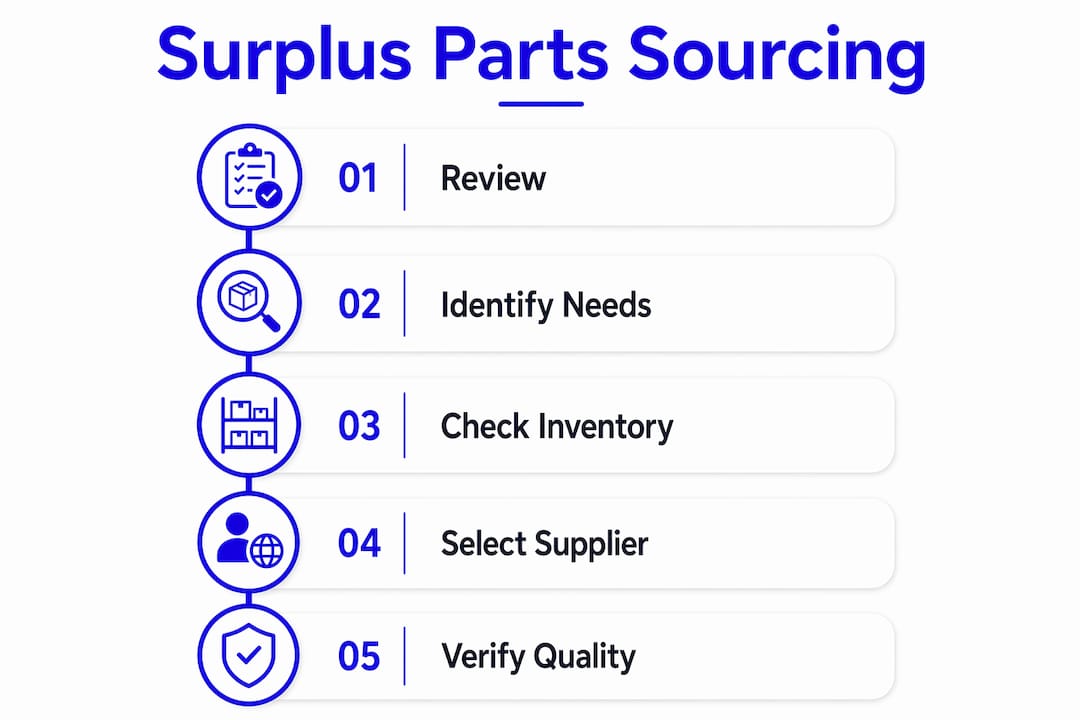
Sourcing surplus parts without a plan creates a different set of problems. Unstructured purchasing leads to duplicate stock, incompatible variants, and storerooms full of parts that no longer match the installed base. A structured approach starts with three data layers: what equipment is installed, what is already in the storeroom, and what is available on the market.
A spare parts review integrating installed base data, storeroom levels, and market availability is the foundation of any effective obsolescence strategy. Without that review, teams make last-time-buy decisions blind. They either over-buy and carry dead stock for years, or under-buy and face a sourcing crisis when the part disappears from all channels.
The last-time-buy concept is central here. When an OEM announces end-of-life for a product like the Allen-Bradley SLC 500 series or a GE Fanuc QuickPanel HMI, integrators face a choice: buy enough stock to cover the remaining equipment life, or rely on the surplus market for future needs. Most experienced integrators do both. They buy a conservative quantity at last-time-buy pricing and plan to supplement with surplus as consumption dictates.
A practical structured approach follows this sequence:
- Audit the installed base. Catalog every automation asset by make, model, firmware version, and criticality. This is not a one-time task. Every retrofit or upgrade changes the list.
- Cross-reference storeroom inventory. Match what you have against what the installed base actually requires. Surplus parts lists become outdated after modifications, and unstructured spare parts lists create gaps that only surplus sourcing can fill.
- Assess market availability. Check surplus channels for parts approaching end-of-life. Market availability shrinks over time, so early action secures better pricing and condition.
- Set reorder triggers. Define minimum stock levels for critical components and link them to surplus sourcing channels so procurement acts before a stockout occurs.
Pro Tip: Set a calendar reminder to run an installed base versus storeroom reconciliation every six months. Legacy systems change faster than most teams track, and a six-month gap is enough to create serious sourcing blind spots.
What quality and compatibility issues do integrators face with surplus parts?
Quality and compatibility are where surplus sourcing gets complicated. Not all surplus parts are equal, and selecting the wrong variant of a technically correct part number can extend downtime rather than reduce it. Firmware and hardware variant mismatches are the most common failure point, requiring additional engineering effort and extending maintenance windows during emergency replacements.
The table below outlines the key distinctions integrators must evaluate when assessing surplus part condition:
| Condition type | Description | Risk level |
|---|---|---|
| New old stock (NOS) | Unused, original packaging, never installed | Low |
| Refurbished/remanufactured | Tested, cleaned, repaired to spec | Medium |
| Used, tested | Pulled from service, functionally verified | Medium |
| Used, untested | Pulled from service, no verification | High |
Beyond physical condition, revision and firmware compatibility require specific attention. A GE Fanuc RX3i CPU module may exist in multiple hardware revisions that are not interchangeable without a firmware update. An Allen-Bradley drive may have I/O variants that look identical but behave differently in the control program. Structured interchangeability records, known in the industry as E-SPIR (Electronic Spare Parts Interchangeability Records), are the standard tool for managing this complexity. E-SPIR documentation maps which part numbers can substitute for which, under what conditions, and with what configuration changes required.
Supplier reliability is the third variable. A part in excellent condition from an unreliable supplier carries hidden risk: no warranty, no testing documentation, and no recourse if the part fails on installation. Evaluate suppliers on four criteria: testing and inspection practices, warranty terms, return policy, and verifiable transaction history.
Pro Tip: Always request the firmware or revision level of a surplus part before purchase, not after. For GE Fanuc and Allen-Bradley components especially, a one-revision difference can mean the part is incompatible with your existing rack or software version.
Where do integrators find surplus automation parts?
Surplus automation parts reach the market through several distinct channels, each with different risk and value profiles. Understanding the channel determines how much due diligence is required.
- Industrial surplus resellers. Specialists like Industrialpartsusa stock tested, warranted surplus and legacy automation components, with a focus on hard-to-find items like GE Fanuc Series 90-70, Omron PLCs, and Mitsubishi motion controllers. These suppliers offer the most predictable quality because they test and warrant what they sell.
- Surplus marketplaces and auctions. Online industrial auction platforms and general surplus marketplaces offer broad selection but inconsistent quality. Parts are often untested and sold as-is, which suits buyers who have in-house testing capability.
- Asset recovery specialists. Companies that decommission manufacturing facilities sell automation equipment in bulk. Pricing is low, but condition varies widely and documentation is rarely available.
- OEM refurbished programs. Some OEMs offer factory-refurbished units for legacy products still in demand. These carry the strongest quality assurance but are limited to products the OEM chooses to support and are priced at a premium.
AI-driven sourcing platforms like Automa.Net reduce manual part identification from 30 to 45 minutes down to seconds, connecting buyers with over 3,500 sourcing experts and providing real-time inventory and pricing transparency. That speed matters when a line is down and every hour of downtime carries a cost.
Surplus parts providers also operate under different financial models. Recovery models range from outright sale at 3 to 20% of market value, consignment at roughly 50%, and marketplace listings at 75 to 85%. Integrators who understand these models can negotiate more effectively and identify when a supplier’s pricing reflects the actual market. For guidance on sourcing discontinued parts quickly, the channel selection decision is often the most important one.
When evaluating any surplus supplier, apply these criteria before placing an order:
- Written warranty covering at minimum 90 days, ideally 12 months
- Documented testing and inspection process
- Clear return and replacement policy
- Verifiable customer references or transaction history in your specific product category
- Same-day or next-day shipping capability for emergency orders
The role of motion controllers in retrofit projects illustrates why supplier selection matters. A motion controller sourced from an untested channel that fails during commissioning costs far more in labor and delay than the price difference between a tested and untested unit.
Key takeaways
Integrators source surplus automation parts because OEM lead times, obsolescence, and budget constraints make surplus the most practical path to uptime for legacy systems.
| Point | Details |
|---|---|
| Lead times drive urgency | OEM lead times beyond 52 weeks make surplus the only viable option for emergency replacements. |
| Structured strategy prevents waste | Auditing installed base and storeroom inventory before sourcing surplus avoids duplicate and incompatible stock. |
| Compatibility requires documentation | E-SPIR records and revision-level verification prevent costly mismatches in firmware and hardware variants. |
| Supplier quality varies by channel | Tested, warranted resellers carry lower risk than auction or as-is sources for critical automation components. |
| Surplus is now strategic | Surplus parts have moved from emergency backup to planned procurement tools in resilient maintenance programs. |
The discipline that separates good surplus sourcing from costly mistakes
I have watched maintenance teams make the same error repeatedly: they treat surplus sourcing as a reactive activity. A part fails, someone searches online, buys the first result that matches the part number, and hopes it works. That approach fails more often than it should, and the failures are expensive.
The integrators who get this right treat surplus sourcing the way they treat any other procurement category. They have approved supplier lists. They maintain interchangeability records. They run obsolescence reviews on a schedule, not in response to a crisis. When a GE Fanuc RX7i module or an Allen-Bradley drive approaches end-of-life, they already know their storeroom position and their market options.
What I find underappreciated is how much the quality assessment process matters at the front end. Teams that invest 20 minutes verifying a supplier’s testing documentation before ordering save hours of troubleshooting after a bad part arrives. The economics are obvious once you calculate it, but most teams skip the step under time pressure.
The future of this space points toward AI-driven inventory visibility and real-time market intelligence. Platforms that aggregate surplus availability across multiple suppliers and flag obsolescence risks automatically will change how integrators plan. The teams that adopt those tools early will have a genuine procurement advantage. The teams that wait will keep running the same reactive cycle.
My advice: align your maintenance, procurement, and engineering teams around a shared installed base record. That single data asset is the foundation for every good surplus sourcing decision. Without it, you are guessing.
— Monica
How Industrialpartsusa supports integrators with legacy automation parts
Industrialpartsusa stocks tested, warranted surplus and legacy automation components for integrators and maintenance teams who cannot afford to wait on OEM lead times. The inventory covers GE Fanuc Series 90-30, RX3i, RX7i, and Genius I/O, along with Allen-Bradley PLCs, Mitsubishi and Omron controllers, ABB Taylor Mod 300, variable frequency drives, HMIs, servo motors, and sensors. Every item ships with a one-year warranty backed by in-house testing and repair. Same-day shipping is available on in-stock items. Whether you need a single replacement module or are building out a spare-parts buffer for a legacy line, Industrialpartsusa has the inventory and the expertise to support your sourcing needs. Browse the full range of production line automation components to find what your system requires.
FAQ
What are surplus automation parts?
Surplus automation parts are new, used, or refurbished industrial control components sold outside OEM distribution channels. They include PLCs, motion controllers, HMIs, drives, and sensors, typically from legacy or discontinued product lines.
Why do integrators use surplus parts instead of buying new from the OEM?
OEM lead times for critical automation components can exceed 52 weeks, and many legacy parts are no longer manufactured at all. Surplus channels provide immediate availability at significantly lower cost for components that keep existing systems running.
How do integrators verify the quality of surplus automation parts?
Reliable suppliers provide documented testing records, firmware and revision information, and a written warranty. Integrators should also request E-SPIR or interchangeability documentation to confirm the part is compatible with their specific installed hardware version.
What is the difference between NOS, refurbished, and used surplus parts?
New old stock (NOS) is unused and in original packaging, carrying the lowest risk. Refurbished parts have been tested and repaired to specification. Used parts have been pulled from service, and quality depends entirely on whether the supplier has tested and verified them.
Where is the best place to source surplus automation parts for legacy systems?
Tested, warranted surplus resellers who specialize in industrial automation carry the lowest risk for critical components. Platforms like Automa.Net provide real-time market visibility, while specialists like Industrialpartsusa offer same-day shipping and in-house repair support for GE Fanuc, Allen-Bradley, and other legacy brands.