
How to Manage Aging Manufacturing Equipment in 2026
Effective management of aging manufacturing equipment is the single most reliable way to cut unplanned downtime and protect production output. Unplanned downtime costs manufacturers $125,000 per hour, and 42% of those incidents trace back to aging assets that structured maintenance could prevent. The average production equipment age in North American manufacturing is 27 years, which means most plants are running machinery well past its original design assumptions. The good news is that equipment lifecycle management, when built on asset criticality ranking, Reliability-Centered Maintenance (RCM), and condition-based monitoring, can extend asset life and reduce costs without requiring full replacement.
How to manage aging manufacturing equipment with a structured PM program
The foundation of any maintenance strategy is knowing which assets matter most. Asset criticality ranking is the practice of scoring each piece of equipment by its impact on production, safety, and cost if it fails. Critical assets, typically 10–15% of your total asset base, should receive 50% of your preventive maintenance (PM) budget. Spreading resources evenly across all equipment wastes money on low-risk assets while under-protecting the machines that can stop your line.
Start by building an asset register. List every piece of equipment, assign a criticality score based on failure consequence, and group assets into tiers. Tier 1 assets get the most frequent and thorough PM tasks. Tier 3 assets may only need periodic inspections or run-to-failure management. This tiering prevents the most common mistake in plant maintenance: applying the same calendar-based schedule to every machine regardless of its role.

Once you have tiers, build a PM task library for each asset class. Tasks should match the failure modes of that specific equipment type. A conveyor drive motor needs vibration checks and lubrication intervals. A legacy PLC rack needs visual inspection, battery checks, and firmware version logging. Matching tasks to failure modes is what separates a useful PM program from a checkbox exercise.
Scheduling should use multiple triggers, not just calendar dates. Combine time-based intervals, usage hours, and condition indicators such as temperature drift or vibration amplitude. Companies with structured PM programs reduce maintenance costs by 25–40%, with return on investment typically realized within 8–16 months. That payback window is short enough to justify the upfront effort of building the program properly.
Pro Tip: Never apply uniform calendar maintenance to all assets. A Tier 1 bottleneck machine and a Tier 3 utility pump do not share the same failure risk. Uniform scheduling wastes budget on the pump and leaves the bottleneck under-maintained.
| PM task type | Trigger | Best suited for |
|---|---|---|
| Time-based inspection | Fixed calendar interval | Low-criticality, stable-failure-rate assets |
| Usage-based service | Operating hours or cycles | Motors, drives, and high-cycle components |
| Condition-based check | Sensor threshold breach | High-criticality assets with measurable wear signals |
| Predictive task | AI or trend analysis | Complex systems with long failure development time |
What is condition-based maintenance and why does it outperform time-based schedules?
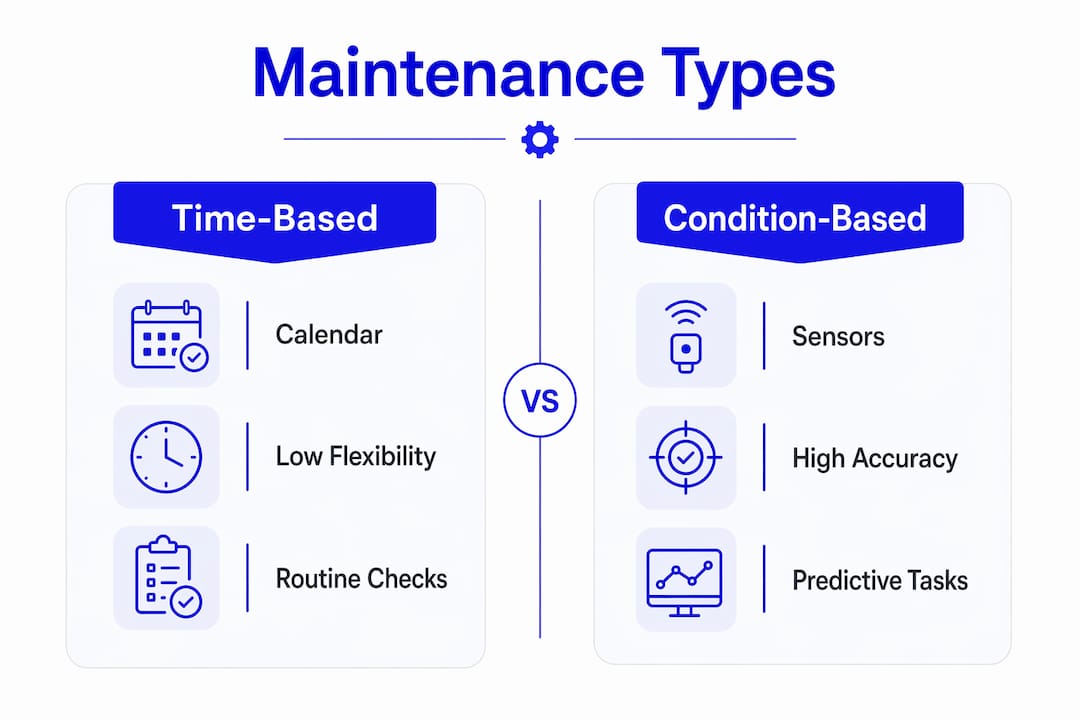
Traditional time-based maintenance fails aging assets in accelerated degradation phases because the failure rate no longer follows the original design curve. A machine that ran reliably on a 90-day lubrication cycle at age 5 may need intervention every 45 days at age 25. Fixed intervals cannot adapt to that shift. Condition-based maintenance (CBM) solves this by triggering work orders from real equipment data, not the calendar.
IoT sensors are the practical entry point for CBM. Vibration sensors on rotating equipment detect bearing wear weeks before audible noise appears. Temperature sensors on control panels flag cooling failures before they cause shutdowns. Energy consumption monitoring on motors reveals efficiency loss that signals winding degradation. Each of these signals maps to a specific failure mode, which is exactly what Reliability-Centered Maintenance (RCM) requires.
RCM is especially valuable for legacy equipment where original manuals are incomplete or missing entirely. The methodology shifts maintenance selection from “what does the manual say?” to “what are the current failure modes and their consequences?” For a 27-year-old GE Fanuc Series 90-30 PLC rack, RCM analysis might reveal that battery failure and backplane connector corrosion are the dominant risks, not the generic tasks listed in a 1999 service guide. You can review a legacy automation maintenance guide for practical examples of applying RCM logic to older control systems.
The P-F Interval concept is central to predictive work. The P-F Interval is the time between when a potential failure becomes detectable and when functional failure occurs. Longer P-F Intervals give maintenance teams more scheduling flexibility. Shorter ones demand faster response. AI-driven analytics extend this by adjusting maintenance intervals dynamically as new sensor data arrives, rather than waiting for a scheduled review.
The performance gains from this approach are concrete. Prescriptive maintenance increased machine output from 130 to 141 units per week in one documented case, while reducing reject rates from 20–25 units per week down to 8–10. That is a measurable production gain from better maintenance timing alone.
- Map each critical asset’s failure modes before selecting sensor types.
- Set alert thresholds based on baseline data, not manufacturer defaults.
- Review AI-generated interval recommendations monthly for the first six months.
- Log every condition-triggered work order to build a failure history database.
- Use the PLC maintenance schedule framework to set data-driven intervals for control system components.
Pro Tip: Select predictive tasks that fit both the failure mode and your operational constraints. A vibration analysis task is useless if you lack a trained analyst or portable analyzer. Match the task to your team’s actual capability.
What are the best retrofit strategies for aging manufacturing machinery?
Mechanical components outlast electronic controls by a wide margin. A press frame built in 1990 may have decades of structural life remaining, but its relay-logic control panel or early-generation PLC is already obsolete. Mechanical longevity often exceeds electronic support, which means the right answer is rarely full machine replacement. Selective retrofitting preserves the mechanical investment while modernizing the automation layer.
Retrofit strategies fall into three practical levels. Component-level upgrades replace individual modules, such as swapping a failed I/O card or CPU module, without touching the rest of the control architecture. Panel-level upgrades replace the entire control cabinet while keeping the machine mechanics intact. Full system replacement is reserved for cases where the mechanical structure itself is at end of life or where the control architecture is so fragmented that piecemeal upgrades cost more than starting fresh.
Component-level upgrades of PLC or I/O modules extend system life without requiring full architecture migration. This approach reduces disruption and cost compared with full replacement. For GE Fanuc Series 90-30 systems, replacing a failed CPU module or adding a Genius I/O block restores function in hours rather than the weeks a full migration would require. An automation system retrofit guide covers the decision criteria for each level in detail.
Protocol gateways solve the communication problem that often blocks partial upgrades. Legacy fieldbus protocols like Genius Bus or Modbus RTU can be bridged to modern Ethernet-based networks using gateway devices. This lets you add new sensors, HMI panels, or SCADA connections without replacing the underlying control logic. The machine keeps running while you layer in new capability.
One risk that maintenance teams consistently underestimate is safety system obsolescence. Older safety relays, light curtains, and emergency stop circuits may not meet current OSHA or IEC 62061 standards. A retrofit that modernizes the PLC but leaves a non-compliant safety circuit in place creates legal and operational exposure. Always include a safety system audit in any retrofit scope.
Pro Tip: Plan staged migration with a defined cutover window. Bring the new control system online in parallel, verify it against the old one, then cut over during a scheduled maintenance window. Never attempt a live cutover on a Tier 1 production asset.
| Retrofit level | Scope | Downtime impact | Best use case |
|---|---|---|---|
| Component upgrade | Single module or card | Hours | Isolated failures, in-stock parts available |
| Panel upgrade | Full control cabinet | 1–3 days | Obsolete architecture, safety non-compliance |
| Full system replacement | Machine and controls | Weeks | End-of-life mechanics or total obsolescence |
| Protocol gateway addition | Communication layer only | Minimal | Adding connectivity without changing control logic |
How does continuous lifecycle monitoring improve long-term equipment performance?
Equipment lifecycle management does not end with a PM program or a retrofit project. The maintenance strategy must evolve as the asset ages, because failure modes change over time. A bearing that showed stable vibration for 20 years may enter an accelerated wear phase after a lubrication system change or a production rate increase. Maintenance history data is what reveals that shift.
Maintenance execution records are the most underused asset in most plants. Every work order, every parts replacement, and every condition reading is a data point. Aggregated over months, those data points show which PM intervals are too long, which are wasteful, and which assets are trending toward failure. Inspect-and-extend strategies for aging equipment require this operational context to avoid premature component failures. Extending an interval without data to support it is guesswork.
Digital twin platforms and lifecycle monitoring software give maintenance teams a structured way to track this data. A digital twin models the asset’s current condition against its historical baseline, flagging deviations that signal emerging failures. Spare parts forecasting becomes more accurate when it draws from real consumption data rather than manufacturer recommendations written for new equipment.
The repair-versus-upgrade decision also benefits from continuous monitoring. When maintenance history shows that a specific subsystem generates 60% of all corrective work orders, that subsystem is a candidate for upgrade regardless of the machine’s overall age. Condition data makes that case objectively, which is far more persuasive to budget holders than anecdotal reports from the maintenance team.
- Track mean time between failures (MTBF) for each critical asset and review quarterly.
- Flag any asset whose corrective maintenance costs exceed 30% of its replacement value annually.
- Adjust PM intervals based on actual failure history, not original manufacturer recommendations.
- Use lifecycle data to build a 3-year capital plan for upgrades and replacements.
Key takeaways
Effective management of aging manufacturing equipment requires asset criticality ranking, condition-based maintenance, and targeted retrofits working together as a continuous system.
| Point | Details |
|---|---|
| Rank assets by criticality | Focus 50% of your PM budget on the 10–15% of assets that drive the most production risk. |
| Shift to condition-based triggers | Replace calendar-only schedules with sensor data and AI analytics to match maintenance to actual equipment state. |
| Retrofit controls before replacing machines | Upgrade PLC modules and control panels to extend mechanical asset life without full replacement costs. |
| Use maintenance history to set intervals | Actual failure data outperforms manufacturer recommendations for aging equipment with changed operating conditions. |
| Include safety systems in every retrofit scope | Outdated safety circuits create compliance risk even when the control logic is fully modernized. |
What I’ve learned from watching plants ignore their aging control systems
The most expensive mistake I see maintenance teams make is treating control system obsolescence as someone else’s problem. The mechanical team watches the machine. The electrical team watches the drives. Nobody owns the PLC until it fails at 2 AM on a Sunday. By then, the part is discontinued, the OEM lead time is 16 weeks, and the plant is down.
The plants that handle aging equipment well share one habit: they audit their automation systems on a schedule, not just when something breaks. An aging automation system audit done annually surfaces obsolescence risks before they become emergencies. It also builds the business case for budget, because a list of end-of-life components with failure probability data is far more compelling than a verbal request.
The other pattern I’ve noticed is that the best maintenance teams resist the urge to over-engineer their condition monitoring programs. They start with vibration and temperature on their top 10 critical assets, get comfortable with the data, and expand from there. Plants that deploy 500 sensors on day one and have no analyst to interpret the data end up with expensive noise. Start narrow, go deep, then expand.
The practical reality of 2026 is that most plants cannot afford to replace aging equipment on a schedule driven by age alone. The machines that are well-maintained, selectively upgraded, and monitored with real data will outlast the ones that get replaced reactively after a catastrophic failure. That is not a philosophical position. It is what the maintenance cost data shows, plant after plant.
— Monica
Parts and support for aging automation systems
When a legacy control component fails, the clock starts immediately. Long OEM lead times are not an option when a production line is down.

Industrialpartsusa stocks new, surplus, and remanufactured automation components for GE Fanuc Series 90-30, Genius I/O, RX3i, Allen-Bradley, Horner Electric, Mitsubishi, and more. Every part ships with a one-year warranty backed by in-house testing and repair. Same-day shipping is available on in-stock items. Whether you need a replacement CPU module, an I/O card, or a hard-to-find legacy drive, the automation parts catalog covers the components that keep aging lines running. For a curated list of components suited to production line upgrades, the top automation components guide is a practical starting point.
FAQ
What does it cost per hour when manufacturing equipment fails unexpectedly?
Unplanned downtime in manufacturing costs $125,000 per hour on average. Structured preventive maintenance directly reduces the frequency of those events.
How old is the average production equipment in North American manufacturing?
The average production equipment age in North American manufacturing is 27 years. That age creates unpredictable failure patterns that calendar-based maintenance cannot reliably address.
What is Reliability-Centered Maintenance and why does it matter for legacy equipment?
Reliability-Centered Maintenance (RCM) selects maintenance tasks based on current failure modes and their consequences rather than original manufacturer schedules. It is especially useful for aging equipment where original manuals are incomplete or no longer reflect actual operating conditions.
When should a manufacturer retrofit rather than replace aging machinery?
Retrofit is the right choice when the mechanical structure remains sound but the control system is obsolete. Component-level upgrades to PLC modules or I/O cards restore function at a fraction of full replacement cost and with far less downtime.
How do you decide which aging assets to prioritize for maintenance investment?
Rank assets by criticality based on their production impact, safety risk, and failure cost. Critical assets, typically 10–15% of the total asset base, should receive the majority of PM budget and the most frequent condition monitoring.