
How to Select Surplus Process Control Parts
Selecting surplus process control parts is the process of identifying, verifying, and purchasing compatible control components from surplus inventory to maintain and optimize legacy manufacturing equipment efficiently. Maintenance teams working with aging GE Fanuc Series 90-30, Allen-Bradley, or ABB Taylor Mod 300 systems face a real problem: OEM lead times stretch for months, yet production cannot wait. The surplus market solves that problem, but only when teams know exactly how to search, verify, and source the right parts. This guide gives you the practical framework to do that reliably.
What process control components are commonly sourced as surplus?
Process control components are the physical hardware that monitors inputs, executes control logic, and drives outputs across a manufacturing system. Understanding what each component does tells you exactly what to look for when sourcing from surplus inventory.
The table below maps the most common surplus process control components to their roles in manufacturing systems.
| Component | Function | Common Systems |
|---|---|---|
| PLC (Programmable Logic Controller) | Executes ladder logic and controls discrete outputs | GE Fanuc Series 90-30, Allen-Bradley |
| HMI (Human-Machine Interface) | Displays process data and accepts operator input | QuickPanel, Beijer, Omron |
| I/O Modules | Connect field devices to the controller | GE Emerson Genius I/O, Series 90-30 modules |
| Sensors and Transmitters | Measure temperature, pressure, flow, and level | Distributed across process lines |
| Variable Frequency Drives | Control motor speed and torque | Conveyor, pump, and fan applications |
| Communication Modules | Link controllers across networks | Genius Bus, Profibus, Ethernet/IP |
Understanding system architecture before sourcing is the foundation of correct parts selection. Open-loop systems run without feedback and need simpler controllers. Closed-loop systems use sensor feedback to adjust outputs continuously, which means the controller must support PID algorithms and precise timing. Distributed Control Systems (DCS) add another layer: each node requires compatible communication protocols and matching I/O addressing.
Legacy equipment like the GE Fanuc Series 90-30 or Genius I/O platform relies on parts that OEMs no longer stock. Surplus inventory fills that gap directly. The production line automation components that matter most for legacy upkeep are CPU modules, I/O racks, and communication cards, because those are the parts most likely to fail and hardest to replace through standard channels.
How do you identify the right surplus process control parts?
Exact part identification is the single most important step in the sourcing process. One wrong digit in a part number can mean a module with the wrong voltage rating, the wrong I/O count, or an incompatible communication protocol.

Search by specific technical attributes
Searching by exact attributes such as a 5–30 mA loop range or a 35 V DC input voltage confirms compatibility before you place an order. Part numbers alone are not always enough. Manufacturers sometimes revise hardware within the same part number family, so checking firmware revision levels and hardware revision codes matters too.
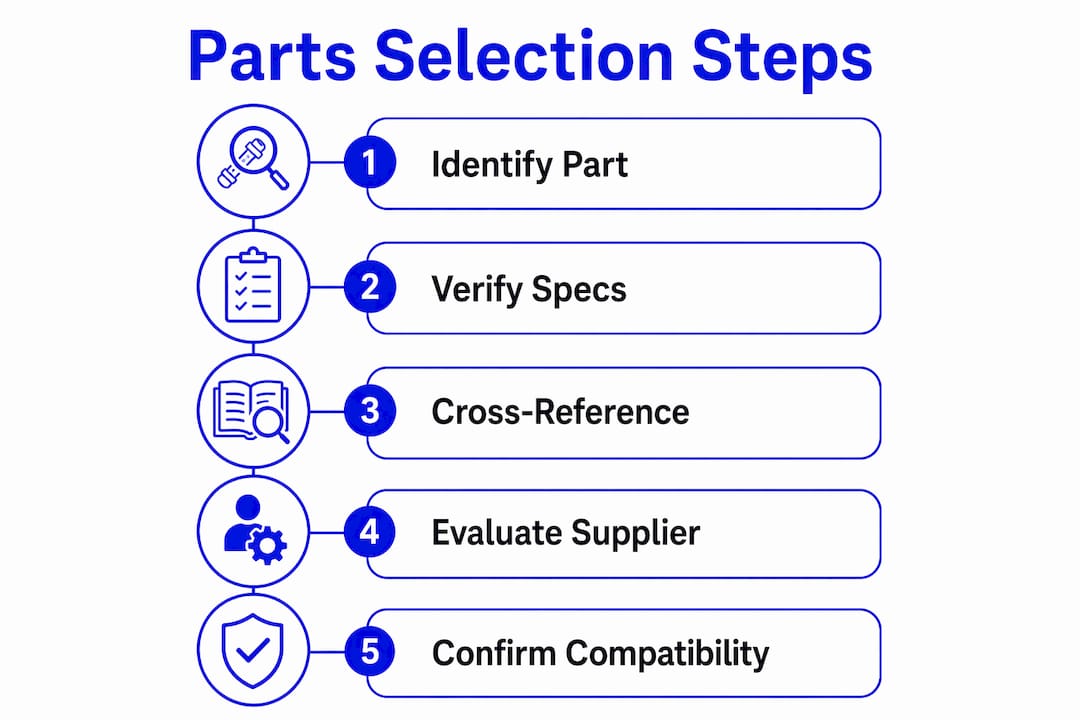
Cross-referencing is the next step when the exact OEM part is unavailable. Cross-referencing services identify alternates, substitutes, and functional equivalents that maintain system performance without requiring a full redesign. For GE Fanuc Series 90-30 systems, for example, several CPU modules share compatible rack interfaces but differ in memory capacity and scan speed. Knowing which attributes are flexible and which are fixed prevents costly mistakes.
Closed-loop control systems add a specific requirement. Controllers must support PID timing and sequencing requirements to avoid production deviations. A surplus controller that lacks the right scan rate or PID resolution will cause process instability even if it physically fits the rack.
Here is what to verify before ordering any surplus process control component:
- Exact part number and revision level confirmed against the system’s original documentation
- Voltage and signal specifications matched to field wiring (e.g., 24 VDC input, 4–20 mA analog)
- Communication protocol compatibility verified against the existing network (Genius Bus, Profibus, Ethernet/IP)
- Firmware version checked for compatibility with the existing CPU and programming software
- Physical condition rating confirmed with the supplier (tested, cleaned, or remanufactured)
Pro Tip: Always pull the original technical datasheet for the part number you need and compare it line by line against the supplier’s listing. If the supplier cannot provide a datasheet or a condition report, treat that as a disqualifying signal.
What is the step-by-step process for sourcing surplus control parts?
A structured sourcing process reduces errors and cuts the time between identifying a need and getting a verified part on the shelf. The steps below reflect how experienced maintenance teams approach this consistently.
- Define the system and the part needed. Document the PLC or DCS model, rack configuration, firmware version, and the exact function of the failing component. Pull the system’s wiring diagrams and I/O maps before contacting any supplier.
- Search multiple surplus suppliers. No single supplier carries every part. Cast a wide net across verified surplus specialists with automation engineering backgrounds.
- Validate authenticity and condition. Verifying part condition and authenticity upfront reduces the risk of failures after installation. Ask for test reports, photos of the physical unit, and condition grading documentation.
- Cross-reference alternatives if needed. If the exact part is unavailable, use cross-reference data to identify a compatible substitute. Confirm the substitute against your system documentation before ordering.
- Order and confirm shipping timeline. Confirm that the supplier ships same-day or within a defined window. For critical production equipment, a supplier with same-day shipping on in-stock items is a direct operational advantage.
- Receive, inspect, and bench-test before installation. Never install a surplus part directly into a live system without a bench check. Test I/O modules for correct signal response and check CPU modules for proper boot behavior.
How to evaluate a surplus supplier
Supplier evaluation criteria include technical support availability and a proven track record in automation parts. The table below compares sourcing methods by the factors that matter most to maintenance teams.
| Sourcing method | Speed | Reliability | Cost | Technical support |
|---|---|---|---|---|
| Direct OEM | Slow (weeks to months) | High | High | Full |
| Surplus specialist | Fast (same-day to days) | High when vetted | Low to moderate | Varies by supplier |
| Online auction platforms | Variable | Low without vetting | Lowest | None |
Suppliers with automation engineering expertise provide better identification, condition verification, and technical handling of surplus PLC and HMI modules. That engineering background means accurate part descriptions and proper packaging, which reduces damage in transit and errors at installation.
What are the common pitfalls when buying surplus control parts?
The most expensive mistakes in surplus sourcing come from skipping verification steps, not from choosing the wrong supplier category. Maintenance teams that move fast without confirming compatibility create longer downtime, not shorter.
“Not all surplus parts are equal. Condition and authenticity directly affect reliability and operational safety. Verifying part condition and authenticity upfront reduces the risk of failures after installation.”
The most common errors maintenance teams make include:
- Ordering by part description instead of part number. Descriptions like “analog input module” cover dozens of incompatible variants. Always order by exact part number.
- Ignoring control system architecture. A module that works in a standalone PLC rack may not function correctly in a DCS node with specific communication requirements. Confirming system architecture before ordering prevents this error.
- Skipping firmware compatibility checks. A GE Fanuc IC693CPU341 running an older firmware version may not communicate correctly with a newer programming terminal. Check firmware compatibility before the part ships.
- Accepting untested parts from unverified sources. Auction platforms and unvetted resellers frequently list parts with no condition documentation. The cost savings disappear quickly when an untested module fails during startup.
- Failing to maintain an internal cross-reference database. Teams that source the same legacy parts repeatedly waste time re-researching the same part numbers. Maintaining internal records improves efficiency and reduces errors when ordering surplus parts repeatedly.
Pro Tip: Build a simple spreadsheet that maps each legacy part number in your facility to its verified alternates, the suppliers who have stocked it, and the firmware version your system requires. That database pays for itself the first time you need an emergency replacement at 2 AM.
Key Takeaways
Selecting surplus process control parts correctly requires exact part identification, system architecture knowledge, and supplier verification before any order is placed.
| Point | Details |
|---|---|
| Search by exact attributes | Use part number, revision level, voltage, and protocol specs to confirm compatibility before ordering. |
| Know your control architecture | Closed-loop and DCS systems require parts that support specific PID timing and communication protocols. |
| Vet your supplier | Choose surplus specialists with automation engineering expertise, test documentation, and same-day shipping capability. |
| Cross-reference when needed | Identify verified alternates using cross-reference data when the exact OEM part is unavailable. |
| Build an internal database | Maintain a cross-reference record for legacy parts to cut sourcing time and reduce repeat errors. |
Why engineering knowledge changes everything in surplus sourcing
The maintenance teams I have seen struggle most with surplus sourcing share one trait: they treat it like buying a commodity. They search for the cheapest listing, skip the condition verification, and then wonder why the part fails within a week of installation.
The teams that get it right treat surplus sourcing like an engineering problem. They start with the system documentation, confirm the control architecture, and then match parts to requirements rather than matching requirements to whatever is cheapest. That shift in approach is not complicated. It just requires discipline.
What I have found consistently is that the supplier’s engineering background matters more than their price. A supplier who can tell you the difference between a GE Fanuc IC693MDL753 and an IC693MDL660 in terms of output logic and point count is a supplier who will catch compatibility errors before they become your problem. A supplier who just lists part numbers without technical context is a liability.
The other thing maintenance teams underestimate is the value of the cross-reference database. Every time your team sources a legacy part, you are generating institutional knowledge. If that knowledge lives only in one technician’s head, it walks out the door when that technician retires. A simple internal database of part numbers, verified alternates, and supplier history is one of the highest-return investments a maintenance team can make.
Prioritize supplier credibility and thorough verification every time. The cost of a failed installation, including lost production, labor, and re-sourcing time, always exceeds the cost of doing it right the first time.
— Monica
Sourcing surplus process control parts with Industrialpartsusa
Maintenance teams that need verified surplus process control components without long OEM lead times have a direct option.
Industrialpartsusa stocks new, used, surplus, and remanufactured automation parts with a focus on legacy and hard-to-find items. The inventory covers GE Fanuc Series 90-30, Genius I/O, RX7i, Allen-Bradley, Omron, Mitsubishi, and more. Parts like the GE Emerson IC693MDL753 output module ship same-day from in-stock inventory. Every part carries a one-year warranty backed by in-house testing, cleaning, and repair capabilities. Contact the Industrialpartsusa team directly for tailored sourcing support on legacy systems, cross-reference assistance, or hard-to-find Genius I/O components.
FAQ
What does “select surplus process control parts” mean?
Selecting surplus process control parts means identifying, verifying, and purchasing compatible control components from surplus inventory to replace or maintain legacy manufacturing equipment. The process requires exact part matching by number, revision, and technical specifications.
How do I verify a surplus part is compatible with my system?
Match the part number, revision level, voltage rating, and communication protocol against your system’s original documentation. For closed-loop systems, confirm the controller supports the required PID scan rate and timing specifications.
Is it safe to use surplus parts in a live production system?
Surplus parts from vetted suppliers with test documentation and condition grading are safe for production use. Always bench-test the part before installation and confirm the supplier provides a warranty covering the part post-installation.
What is the fastest way to source discontinued process control parts?
Surplus specialists with in-stock inventory and same-day shipping capability are the fastest sourcing option for discontinued parts. OEM channels typically require weeks to months for legacy components, while a vetted surplus supplier can ship the same day.
When should I cross-reference an alternate part instead of the exact OEM number?
Cross-reference an alternate when the exact OEM part is unavailable and a functional equivalent exists with matching voltage, I/O count, communication protocol, and firmware compatibility. Confirm the alternate against your system documentation before ordering.
Recommended
- Why Integrators Source Surplus Automation Parts – Global Electrical and Industrial
- Secondary Market Automation Parts: A Buyer’s Guide – Global Electrical and Industrial
- Sell Your Surplus Parts – Global Electrical and Industrial
- How to Source Discontinued Automation Parts Fast – Global Electrical and Industrial