
Industrial Sensor Categories Overview: 2026 Engineer’s Guide
Industrial sensors are defined as devices that convert physical or chemical properties into readable electrical signals for use in automated control systems. This industrial sensor categories overview covers the full classification framework engineers rely on to select the right sensor for manufacturing automation, from proximity detection to Edge AI vision systems. The global sensor market spans ten primary categories, each with distinct measurement principles, output types, and environmental requirements. Understanding these categories is the first step toward improving process control, reducing unplanned downtime, and getting the most from your PLC infrastructure.
How are industrial sensors classified by function and technology?
Industrial sensor classification follows two primary axes: what the sensor measures and how it generates its output signal. Getting this framework right before you specify hardware saves significant rework during system integration.
By function, sensors split into two groups:
- Presence detection: Sensors that detect whether an object is present or absent. Proximity sensors are the clearest example.
- Process variable measurement: Sensors that quantify a physical condition such as temperature, pressure, flow, or humidity over a continuous range.
By power and output signal, four main sensor types emerge from the combination of active/passive power requirements and analog/digital output:
- Active-Analog: Requires external power and produces a continuous signal. A strain gauge is a typical example.
- Active-Digital: Requires external power and outputs a binary or discrete signal. Most inductive proximity sensors fall here.
- Passive-Analog: Generates its own signal from the measured phenomenon. A thermocouple produces millivolt output from temperature difference.
- Passive-Digital: Generates its own binary signal. A PIR motion sensor is a common example.
This classification directly determines which PLC input card you need. An analog input module handles 4–20mA or 0–10V signals, while a digital input module handles discrete on/off states. Matching sensor output to PLC input type is a foundational engineering decision that affects both hardware cost and system reliability.
Pro Tip: When specifying sensors for a new control panel, document the output type of every sensor before ordering PLC I/O cards. A mismatch between a 4–20mA transmitter and a digital input module is a common and costly mistake.
Key categories of industrial sensors and their applications
Industrial sensors commonly measure ten core process variables. Each category serves distinct automation use cases, and knowing the differences helps you specify the right device the first time.
1. Proximity sensors
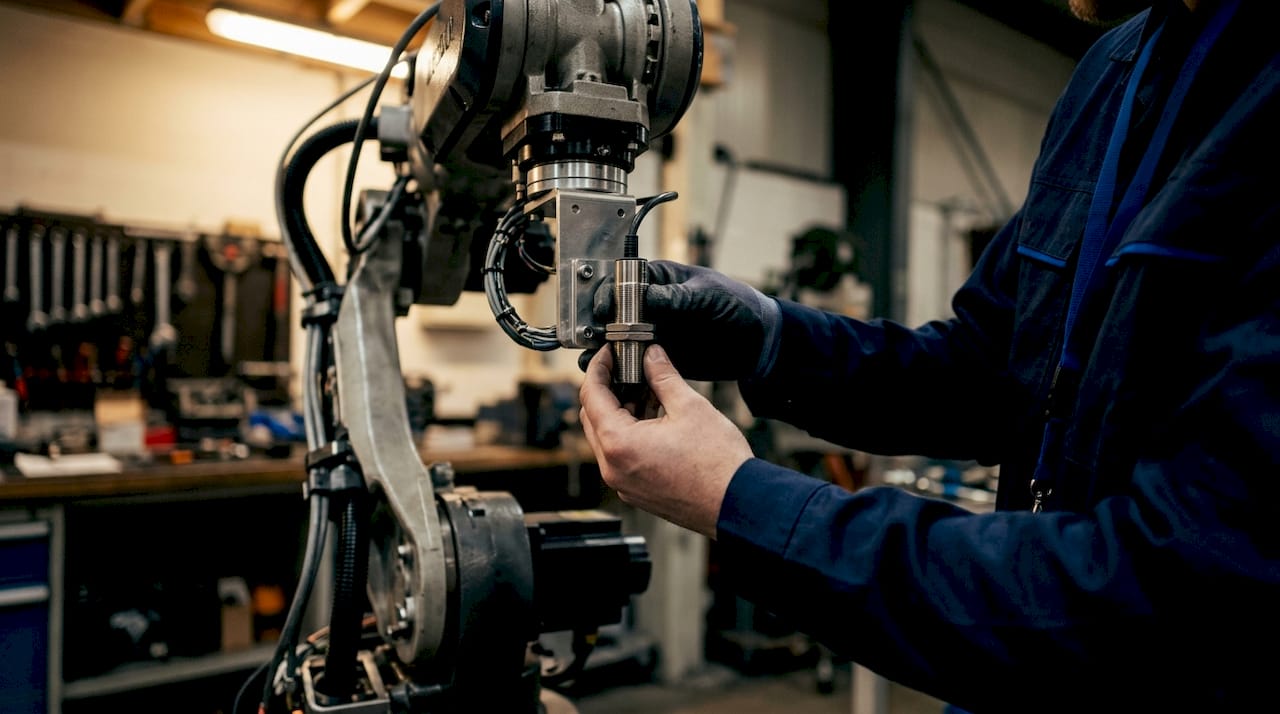
Proximity sensors detect the presence or absence of an object without physical contact. Key proximity sensor types include inductive, capacitive, photoelectric, ultrasonic, and magnetic variants. Inductive sensors detect metallic targets and dominate assembly line part detection. Capacitive sensors detect non-metallic materials including liquids and powders, making them useful for level detection in plastic or glass tanks.
2. Temperature sensors
Temperature sensors are the most widely deployed sensor type in manufacturing. Thermocouples cover wide temperature ranges and are rugged enough for furnace and kiln environments. Resistance Temperature Detectors (RTDs) offer higher accuracy for process control applications where stability matters more than range.
3. Pressure sensors
Pressure sensors measure gauge, absolute, or differential pressure in fluid and gas systems. They are standard in hydraulic circuits, pneumatic actuators, and HVAC systems. Differential pressure sensors also serve as indirect flow meters in pipe systems.
4. Level sensors
Level sensors monitor liquid or solid material height in tanks, silos, and hoppers. Ultrasonic and radar types work without contact, which is critical for corrosive or high-temperature media. Float switches and hydrostatic pressure transmitters cover lower-cost, simpler applications.
5. Flow sensors
Flow sensors measure the rate of fluid or gas movement through a pipe or channel. Electromagnetic flow meters work well with conductive liquids. Coriolis meters provide mass flow measurement with high accuracy, making them the preferred choice for custody transfer and batch processing.
6. Vibration sensors
Vibration sensors detect mechanical oscillation in rotating equipment such as motors, pumps, and compressors. Accelerometers are the standard device type. Vibration monitoring is the backbone of condition-based maintenance programs because bearing wear and imbalance show up in vibration signatures before catastrophic failure occurs.
7. Gas sensors
Gas sensors detect the concentration of specific gases in the surrounding atmosphere. Electrochemical sensors measure toxic gases like carbon monoxide and hydrogen sulfide. Catalytic bead sensors detect combustible gases. Both types are mandatory in confined spaces and chemical processing environments under OSHA regulations.
8. Humidity sensors
Humidity sensors measure relative or absolute moisture content in air or process gases. Capacitive humidity sensors are accurate across a wide range and are common in cleanrooms, pharmaceutical manufacturing, and food processing. Resistive types offer a lower-cost alternative for less demanding applications.
9. Position sensors
Position sensors measure linear or rotary displacement of a mechanical component. Linear Variable Differential Transformers (LVDTs) provide high-resolution linear position feedback. Encoders, both incremental and absolute, are standard on servo axes and CNC machine tools. Position feedback is what closes the control loop in motion control systems.
10. Vision sensors
Vision sensors capture images and process them to detect defects, verify assembly, or guide robots. Edge AI vision sensors with under 50ms latency are now used in quality inspection and AGV navigation. Vision systems from platforms like DVT/Cognex represent the high end of this category, combining camera hardware with onboard image processing.
Pro Tip: For sensor selection in mixed environments, start with the harshest condition the sensor will face, whether that is temperature, vibration, or chemical exposure, and filter your options from there. Selecting for average conditions and then adding protection after the fact always costs more.
Comparing sensor features: precision, response time, and environmental robustness
Effective sensor selection balances accuracy, response time, environmental resistance, and output signal compatibility to achieve reliable manufacturing control. No single sensor category excels in all four dimensions.
Accuracy and resolution vary dramatically across categories. MEMS optical sensors achieve 1.4 µm resolution, making them suitable for precision metrology applications. Standard inductive proximity sensors, by contrast, offer positional repeatability in the range of fractions of a millimeter but are not designed for fine measurement. RTD temperature sensors typically achieve ±0.1°C accuracy, while thermocouples are closer to ±1–2°C depending on type and calibration.
Response time determines whether a sensor can keep up with your control loop. Smart sensors show under 50ms latency, which is adequate for most process control applications. High-speed machine vision and motion control applications may require sub-10ms response. Selecting a sensor with a response time slower than your control loop update rate introduces lag that degrades closed-loop performance.
| Sensor category | Typical accuracy | Response time | EMI resistance | Temperature range |
|---|---|---|---|---|
| Inductive proximity | ±0.1 mm repeatability | <1 ms | High | -25°C to 70°C |
| RTD temperature | ±0.1°C | 1–10 s | Moderate | -200°C to 850°C |
| Pressure transmitter | ±0.1% FS | <100 ms | High (4–20mA) | -40°C to 85°C |
| Vibration accelerometer | ±1% FS | <10 ms | Moderate | -55°C to 125°C |
| Vision sensor | 1.4 µm (MEMS) | <50 ms | Low to moderate | 0°C to 50°C |
Environmental robustness is often the deciding factor on the plant floor. Electromagnetic interference from variable frequency drives, welding equipment, and large motors degrades sensor signal quality. Signal integrity using 4–20mA or digital outputs is more critical than price when operating in high-EMI environments. The 4–20mA current loop standard resists voltage noise over long cable runs, which is why it remains the dominant signal type in process industries decades after its introduction.
Pro Tip: Specify IP67 or IP69K ingress protection ratings for any sensor installed near washdown zones or outdoor environments. The cost difference over IP54-rated devices is small; the maintenance savings are significant.
Emerging trends and smart sensor technologies shaping industrial sensing in 2026
Smart sensors with onboard Edge AI are shifting maintenance strategies from reactive to proactive by enabling early fault detection through real-time analytics at the device level. This is not a future concept. Plants running condition monitoring programs today are already using these devices to catch bearing failures weeks before they cause downtime.
Key trends reshaping sensor technology in 2026 include:
- Edge AI integration: Sensors now process data locally rather than sending raw signals to a central controller. This reduces network load and enables faster fault detection without cloud dependency.
- IO-Link adoption: IO-Link smart sensors provide predictive maintenance via remote diagnostics but introduce setup latency up to 50ms, which engineers must account for in high-speed control loops.
- MEMS and optical fiber sensors: MEMS sensors at 3×3 mm scale offer ±2000°/s gyroscope performance, while optical fiber sensors handle temperatures up to 300°C, opening applications in environments where silicon-based sensors fail.
- Self-reporting health status: Modern smart sensors report their own calibration drift, contamination levels, and remaining service life directly to the PLC or SCADA system. This capability eliminates manual sensor inspection cycles.
- Integration with industrial Ethernet networks: Sensors increasingly connect via PROFINET, EtherNet/IP, or Modbus TCP, enabling direct data exchange with enterprise systems without additional signal converters.
The shift toward smart sensing also raises integration complexity. Engineers specifying IO-Link or Edge AI sensors for the first time need to verify PLC firmware compatibility and network bandwidth before deployment. The performance gains are real, but they require upfront engineering work to realize.
Key Takeaways
Selecting the right sensor category requires matching measurement principle, output type, and environmental rating to the specific demands of your application.
| Point | Details |
|---|---|
| Classify before you specify | Determine whether you need presence detection or process variable measurement before evaluating individual products. |
| Match output to PLC input | Analog sensors need analog input cards; digital sensors need discrete input cards. Mismatches cause costly rework. |
| Prioritize signal integrity | In high-EMI environments, 4–20mA and digital outputs outperform voltage signals regardless of sensor cost. |
| Account for latency | IO-Link and smart sensors can introduce up to 50ms latency, which affects high-speed control loop performance. |
| Rate for the worst condition | Specify IP rating, temperature range, and EMI resistance for the harshest condition the sensor will face, not the average. |
What engineers get wrong about sensor selection
The most common mistake I see is treating sensor selection as a procurement task rather than an engineering decision. Engineers hand a part number to a buyer, the buyer finds the cheapest equivalent, and six months later the plant is chasing intermittent faults that trace back to a sensor with inadequate EMI shielding or the wrong output impedance.
The second mistake is underweighting response time. A pressure transmitter with a 500ms response time looks fine on a spec sheet. Put it in a fast-acting safety interlock loop and it becomes a liability. The control system assumes the sensor is telling the truth about current conditions. A slow sensor lies by omission.
What I have found actually works is building a one-page sensor specification template for each application before talking to any supplier. That template forces you to define the measurement range, required accuracy, response time, output type, ambient temperature range, and ingress protection rating upfront. When you have those numbers, evaluating options takes minutes instead of weeks. The role of sensors in automation is too central to leave to a catalog search.
— Monica
Sourcing industrial sensors and automation components
Automation engineers working with legacy systems often face a harder sourcing problem than sensor selection itself. The sensor you need may be discontinued, long-lead from the OEM, or priced at a premium because demand exceeds supply.

Industrialpartsusa stocks new, surplus, and remanufactured automation components across sensor categories and the broader automation stack, including PLCs, I/O modules, HMIs, and drives. Every component ships with a one-year warranty backed by in-house testing and repair. Same-day shipping is available on in-stock items, which matters when a sensor failure is holding up production. Engineers sourcing automation parts for production lines can browse the full catalog at Industrialpartsusa or contact the team directly for hard-to-find components.
FAQ
What are the main industrial sensor categories?
The ten main categories are proximity, temperature, pressure, level, flow, vibration, gas, humidity, position, and vision sensors. Each category targets a specific physical or chemical measurement in manufacturing environments.
How do I choose between analog and digital sensor outputs?
Choose analog output (4–20mA or 0–10V) when you need continuous process variable measurement. Choose digital output when you only need a presence or absence signal, or when the sensor connects via IO-Link or a fieldbus protocol.
What does sensor latency mean for control loops?
Sensor latency is the delay between a physical event and the sensor’s output signal reaching the controller. Latency above 50ms can degrade closed-loop performance in high-speed motion or safety interlock applications.
Why is 4–20mA still the standard in process industries?
The 4–20mA current loop resists electromagnetic interference over long cable runs and allows the controller to detect a broken wire (0mA) versus a valid low reading (4mA). That fault detection capability makes it more reliable than voltage-based signals in industrial environments.
What is IO-Link and when should engineers use it?
IO-Link is a point-to-point communication standard that allows smart sensors to transmit process data, diagnostic information, and device parameters over a standard three-wire cable. Use it when you need remote sensor diagnostics or predictive maintenance data, and when your control system supports IO-Link master modules.
Recommended
- What Is a Process Control System? Engineer’s Guide – Global Electrical and Industrial
- GE Emerson Genius I/O IC660BBR100 Industrial Automation Part – Global Electrical and Industrial
- What Is Industrial Ethernet? A 2026 Engineer’s Guide – Global Electrical and Industrial
- The Role of Sensors in Automation: Engineer’s Guide – Global Electrical and Industrial