
MRO Inventory Management for Automation: 2026 Guide
MRO inventory management for automation is defined as the systematic use of AI-native platforms, automated storage systems, and supplier consolidation to control maintenance, repair, and operations parts across manufacturing facilities. The industry term is “MRO management,” and it covers every spare part, consumable, and tool that keeps production equipment running without being part of the finished product. Done right, it reduces excess stock by 30–40% and cuts carrying costs by 15–25%. For maintenance and operations managers running legacy equipment, those numbers translate directly into fewer emergency shutdowns and more predictable budgets.
What tools and technologies enable MRO inventory management for automation?
Effective automated inventory control starts with the right technology stack, not with buying more parts. Three core systems form the foundation: AI-native MRO platforms, Automated Storage and Retrieval Systems (ASRS), and real-time tracking hardware.
AI-native MRO platforms
AI-native platforms do more than track stock levels. They analyze consumption patterns, predict failures before they happen, and draft purchase orders automatically. Automated MRO systems can deliver 3–5x ROI through reduced downtime, extended asset lifecycles, and improved safety compliance. That return compounds over time as the system learns your facility’s specific demand cycles.
ASRS for spare parts management
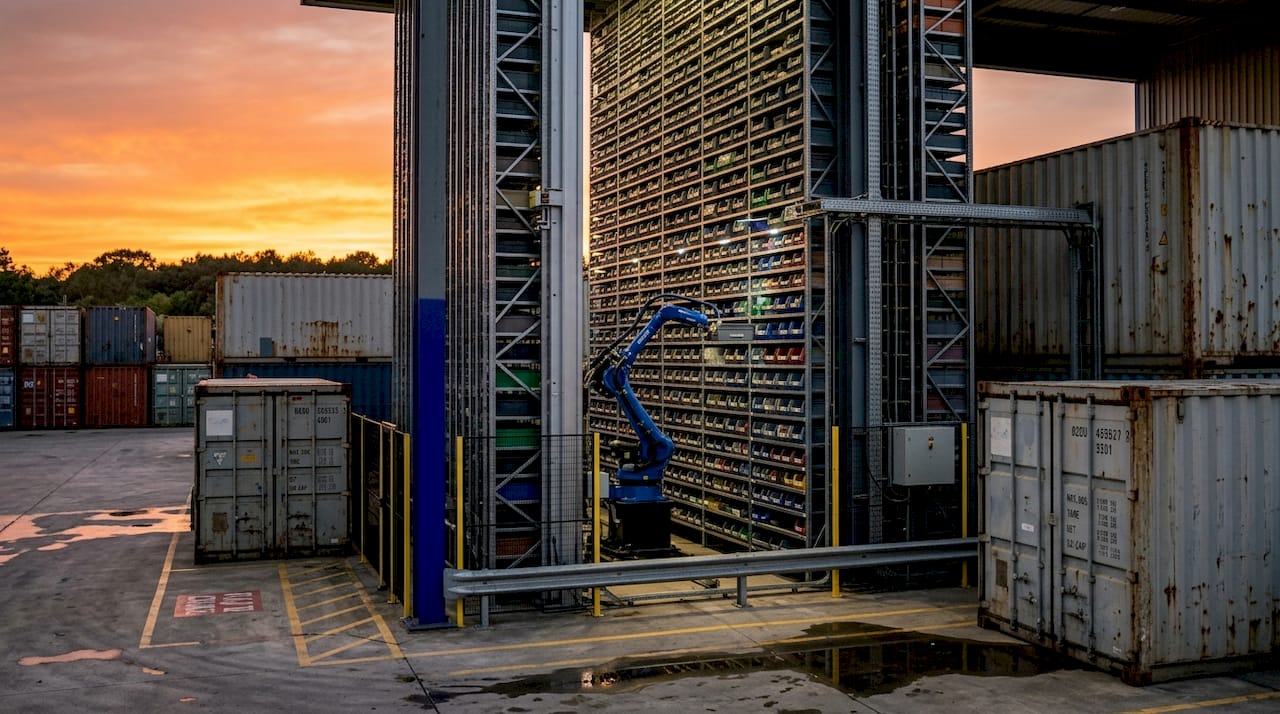
Automated Storage and Retrieval Systems bring physical order to parts rooms that have grown chaotic over decades. An ASRS uses vertical carousels or robotic shuttles to store and retrieve parts on demand, eliminating the time technicians spend searching shelves. Warehouse automation ROI is typically achieved within 12–24 months, with the added benefit of recovering significant floor space. For legacy equipment environments with hundreds of unique part numbers, that space recovery alone justifies the investment.
Barcode and RFID integration
Manual data entry is where MRO accuracy breaks down. Barcode and RFID integration eliminate manual input errors during part retrieval and update inventory records in real time. Every scan creates an audit trail, which makes cycle counting faster and discrepancy resolution straightforward.
ERP and CMMS integration
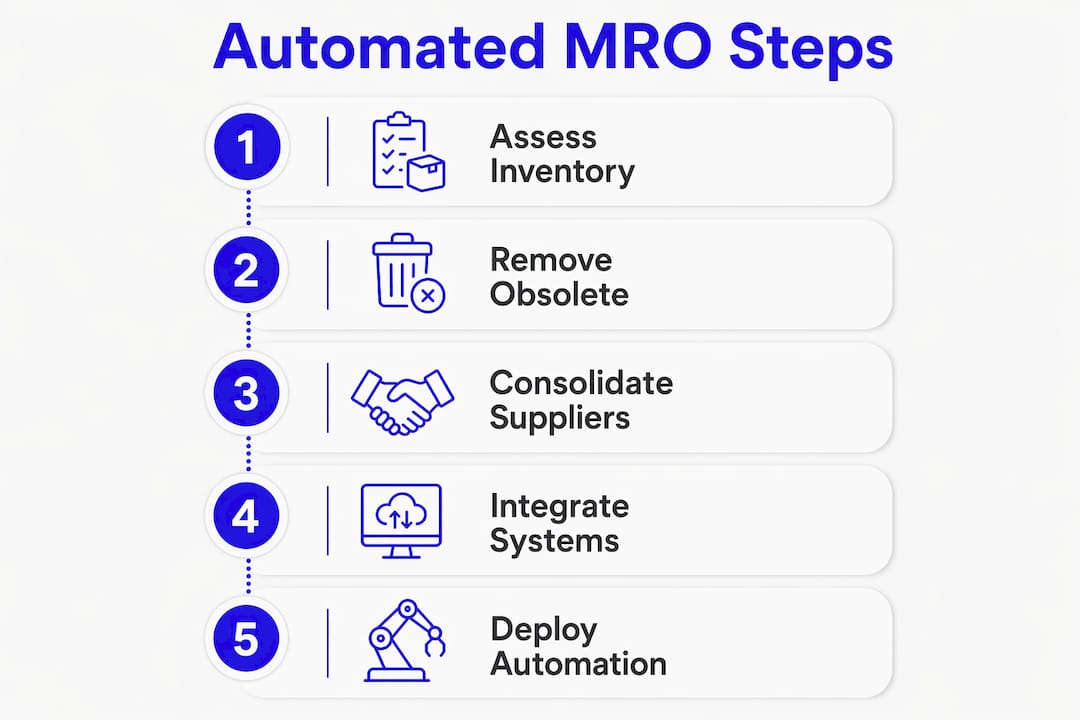
Your MRO platform must connect to your Enterprise Resource Planning (ERP) system and Computerized Maintenance Management System (CMMS). Without that connection, work orders and purchase requisitions live in separate silos, and the automation layer cannot act on maintenance schedules. Integration also lets the system align spare parts demand with planned downtime windows, so parts arrive before the technician needs them.
Pro Tip: Start with CMMS integration before connecting your ERP. Maintenance work order data is the most direct signal for MRO demand, and getting that feed clean first prevents bad data from polluting your broader procurement automation.
| Technology | Primary function | Key benefit |
|---|---|---|
| AI-native MRO platform | Demand forecasting and auto-replenishment | Reduces excess stock and emergency orders |
| ASRS | Physical storage and retrieval automation | Recovers floor space, speeds part access |
| Barcode/RFID | Real-time tracking at point of use | Eliminates manual errors, improves accuracy |
| ERP/CMMS integration | Data synchronization across systems | Aligns parts availability with work orders |
How to optimize MRO inventory before automating?
Automating a disorganized inventory amplifies the disorganization. The single most common reason MRO optimization efforts fail is poor data consolidation and unmanaged supplier relationships. Fix those two problems first.
Remove obsolete and inactive inventory
Walk your parts room and flag any item that has not moved in 24 months. Obsolete inventory ties up capital and confuses automated replenishment algorithms, which may reorder parts that have no future demand. For legacy equipment like GE Fanuc Series 90-30 or Allen-Bradley PLCs, distinguish between “obsolete to the market” and “obsolete to your facility.” A part discontinued by the OEM may still be critical to your operation.
Consolidate your supplier base
The average industrial facility buys MRO from 150–500 suppliers. That fragmentation makes contract management impossible and drives up per-transaction costs. Consolidating to 10–20 preferred vendors and negotiating volume contracts cuts acquisition costs by 15–25%. The math is straightforward: fewer invoices, fewer approval workflows, and better pricing from vendors who value the volume.
Key steps for supplier consolidation:
- Audit all active vendors and categorize by spend, reliability, and product coverage.
- Identify which vendors supply the same category and select the one with the best lead times and pricing.
- Negotiate preferred supplier agreements with defined service levels and pricing tiers.
- Set up contract compliance monitoring from day one, not after the first renewal cycle.
- Assign a single point of contact at each preferred vendor to speed up emergency requests.
Pro Tip: When consolidating suppliers for legacy automation parts, keep at least one specialist supplier for obsolete components outside your preferred vendor list. Specialists like Industrialpartsusa stock surplus and remanufactured parts for discontinued platforms that general distributors cannot source.
Monitor contract compliance continuously
Preferred supplier contracts lose their value fast without enforcement. Contract compliance drops to 60–70% within 12 months when there is no automated monitoring in place. That erosion wipes out the savings you negotiated. Automated compliance tools flag off-contract purchases in real time, giving managers the data to correct behavior before it becomes a budget problem.
What are the steps to implement automated MRO inventory management?
Implementation works best as a phased rollout, not a single cutover. Rushing the transition creates data gaps that undermine the system’s forecasting accuracy from the start.
Phase 1: Establish real-time visibility
- Install barcode scanners or RFID readers at every storage location and point of use.
- Conduct a full physical count and load accurate quantities into your MRO platform.
- Map each part to its associated equipment and work order history in the CMMS.
- Set minimum and maximum stock thresholds based on historical consumption, not guesswork.
Phase 2: Configure AI demand forecasting
- Feed at least 12 months of consumption history into the platform before enabling auto-replenishment.
- Set safety stock calculations that account for vendor lead times and criticality ratings.
- Define which parts require human authorization before a purchase order is issued.
- Test the forecasting model against a subset of high-turnover parts before expanding to the full catalog.
Phase 3: Deploy automated replenishment
- Enable the system to draft purchase orders automatically when stock hits reorder points.
- Route draft orders to the appropriate manager for review before submission to the vendor.
- Configure multi-site demand aggregation if your facility has more than one storeroom.
- Set up vendor lead time tracking so the system adjusts reorder points when supplier performance changes.
Phase 4: Train your team
Staff training determines whether the system delivers its promised returns. Focus on two areas:
- How to interpret system alerts and when to override an automated recommendation.
- How to flag data errors, such as a part scanned to the wrong location, so the system stays accurate.
The human-in-the-loop approach is the right model for MRO automation. AI handles repetitive tasks like reorder calculations and order drafting, while humans retain judgment for high-stakes procurement decisions. That balance prevents the system from making costly mistakes on critical or long-lead parts.
How to avoid common pitfalls in MRO automation?
The biggest threat to sustained MRO automation success is not technology failure. It is behavioral drift, where staff revert to manual purchasing habits and the system’s data degrades.
“Without tools to detect tail spend and off-contract purchases, automation savings disappear quickly as manual purchases resume. The tail spend trap means 80% of purchase orders account for only 20% of total MRO spend, yet those low-value transactions carry the highest risk of going off-contract.”
Sustained success requires active management in four areas:
- Tail spend monitoring: Flag any purchase made outside the preferred vendor list and require manager approval before it is processed.
- Emergency order tracking: Emergency parts orders cost 3–5x the normal price. Track emergency order frequency as a KPI. A rising trend signals a forecasting gap, not a supply problem.
- Obsolete inventory reviews: Schedule quarterly reviews to identify parts that have not moved since the last cycle. Remove them from active replenishment and evaluate whether they can be sold as surplus.
- ROI measurement: Measure carrying cost reduction, stockout frequency, and emergency order spend at 90-day intervals. Early data lets you tune the system before small errors compound.
The secondary market for automation parts is a practical resource when automated replenishment surfaces a critical part that preferred vendors cannot supply. Surplus and remanufactured parts from vetted suppliers fill gaps that standard supply chains cannot cover, especially for legacy platforms.
Key Takeaways
Effective MRO automation requires clean data, consolidated suppliers, and human oversight at critical decision points before technology delivers its full return.
| Point | Details |
|---|---|
| Clean data first | Remove obsolete inventory and correct stock counts before enabling any automation. |
| Consolidate suppliers | Reduce vendors to 10–20 preferred partners to cut acquisition costs by 15–25%. |
| Use human-in-the-loop AI | Let AI draft orders, but require human sign-off on high-value or critical parts. |
| Monitor compliance actively | Track contract compliance continuously to prevent savings from eroding within 12 months. |
| Measure ROI at 90-day intervals | Review carrying costs, stockouts, and emergency orders quarterly to catch problems early. |
Why I think most MRO automation projects underdeliver
After working with maintenance and operations managers across discrete and process manufacturing, the pattern is consistent. Teams invest in the software layer before fixing the data layer, and the system spends its first year learning from bad inputs. The manufacturing automation upgrade checklist I recommend to every manager starts with a physical audit, not a software demo.
The other mistake I see regularly is treating automation as a set-it-and-forget-it solution. AI-driven MRO systems prepare actions, but they require human approval for critical procurements. That is not a limitation of the technology. It is the correct design. A system that autonomously orders a $40,000 servo drive without human review is a liability, not an asset.
The ROI case for ASRS and AI-native platforms is real. Facilities that complete the full implementation cycle, including supplier consolidation and compliance monitoring, see the 12–24 month payback period hold up in practice. The ones that skip supplier consolidation rarely see it. Start narrow, prove the model on one storeroom or one equipment class, and expand from there.
— Monica
Parts support for your MRO automation rollout
Building a reliable MRO inventory system for legacy automation equipment means having a parts supplier who can fill gaps that standard distributors cannot. Industrialpartsusa stocks new, surplus, and remanufactured automation parts for platforms including GE Fanuc Series 90-30, RX3i, Allen-Bradley PLCs, Horner Electric, Mitsubishi, Omron, and more. Same-day shipping on in-stock items means your automated replenishment system has a reliable fulfillment partner when lead times matter. Every part ships with a one-year warranty backed by in-house testing and repair. For legacy and hard-to-find components that fall outside your preferred vendor contracts, browse the full catalog at Industrialpartsusa to find what your system needs.
FAQ
What is MRO inventory management for automation?
MRO inventory management for automation is the use of AI platforms, ASRS, and automated replenishment tools to control spare parts and maintenance supplies in manufacturing. The goal is to reduce stockouts, cut carrying costs, and eliminate manual purchasing errors.
How much can automated MRO management reduce inventory costs?
AI-native MRO platforms reduce excess stock by 30–40% and cut carrying costs by 15–25%. Emergency parts orders, which cost 3–5x the normal price, also decrease significantly when demand forecasting is accurate.
What should I do before automating MRO inventory?
Remove obsolete stock, correct physical counts, and consolidate your supplier base to 10–20 preferred vendors before enabling automation. Clean data and managed supplier relationships are the prerequisites for accurate AI forecasting.
How does the human-in-the-loop model work in MRO automation?
The system drafts purchase orders and flags reorder points automatically, but a human manager reviews and approves high-value or critical part orders before submission. This approach prevents costly autonomous errors on long-lead or expensive components.
How long does MRO warehouse automation take to pay back?
Most facilities achieve full ROI on ASRS and related warehouse automation within 12–24 months, driven by stockout elimination, reduced emergency orders, and recovered floor space.
Recommended
- Manufacturing Automation Upgrade Checklist for 2026 – Global Electrical and Industrial
- How to Migrate Obsolete Automation Controls in 2026 – Global Electrical and Industrial
- Secondary Market Automation Parts: A Buyer’s Guide – Global Electrical and Industrial
- What Is Process Automation in Manufacturing: 2026 Guide – Global Electrical and Industrial