Production Line Automation Components: Top 10 for Manufacturers
Selecting the right production line automation components can make or break a facility upgrade. With dozens of component categories, competing standards, and integration requirements that vary by line configuration, the decision is rarely straightforward. Get it right and you gain measurable gains in throughput, safety, and long-term scalability. Get it wrong and you’re dealing with costly rework, compliance gaps, and equipment that doesn’t talk to the rest of your system. This guide gives you a criteria-driven framework and a ranked look at the components that matter most.
Table of Contents
- Key takeaways
- 1. Criteria for evaluating production line automation components
- 2. Programmable Logic Controllers (PLCs)
- 3. Safety PLCs and functional safety components
- 4. Human-Machine Interfaces (HMIs)
- 5. Variable frequency drives (VFDs)
- 6. Powered roller conveyors and transfer modules
- 7. Sensors for presence, position, and quality
- 8. Actuators and motion controllers
- 9. Assembly line robotics
- 10. Comparison of top automation components
- My honest take on automation component selection
- Source your automation components without the lead-time headache
- FAQ
Key takeaways
| Point | Details |
|---|---|
| Safety PLCs are non-negotiable | Standard PLCs cannot fulfill safety functions; dedicated Safety PLCs are required for compliance with ISO 13849 and IEC 62061. |
| Integration drives performance | Real-time communication networks tying sensors, controllers, and software together are what actually deliver efficiency gains. |
| Modular systems pay off long-term | Modular, software-integrated components reduce future engineering effort and support scalable line changes. |
| Compliance documentation is mandatory | OSHA lockout/tagout and functional safety requirements demand formal documentation, not just hardware. |
| Match components to facility goals | Component selection should reflect your line’s size, throughput targets, and upgrade roadmap, not just current needs. |
1. Criteria for evaluating production line automation components
Before you compare specific components, you need a framework. Without one, you end up choosing based on price or brand familiarity rather than fit.
The core criteria every manufacturing professional should apply:
- Reliability and MTBF ratings: How long does the component run before failure? What’s the vendor’s track record in your application type?
- Compatibility: Does it integrate with your existing PLCs, HMIs, and communication protocols (EtherNet/IP, PROFIBUS, Modbus)?
- Scalability: Can the component support additional I/O, expanded zones, or higher throughput without a full replacement?
- Safety certifications: Does it meet applicable standards like SIL 2/3 or PLd/e where safety functions are involved?
- Maintenance requirements: Is the component serviceable in-house, or does every repair require a factory call?
Automation reliability depends on interdependent layers: robotics, PLC/DCS control, and MES software, all connected through a communication network that enables real-time performance. If any layer is poorly matched, the whole system underperforms.
Pro Tip: Prioritize modular components with open communication protocols. They cost more upfront but dramatically reduce integration time during future upgrades.
2. Programmable Logic Controllers (PLCs)
PLCs are the backbone of control systems for production. They handle motor sequencing, conveyor timing, I/O management, and process logic across virtually every automated line. Brands like GE Fanuc (Series 90-30, RX3i), Allen-Bradley, Mitsubishi, and Omron each have strong installed bases, and your choice often depends on what’s already running in your facility.
What most engineers get wrong: treating a standard PLC as a safety device. Standard PLCs are not safety devices. They lack the redundancy, diagnostic coverage, and validated logic execution required for safety-rated functions.
“Many manufacturers mistakenly treat standard PLCs as safety devices, risking non-compliance and safety failures.”
If your line includes any safety-critical function, a dedicated Safety PLC certified to SIL 2/3 or PLd/e is required. Safety PLCs monitor emergency stops, interlocks, and light curtains with the fault-detection architecture that standard PLCs simply don’t have.
Pro Tip: Document your PLC’s role clearly in your risk assessment. Mixing safety and general control logic in a standard PLC is a compliance violation waiting to happen.
3. Safety PLCs and functional safety components
This deserves its own section because the stakes are high. Safety PLCs certified to PLd/e or SIL 2/3 include redundant processing, self-diagnostics, and strict separation between safety and standard logic execution. That architecture is what makes them certifiable.
Key safety devices a Safety PLC typically monitors:
- Emergency stop circuits
- Safety interlocks and gate switches
- Light curtains and area scanners
- Two-hand control devices
- Pressure-sensitive safety mats
Beyond the hardware, OSHA 1910.147 requires documented lockout/tagout procedures for any maintenance activity involving hazardous energy. Tagout alone is only permitted when locking is physically impossible. This is a documentation requirement, not just a hardware one. Your Safety PLC installation must be backed by formal risk analysis, validated logic, and operator training records.
4. Human-Machine Interfaces (HMIs)
An HMI is where your operators interact with the production system in real time. A poorly chosen HMI creates bottlenecks, misread alarms, and slow fault recovery. A well-chosen one gives operators clear process visibility and fast response capability.
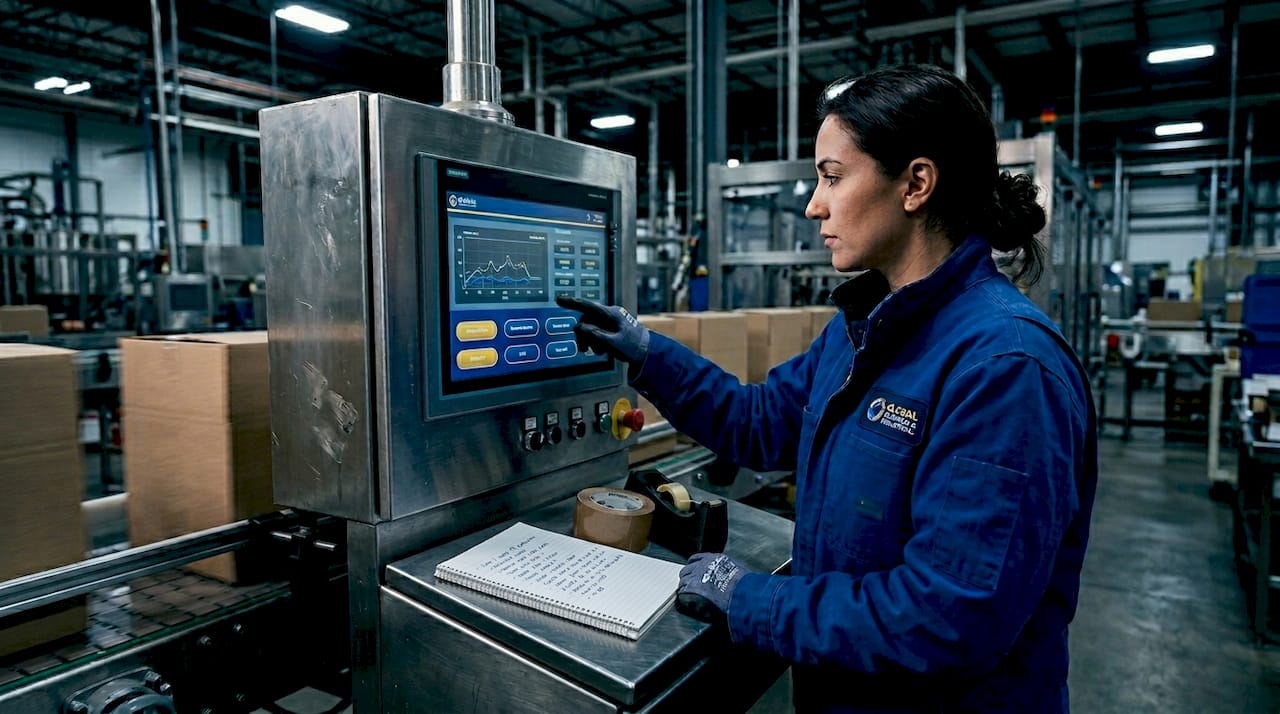
Key selection factors include screen size and resolution for the environment, touchscreen responsiveness with gloves, communication driver support for your PLC platform, and remote access capability for maintenance teams. Brands like Beijer, Horner Electric, and GE QuickPanel have strong track records in manufacturing environments. The HMI should also log alarms and events locally to support compliance and troubleshooting.
5. Variable frequency drives (VFDs)
VFDs control motor speed by varying the frequency of the electrical supply, which translates directly into energy savings and reduced mechanical wear. On a production line, they’re used on conveyors, pumps, fans, and any application where load varies.
Selecting the right VFD means matching it to motor horsepower and voltage, verifying harmonic distortion compliance for your facility, and confirming the drive supports your network protocol. Many legacy lines run older drives that are no longer manufactured. Sourcing a tested, surplus replacement is often faster and more cost-effective than redesigning the motor control circuit around a new platform.
6. Powered roller conveyors and transfer modules
Conveyors are the circulatory system of any production line. Powered roller conveyors improve product flow with motorized rollers, zoned control, sensor-based indexing, and PLC integration. They support accumulation, controlled stops, and staging without manual intervention.
| Feature | Benefit |
|---|---|
| Zoned motor control | Allows independent zone operation, reducing energy use and product damage |
| Sensor-based indexing | Enables precise positioning without manual adjustment |
| PLC integration | Connects conveyor logic directly to production control systems |
| Modular sections | Simplifies line reconfiguration and section replacement |
For right-angle transfers between conveyor lines, specialized modules like the X-Flow 90 handle product redirection without jamming or damage, using anti-slip belts and a compact footprint. Modular conveyor platforms that unify hardware, motion control, and software further reduce setup time and make workflow changes faster to execute.
Pro Tip: When specifying conveyors, confirm that zone controllers support your PLC’s communication protocol natively. Retrofitting protocol converters later adds cost and failure points.
7. Sensors for presence, position, and quality
Sensors are the nervous system of automated manufacturing equipment. Without accurate, reliable sensing, every downstream component is working on bad data.
Common sensor types and their roles:
- Photoelectric sensors: Detect part presence, count products, and trigger downstream actions
- Inductive proximity sensors: Confirm metal part position without contact
- Vision systems: Perform inline quality inspection, barcode reading, and dimensional verification
- Encoder feedback sensors: Provide position and speed data to motion controllers
- Pressure and temperature sensors: Monitor process conditions in real time
Sensor selection should account for the environment (washdown, high temperature, vibration), the required switching frequency, and the output signal type your PLC accepts. Vision systems from platforms like Cognex add inspection capability that no other sensor type can replicate.
8. Actuators and motion controllers
Actuators convert electrical signals into physical motion. Pneumatic cylinders, servo motors, and linear actuators each have distinct trade-offs in speed, force, precision, and cost. Servo motors paired with motion controllers are the standard choice for high-precision assembly line robotics tasks where repeatability is measured in fractions of a millimeter.
Motion controllers sit between the PLC and the drive/motor, handling trajectory planning and closed-loop position control. For multi-axis applications, a dedicated motion controller offloads that processing from the PLC and delivers smoother, faster motion profiles. Matching the motion controller to your servo drive brand is critical for minimizing tuning effort and maximizing diagnostic visibility.
9. Assembly line robotics
Robots have become practical for a much wider range of manufacturing applications than they were a decade ago. Collaborative robots (cobots) can work alongside operators without full guarding enclosures, while traditional industrial robots handle high-speed, high-force tasks behind safety barriers.
The key selection criteria for assembly line robotics: payload capacity, reach, cycle time, repeatability, and ease of reprogramming. PLCs handle real-time machine control while MES systems provide plant-wide orchestration and traceability. Robots typically interface with both layers. For facilities learning how to automate production lines, cobots with intuitive teach pendants offer a lower barrier to entry than traditional six-axis robots.
10. Comparison of top automation components
| Component | Key strength | Main trade-off | Best for |
|---|---|---|---|
| Standard PLC | Cost-effective, widely supported | Not suitable for safety functions | General machine control |
| Safety PLC | Certified for SIL/PL safety functions | Higher cost, more complex validation | Safety-critical applications |
| HMI | Operator visibility and control | Requires driver compatibility with PLC | All production environments |
| VFD | Energy savings, motor protection | Harmonic distortion management needed | Variable-load motor applications |
| Powered roller conveyor | Flexible, scalable material flow | Upfront cost vs. gravity alternatives | High-throughput lines |
| Vision sensor | Inline quality and inspection | Higher cost, requires lighting setup | Quality-critical assembly |
| Servo motor + controller | High precision, fast response | Complex tuning, higher component cost | Precision assembly, robotics |
| Cobot | Flexible, safe near operators | Lower speed/payload than industrial robots | Mixed human-robot workstations |
The right mix depends on your facility’s throughput targets, safety requirements, and existing infrastructure. A plant running legacy GE Fanuc or Allen-Bradley systems doesn’t need to replace everything. Often, targeted component upgrades deliver the biggest return.
My honest take on automation component selection
I’ve worked with enough manufacturing teams to know that the biggest mistakes in automation upgrades don’t happen at the component level. They happen at the planning level.
The most common pattern I see: a facility invests in new automated manufacturing equipment, then discovers that their existing PLC platform can’t communicate with it, or that their safety architecture doesn’t meet the new system’s requirements. Those gaps cost more to fix after installation than they would have during spec.
My honest advice is to treat the communication network as a first-class design decision, not an afterthought. The industrial automation solutions that hold up over time are the ones where someone mapped out the full signal path from sensor to controller to software before purchasing anything.
The other thing I’d push back on: don’t dismiss legacy components too quickly. A well-maintained GE Fanuc Series 90-30 running a stable process doesn’t need to be replaced just because it’s old. What it may need is a reliable source for spare parts and a clear upgrade path documented for when the time comes. That’s a very different problem than starting from scratch.
Source your automation components without the lead-time headache
When you’re tracking down a specific PLC module, a hard-to-find I/O card, or a legacy drive that the OEM stopped making years ago, lead times from traditional distributors can stretch to weeks or months. Industrialpartsusa stocks new, surplus, and remanufactured industrial automation parts across GE Fanuc, Allen-Bradley, Mitsubishi, Omron, and more, with same-day shipping on in-stock items.
Every component is tested, cleaned, and backed by a one-year warranty. Whether you need a GE Genius I/O module for an existing control system or a replacement VFD to keep a line running, Industrialpartsusa can source it faster than going back to the manufacturer. Reach out for a quote and get your line back up without the wait.
FAQ
What are the main production line automation components?
The core components include PLCs, Safety PLCs, HMIs, VFDs, sensors, actuators, conveyors, motion controllers, and assembly line robotics. Each handles a distinct function within the overall control and material flow architecture.
When is a Safety PLC required instead of a standard PLC?
A Safety PLC is required whenever a control function is classified as safety-related under ISO 13849 or IEC 62061. Standard PLCs lack the redundancy and diagnostic coverage needed to achieve SIL 2/3 or PLd/e ratings.
How do PLCs and MES systems work together?
PLCs handle real-time, deterministic machine control at the equipment level. MES systems manage plant-wide scheduling, traceability, and data collection. They operate at different layers and complement each other rather than replacing one another.
What does OSHA require for automation maintenance safety?
OSHA 1910.147 requires documented lockout/tagout procedures for controlling hazardous energy during maintenance. Lockout must be used when an energy-isolating device is lockable; tagout alone is only permitted when locking is physically impossible.
How do I choose between modular and fixed conveyor systems?
Modular conveyor systems cost more upfront but support faster reconfiguration and easier section replacement. Fixed systems are lower cost for stable, unchanging line layouts. If your production mix changes regularly, modular is the better long-term investment.
— Monica
Recommended
- Global Electrical and Industrial – Your Partner in Automation
- Shop PLC & Automation Parts – Global Electrical and Industrial
- GE Emerson IC660BPM100 Genius I/O Industrial Automation Part – Global Electrical and Industrial
- GE Emerson Genius I/O Industrial Automation Part IC660TBA101 – Global Electrical and Industrial