
Taylor Mod 300: Maintenance and Upgrade Guide for 2026
The ABB Taylor Mod 300 is a distributed control system (DCS) originally developed for large-scale industrial process automation, and it remains active in refineries, chemical plants, and power facilities worldwide. Maintenance and repair professionals working with this platform face a specific set of challenges: aging hardware, shrinking parts availability, and the pressure to integrate legacy control logic with modern automation infrastructure. This guide covers the Taylor Mod 300 system architecture, practical maintenance strategies, integration techniques, and migration planning so you can make informed decisions without taking your plant offline.
What are the core components and control languages of the Taylor Mod 300?
The Taylor Mod 300 system is built around a modular hardware architecture that separates control, I/O, and field connections into distinct assemblies. The main hardware elements are electronic assemblies, I/O modules, and terminal assemblies. Each layer handles a specific function, which makes targeted repairs and partial replacements possible without disturbing the entire system.
The MOD 300 software provides three control languages optimized for different control functions. Each language serves a distinct purpose:
- Configurable Control Functions (CCF): A graphical, function-block programming environment suited for continuous process control loops such as PID regulation.
- Taylor Control Language (TCL): A high-level procedural language used for batch sequencing, startup routines, and complex logic that CCF cannot handle alone.
- Taylor Ladder Logic (TLL): A relay-style programming language for discrete I/O control, familiar to technicians with PLC backgrounds.
The combination of CCF, TCL, and TLL gives the MOD 300 flexibility that many single-language DCS platforms lack. A plant running both continuous and batch processes can address both control needs within one system.
Field-level connections rely on the TRIO Remote I/O approach, which accumulates large numbers of I/O points located remotely on the plant floor. This distributed I/O architecture reduces wiring runs and allows I/O to be placed close to field instruments, which cuts signal degradation and simplifies troubleshooting.

| Component | Function |
|---|---|
| Electronic Assembly | Hosts the control processor and communication logic |
| I/O Module | Interfaces analog and digital field signals |
| Terminal Assembly | Provides field wiring termination points |
| CCF Language | Function-block continuous process control |
| TCL Language | Procedural batch and sequence programming |
| TLL Language | Discrete relay-style ladder logic |
Pro Tip: When diagnosing a MOD 300 fault, identify which language layer the fault originates in before pulling hardware. A CCF configuration error looks identical to a failed I/O module at the operator station, but the fix is entirely different.
How do maintenance and repair professionals manage legacy Taylor Mod 300 systems today?
Legacy MOD 300 systems face two compounding problems: diminishing technical expertise and limited parts availability from the original manufacturer. Engineers who built their careers on MOD 300 are retiring, and ABB no longer actively supports the platform. That combination puts maintenance teams in a difficult position.
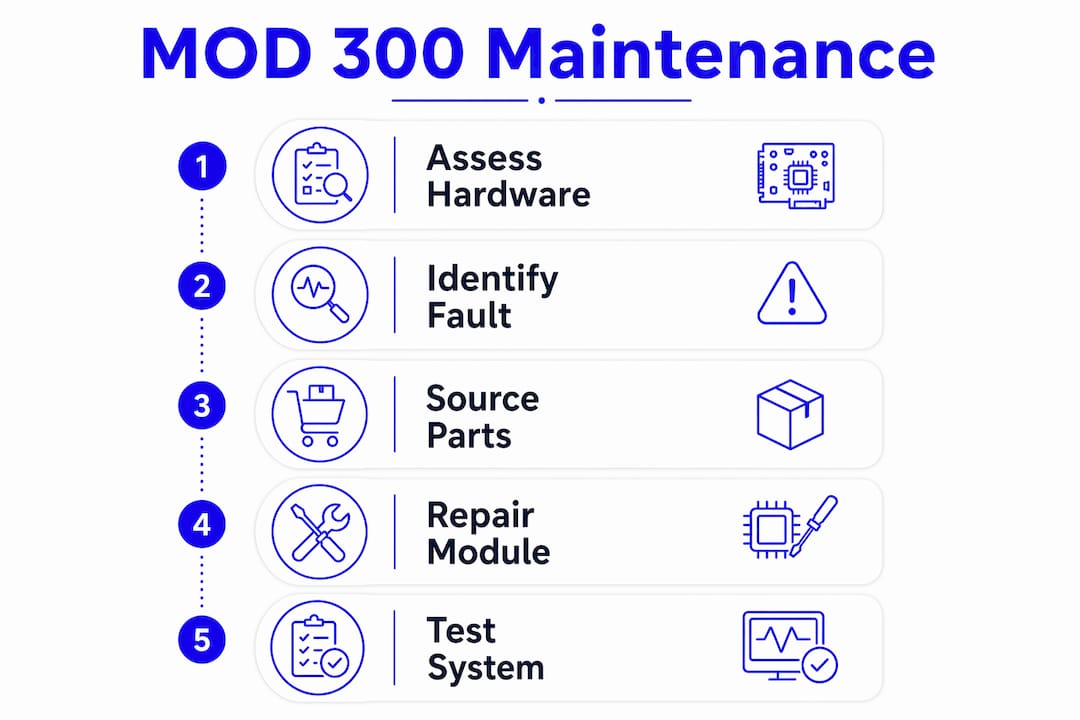
The most practical response is a structured spare parts strategy. Surplus and secondary market parts are the primary source for MOD 300 components today. Specific assemblies such as the Electronic Assembly 6248BP10822 and the Terminal Assembly 6241BP10832 remain available through specialized industrial parts suppliers, which means you do not have to accept a full system replacement just because one module fails.
Effective maintenance for a MOD 300 installation typically includes:
- Scheduled module testing: Pull and bench-test critical electronic assemblies on a defined cycle, not just when failures occur.
- Spare inventory management: Maintain at least one spare for every module type that has no available substitute. Prioritize high-failure-rate components like power supplies and communication cards.
- Documentation audits: Verify that CCF, TCL, and TLL program backups are current and stored off-system. Many plants discover their only backup is on a floppy disk or a server that no longer exists.
- Technician cross-training: Pair experienced MOD 300 engineers with younger technicians before institutional knowledge walks out the door.
Pro Tip: Build a criticality map of your MOD 300 hardware before sourcing spares. Rank each module by replacement lead time and process impact. Source spares for the highest-risk items first, not the cheapest ones.
A structured PLC maintenance schedule adapted for DCS environments applies directly here. Preventive maintenance intervals for MOD 300 should account for the age of capacitors in power supply modules, which degrade on a timeline regardless of run hours.
What options exist for integrating the Taylor Mod 300 with modern automation platforms?
Full DCS replacement is expensive, time-consuming, and carries significant process risk. Most plants running MOD 300 choose a hybrid path instead. Wrapping legacy MOD 300 systems with modern interface layers is the standard approach recommended by integration specialists.
The wrapping strategy works by adding a middleware or gateway layer that translates MOD 300 proprietary communication protocols into formats readable by modern systems. This lets you connect the MOD 300 to Safety Instrumented Systems (SIS), Plant Historians, and Manufacturing Execution Systems (MES) without rewriting control logic or replacing field hardware.
Common integration targets include:
- Plant Historian platforms: Connecting MOD 300 process data to a historian enables trend analysis, regulatory reporting, and predictive maintenance without touching the control layer.
- Safety Instrumented Systems (SIS): Modern SIS platforms require data exchange with the DCS for alarm management and safety function validation. A gateway layer handles this without compromising SIS independence.
- MES and ERP systems: Production data from MOD 300 loops can feed scheduling and quality systems through OPC-DA or OPC-UA translation layers.
The key risk in integration is bottlenecks between MOD 300 and modern systems caused by protocol mismatches and scan rate differences. A MOD 300 controller scanning at one rate and a historian polling at another rate can produce data gaps that corrupt trend records. Verify scan rate alignment during any integration project.
Partial hardware upgrades are also viable. Replacing aging operator workstations with modern HMI platforms while keeping the MOD 300 control layer intact is a common first step. This improves operator visibility without touching proven control logic.
What are best practices when migrating from the Taylor Mod 300 to a new control system?
Migration from a legacy DCS is a multi-year project when done correctly. Phased migration approaches minimize operational downtime and reduce risk compared to a single cutover event. The phased method replaces one process unit or control loop group at a time, validating each section before moving to the next.
A structured migration follows this sequence:
- System assessment: Document every control loop, I/O point, interlock, and alarm in the existing MOD 300 system. Gaps in this documentation are the leading cause of migration failures.
- Target platform selection: Choose the replacement DCS based on process requirements, vendor support life, and your team’s existing skills. Avoid selecting a platform your integrator knows but your maintenance team does not.
- Parallel operation planning: Design a period where the old MOD 300 and the new system run simultaneously on the same process unit. This dual-running phase catches logic translation errors before they affect production.
- Phased cutover: Transfer control loop by loop or unit by unit. Never cut over an entire plant section in a single maintenance window.
- Validation and documentation: Verify each transferred loop against the original MOD 300 performance baseline. Update all documentation to reflect the new system before decommissioning MOD 300 hardware.
Pro Tip: Hire an automation consultant who has completed at least two MOD 300 migrations, not just general DCS migrations. The CCF-to-modern-function-block translation has specific pitfalls that only show up in practice, particularly around cascade control and feedforward configurations.
Common migration pitfalls include underestimating the time needed for I/O mapping verification, skipping the parallel operation phase to save cost, and failing to retrain operators on the new HMI before cutover. Each of these shortcuts has caused unplanned shutdowns on real projects.
Key takeaways
The Taylor Mod 300 remains maintainable and integrable through structured spare parts sourcing, middleware-based integration, and phased migration planning.
| Point | Details |
|---|---|
| Three control languages | CCF, TCL, and TLL each serve distinct control functions within one DCS platform. |
| Surplus parts extend system life | Electronic and terminal assemblies remain available through specialized industrial suppliers. |
| Wrapping beats full replacement | Adding middleware layers connects MOD 300 to modern SIS and historian systems without process risk. |
| Phased migration reduces downtime | Replacing loop groups one at a time with a parallel operation phase prevents unplanned shutdowns. |
| Documentation is the foundation | Accurate I/O and loop documentation is the single most critical input for any migration or integration project. |
What I’ve learned from years of legacy DCS work
The plants that struggle most with MOD 300 maintenance are not the ones with the oldest hardware. They are the ones that deferred documentation updates for a decade and now cannot tell you what half their I/O points actually do. Hardware is replaceable. Institutional knowledge encoded in undocumented CCF configurations is not.
My honest view on the upgrade-versus-maintain debate: most plants pull the trigger on full migration too early and for the wrong reasons. A MOD 300 system with good spare inventory, current documentation, and a trained technician on staff can run reliably for years. The business case for full replacement only becomes clear when integration costs with modern SIS and historian platforms exceed the cost of the migration itself.
Sourcing parts through a specialist like Industrialpartsusa changes the calculus significantly. When you can get a tested electronic assembly shipped same-day rather than waiting months for an OEM quote on a discontinued part, the maintenance-versus-replace decision shifts back toward maintenance. That matters when your process cannot afford a planned outage for a full DCS cutover.
The integration path is where I see the most creative engineering. Wrapping a MOD 300 with a modern OPC-UA gateway and connecting it to a cloud historian is not a compromise. It is a legitimate architecture that gives you modern data visibility without touching proven control logic. Plants that take this approach often delay full migration by five or more years while still meeting regulatory and reporting requirements.
— Monica
Taylor Mod 300 parts and support at Industrialpartsusa
Industrialpartsusa stocks tested surplus MOD 300 components including electronic assemblies and terminal assemblies, available for same-day shipping to facilities worldwide.
Whether you need a single replacement module to keep your system running or want to discuss a phased migration strategy, Industrialpartsusa provides the parts and repair services to support both paths. The team at Industrialpartsusa works with maintenance professionals across manufacturing and process industries, supplying hard-to-find automation parts backed by a one-year warranty. For repair services on failed MOD 300 assemblies, the industrial repair services team handles testing, cleaning, and refurbishment in-house.
FAQ
What is the Taylor Mod 300 used for?
The Taylor Mod 300 is a distributed control system designed for continuous and batch process control in industries such as refining, chemicals, and power generation. It uses three programming languages, CCF, TCL, and TLL, to handle a wide range of control functions within one platform.
Are Taylor Mod 300 spare parts still available?
Specific MOD 300 components including electronic assemblies and terminal assemblies are available through specialized industrial surplus suppliers. ABB no longer actively supports the platform, so the secondary market is the primary source for replacement parts.
Can the Taylor Mod 300 connect to modern SIS or historian systems?
The MOD 300 can connect to modern Safety Instrumented Systems and Plant Historians through middleware or gateway layers that translate its proprietary protocols. This wrapping approach avoids full DCS replacement while enabling data exchange with current automation platforms.
How long does a Taylor Mod 300 migration take?
A phased migration from MOD 300 to a modern DCS typically spans multiple years depending on plant size and process complexity. A stepwise approach replacing one unit or loop group at a time with a parallel operation phase is the standard method for minimizing downtime.
What is the biggest risk in a Taylor Mod 300 migration?
Incomplete documentation of existing control loops and I/O points is the leading cause of migration failures. Skipping the parallel operation phase to reduce project cost is the second most common source of unplanned shutdowns during cutover.