
The Role of Motion Controllers in Retrofit Projects
Motion controllers in retrofit projects are dedicated hardware devices that execute high-speed closed-loop control of motion-critical axes, separate from the supervisory logic handled by a PLC. The role of motion controllers in retrofit is not cosmetic. It is architectural. When you add a Beckhoff EtherCAT controller or a Bosch-Rexroth DPC/DPQ card to a legacy machine, you are inserting a real-time control layer that a standard PLC scan cycle cannot replicate. Investment cost and production downtime remain the two decisive factors in retrofit strategy, which is exactly why getting the motion controller architecture right from the start matters more than any other single decision.
How do motion controllers differ from PLCs in retrofit architecture?
A PLC manages supervisory tasks: temperature regulation, HMI communication, safety interlocks, and process sequencing. A motion controller manages axes. That distinction sounds simple, but the engineering consequence is significant. PLCs are insufficient for loops requiring sub-10ms response times because their scan cycles introduce timing variability that destroys position and velocity accuracy in high-speed applications.
The Bosch-Rexroth injection molding machine retrofit is the clearest real-world illustration of this separation. In that architecture, DPC/DPQ cards own the injection and clamp axis loops entirely, while the PLC handles temperature zones, operator interface, and safety relay logic. Neither system steps on the other. The result is deterministic servo performance on the motion side and flexible supervisory logic on the PLC side, without either compromising the other.
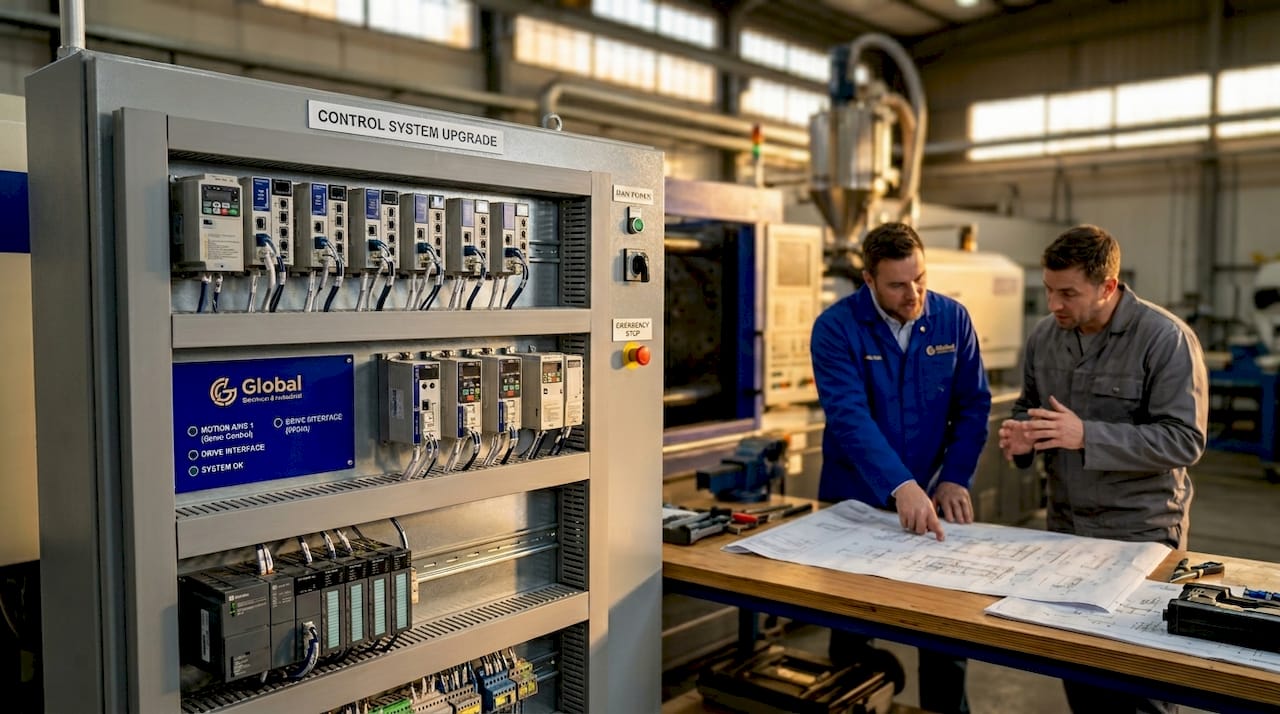
Allen-Bradley ControlLogix with SERCOS integration follows the same principle. The 1756-MxxSE modules handle axis coordination at the fieldbus level, while the ControlLogix processor manages program flow and I/O. This architecture is why SERCOS motion axis integration requires RSLogix Studio 5000 v20 or later, specific firmware alignment, and verified module status before any production run. The motion layer and the supervisory layer each have their own commissioning requirements.
For engineers evaluating motion control fundamentals before specifying retrofit hardware, understanding this architectural split is the prerequisite for every subsequent decision.
- Supervisory PLC tasks: temperature control, HMI updates, safety interlocks, process sequencing
- Dedicated motion controller tasks: position loops, velocity loops, torque control, multi-axis synchronization
- Why separation matters: PLC scan jitter exceeds tolerance thresholds for axes requiring sub-10ms closed-loop response
- Common retrofit pairings: ControlLogix + 1756-MxxSE SERCOS modules, GE Series 90-30 + IC693DSM314 motion module, Beckhoff CX series + EtherCAT drives
Pro Tip: Never assume a PLC upgrade alone will fix motion performance issues. If your legacy machine has axis positioning errors or velocity instability, the problem is almost always in the control loop architecture, not the processor speed.
What are best practices for integrating motion controllers in legacy system retrofits?
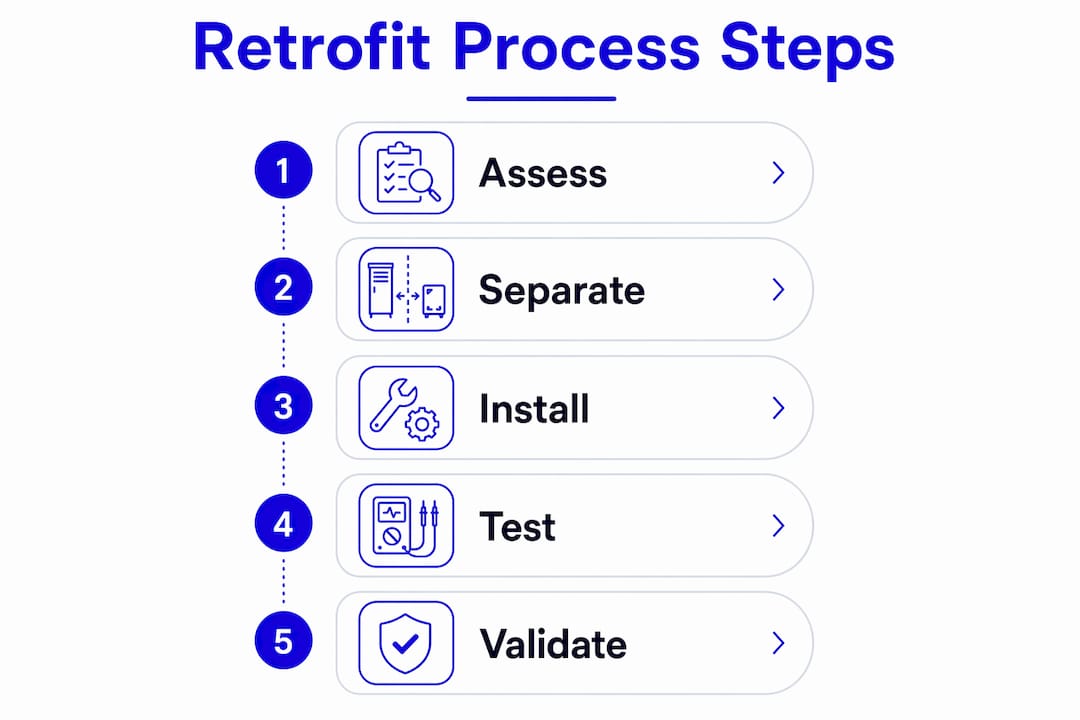
Successful motion controller integration follows a defined sequence. Skipping steps in that sequence is the primary cause of commissioning failures, configuration loss, and unplanned downtime. The following workflow applies whether you are adding SERCOS axes to a ControlLogix system or replacing a custom motion board with a LinuxCNC and MESA 7i77 combination.
- Audit the existing system. Document every axis, encoder type, drive interface, and fieldbus protocol currently in use. Identify firmware versions on all existing modules. This baseline prevents surprises during hardware swap.
- Select the communication protocol. EtherCAT, SERCOS, and ProfiNet RT all provide deterministic communication, but they are not interchangeable. EtherCAT offers sub-100 microsecond cycle times. SERCOS is deeply integrated into Rockwell’s motion ecosystem. ProfiNet RT suits Siemens-centric architectures. Choose based on your existing infrastructure, not vendor preference.
- Prepare the project file correctly. Offline project mismatches cause configuration loss in live systems. Use the Data Preserve Download Tool and merge offline modifications against the live .ACD file before downloading. This step alone prevents the most common retrofit commissioning failure.
- Add and configure motion hardware. Install the motion modules, assign axis tags, configure drive parameters, and verify module status indicators before enabling any motion. In ControlLogix, check network statistics for SERCOS errors after initial power-up.
- Run shadow mode parallel testing. Operate the new motion controller in parallel with the legacy system before cutover. Compare output behavior under identical load conditions. This is the only reliable way to confirm the new system matches legacy timing before you remove the old hardware.
- Commission servo loops. Tune PID gains, verify encoder scaling, test E-stop chain hardware wiring, and confirm safety I/O interactions. The commissioning phase is the most failure-prone stage of any retrofit, and thorough testing of jitter, latency, and encoder feedback is non-negotiable.
- Run soak tests. A 48 to 72 hour continuous run under production load conditions is the minimum acceptance threshold before declaring the retrofit complete.
Pro Tip: Always keep a rollback plan active until soak testing is complete. That means preserving the original project file, documenting all original drive parameters, and keeping legacy hardware on-site until the new system has run through at least one full production shift without faults.
How do motion controllers help maintain takt time during retrofit?
Takt time is the maximum allowable cycle time per unit to meet production demand. In high-throughput lines, takt time tolerances can be as tight as a few milliseconds. Replacing a legacy custom motion board with a commercial motherboard or a new controller platform introduces latency and jitter risks that directly threaten those tolerances.
The core challenge is that commercial hardware does not inherently provide deterministic control. A standard x86 motherboard running Windows will introduce interrupt latency that makes servo loop timing unpredictable. Replacing legacy motion boards requires keeping control loops deterministic through FPGA-based motion cards, a real-time operating system, or dedicated PCIe I/O. This is not optional. It is the technical requirement that separates a successful retrofit from a production disaster.
The preferred architecture for complex retrofits is a hybrid approach: a commercial motherboard handles orchestration and high-level program logic, while dedicated hardware such as an FPGA or motion card owns the servo loops. For loop frequencies above 1 kHz, the servo loop must run in hardware. Slower loops can run under RT-Linux with careful CPU and interrupt management, but only after measured validation confirms the latency budget is met.
| Approach | Determinism level | Best use case |
|---|---|---|
| FPGA motion card | Highest (sub-microsecond) | High-speed servo loops above 1 kHz |
| RT-Linux with PCIe I/O | High (microsecond range) | Mid-speed axes, coordinated motion |
| Standard PLC scan | Low (millisecond range) | Supervisory tasks only |
| Commercial OS (Windows) | Unpredictable | Not suitable for closed-loop motion |
- Measure baseline jitter on the legacy system before replacement. You cannot hit a target you have not measured.
- Define acceptance criteria before cutover: maximum missed cycles, maximum overshoot percentage, and maximum latency deviation from the legacy baseline.
- Run stress tests that simulate peak production load, not just nominal conditions.
- Maintain a documented rollback plan with a defined trigger threshold for reverting to legacy hardware.
Pro Tip: Shadow mode testing is not just a safety check. It generates the timing data you need to prove the new system meets takt time requirements to plant management and quality teams. Document every test run.
What are practical outcomes of motion controller retrofits in industry?
The Bridgeport BOSS 8 CNC retrofit using LinuxCNC and MESA 7i77 hardware is one of the most thoroughly documented examples of retrofit motion control technology in practice. The project replaced the original proprietary control with an open architecture, integrating motion planning, PID-tuned servo loops, VFD speed control, and a hardwired E-stop chain. Commissioning included encoder scaling verification, relay output testing, and full safety interlock validation before the machine returned to production. The outcome was a machine with modern motion control capability at a fraction of the cost of a new CNC.
The ABB modernization case demonstrates the business case at scale. ABB drive retrofits improve performance by 30% over a 72-hour installation window with minimal production disruption. That figure matters because it quantifies what engineers already know qualitatively: a targeted motion controller upgrade delivers measurable throughput and precision gains without the capital expenditure and lead time of full equipment replacement.
| Retrofit example | Hardware used | Key outcome |
|---|---|---|
| Bridgeport BOSS 8 CNC | LinuxCNC + MESA 7i77 | Modern motion control at low capital cost |
| ABB drive modernization | ACS880 drives | 30% performance improvement in 72 hours |
| Bosch-Rexroth IMM | DPC/DPQ cards + PLC | Deterministic axis control with supervisory separation |
| ControlLogix SERCOS expansion | 1756-MxxSE modules | Added motion axes without production disruption |
Beyond performance numbers, retrofit motion control technology delivers three structural benefits. First, it extends equipment lifecycle by replacing the control layer without touching the mechanical structure, which is the highest-value component of most legacy machines. Second, it improves precision by replacing analog or early digital control with modern closed-loop feedback architectures. Third, it adds IoT readiness. Modern motion controllers from Beckhoff, Rockwell, and similar vendors expose data over standard protocols, enabling condition monitoring and predictive maintenance without a separate hardware layer. You can review the 2026 automation upgrade checklist for a structured framework on prioritizing which systems to retrofit first.
Key takeaways
Motion controllers in retrofit projects deliver deterministic closed-loop performance that PLCs cannot provide, and the architecture separating these two functions is the single most critical design decision in any legacy system modernization.
| Point | Details |
|---|---|
| Architectural separation is mandatory | PLCs handle supervisory tasks; dedicated motion controllers own axis loops requiring sub-10ms response. |
| Protocol selection determines performance | EtherCAT, SERCOS, and ProfiNet RT each suit different existing infrastructure; choose based on your system, not vendor preference. |
| Shadow mode testing prevents cutover failures | Parallel testing under production load is the only reliable method to confirm timing parity before removing legacy hardware. |
| Commissioning is the highest-risk phase | Encoder scaling, PID tuning, and safety I/O verification must all pass before any production run. |
| Retrofit delivers measurable ROI | ABB drive retrofits demonstrate 30% performance gains in 72 hours, with far lower capital cost than full replacement. |
What I’ve learned after years of watching retrofit projects succeed and fail
The engineers who succeed at motion controller retrofits share one habit: they validate timing before they celebrate installation. The ones who struggle treat the physical hardware swap as the finish line. It is not. The finish line is a 72-hour soak test with zero missed cycles and overshoot within spec.
I have seen projects where the motion hardware was installed correctly, the wiring was clean, and the drive parameters were set precisely, but the system still failed in production because nobody measured baseline jitter on the legacy system before replacement. Without that baseline, you have no acceptance criteria. You are guessing.
The other pattern I keep seeing is over-reliance on software safety. Hardware safety interlocks must be hardwired. A motion controller that relies on software to execute an E-stop is not a safe machine. The Bridgeport BOSS 8 retrofit guide is explicit about this: the E-stop chain is hardwired, full stop. That principle applies to every retrofit regardless of platform.
My honest recommendation for any team planning a motion controller retrofit: run a staged rollout. Pilot one machine, run it through full soak testing, document every timing measurement, and use that data to refine the process before scaling. The teams that skip the pilot to save time almost always spend more time recovering from a failed production cutover than the pilot would have taken.
— Monica
Source your motion control components for retrofit projects
Finding the right motion controller hardware for a retrofit is often the longest lead-time item in the project. Industrialpartsusa stocks new, surplus, and remanufactured motion controllers, drives, I/O modules, and PLC components from GE Fanuc, Allen-Bradley, ABB, Beckhoff, and more, with same-day shipping on in-stock items. For legacy or discontinued hardware that OEMs no longer supply, Industrialpartsusa also provides in-house repair and testing services backed by a one-year warranty. Whether you need a GE Series 90-30 motion module for an existing retrofit or a full set of automation components for a new project, visit Industrialpartsusa to check current inventory and get your project moving.
FAQ
What is the role of motion controllers in retrofit projects?
Motion controllers in retrofit projects provide dedicated high-speed closed-loop control of motion axes, separate from PLC supervisory logic. This separation delivers the sub-10ms response times that position and velocity loops require, which a standard PLC scan cycle cannot reliably achieve.
How do motion controllers work in a retrofit architecture?
A motion controller executes real-time feedback loops for servo drives using deterministic communication protocols such as EtherCAT or SERCOS, while the PLC handles temperature, HMI, and safety interlock tasks. The two systems communicate setpoints and status without sharing the same execution cycle.
What communication protocols are used in retrofit motion control?
EtherCAT, SERCOS, and ProfiNet RT are the three primary deterministic protocols used in retrofit motion control systems. EtherCAT offers the tightest cycle times, SERCOS integrates natively with Rockwell ControlLogix, and ProfiNet RT suits Siemens-based architectures.
How do you prevent configuration loss when adding motion axes to an existing system?
Use the Data Preserve Download Tool and merge offline project modifications against the live controller file before downloading. Offline project mismatches are the leading cause of configuration loss during motion axis integration in ControlLogix systems.
What testing is required before a motion controller retrofit goes live?
Shadow mode parallel testing, servo loop commissioning including PID tuning and encoder verification, and a 48 to 72 hour soak test under production load are all required before cutover. Acceptance criteria must include maximum missed cycles, overshoot limits, and latency deviation thresholds measured against the legacy system baseline.