
Types of Industrial Repair Services: 2026 Guide for Managers
Industrial repair services are defined as specialized maintenance and corrective interventions applied to manufacturing machinery, automation systems, and heavy equipment to restore full operational function. The industry, classified under NAICS 81131, covers everything from motor repair and blade sharpening to refrigeration and control system restoration. For maintenance and facilities managers, understanding the distinct types of industrial repair services is the difference between a planned response and a costly, unplanned shutdown. This guide breaks down every major repair category, compares delivery modes, and gives you a practical framework for matching the right service to the right failure.
1. What are the main types of industrial repair services?
Industrial repair services segment into three core subsystem categories: mechanical, electrical, and hydraulic. Each targets a distinct failure domain within manufacturing equipment, and misidentifying the category at the point of failure is one of the fastest ways to waste both time and budget.
Mechanical repair covers engine rebuilds, pump reconditioning, gearbox overhauls, belt and chain drive restoration, and structural component replacement. These services address wear, fatigue, and physical damage in rotating or reciprocating machinery. A centrifugal pump losing efficiency due to impeller wear is a mechanical repair job, not an electrical one.
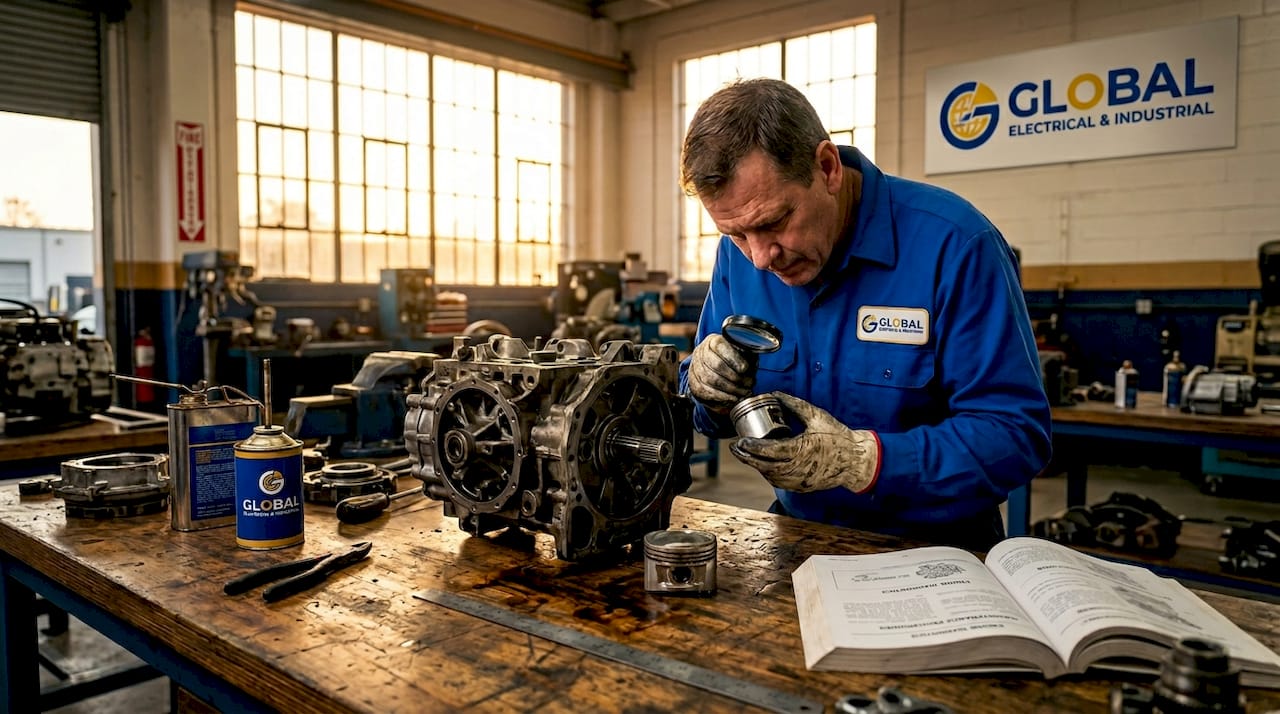
Electrical repair addresses circuit faults, wiring failures, control panel restoration, motor rewinding, and automation component replacement. This category includes PLC module repair, variable frequency drive (VFD) troubleshooting, and HMI screen restoration. Allen-Bradley and GE Fanuc control systems are common targets in this category on the plant floor.
Hydraulic repair focuses on pumps, cylinders, valves, and hydraulic control systems. Seal replacement, cylinder honing, and pump pressure testing fall here. Hydraulic failures are particularly dangerous because they often manifest as slow degradation rather than sudden stops, making them easy to misattribute to mechanical causes.
Pro Tip: Before calling a repair vendor, document which subsystem is failing. Mechanical, electrical, and hydraulic faults require different technician certifications and toolsets. Sending the wrong crew costs you a full day.
2. How maintenance strategies shape your repair service choices
Maintenance strategies fall into four recognized types: reactive, preventive, predictive, and reliability-centered maintenance (RCM). Each strategy generates a different demand profile for repair services, and understanding this connection is what separates reactive fire-fighting from planned operational control.
-
Reactive maintenance triggers repair after a failure has already occurred. It requires vendors with 24/7 emergency availability and fast diagnostic turnaround. This is the most expensive repair mode per incident, but it remains appropriate for non-critical, easily replaceable assets.
-
Preventive maintenance (PM) schedules repair and service at fixed time intervals regardless of equipment condition. PM differs from predictive maintenance in that it does not require condition-monitoring infrastructure. It suits assets where failure consequences are severe but failure modes are well understood and time-dependent.
-
Predictive maintenance (PdM) uses condition-monitoring data such as vibration analysis, thermal imaging, and oil sampling to trigger repairs only when degradation thresholds are crossed. PdM demands more upfront investment in sensors and data interpretation but reduces unnecessary repair interventions significantly.
-
Reliability-centered maintenance (RCM) is a structured decision framework based on SAE JA1011 that analyzes asset functions, failure modes, and consequence categories to select the optimal maintenance or repair task for each failure scenario. RCM does not default to any single strategy. It assigns the right strategy to the right failure mode.
“Maintenance is primarily proactive; repair is reactive. Organizations that blur this distinction end up escalating repair demand rather than reducing it.” — Tractian Maintenance Glossary
The practical implication for you as a facilities manager: your repair vendor selection should follow your maintenance strategy, not precede it. A PdM program demands vendors with fast diagnostic capability. An RCM program demands vendors with OEM documentation access and failure mode expertise.
3. Specialized repair services for bearings and industrial drives
Specialized repair services target high-value, high-criticality components where standard mechanical or electrical repair protocols are insufficient. Two categories dominate this space: bearing repair and industrial drive repair.
Bearing repair involves inspection, cleaning, dimensional measurement, reconditioning to original specifications, and documented quality assurance. Timken’s industrial bearing repair process demonstrates that proprietary reconditioning methods can extend bearing service life up to four times compared to standard replacement cycles. That figure matters because bearings are among the most frequently replaced components in rotating equipment, and premature replacement is a significant hidden cost.
| Component | Repair Scope | Key Quality Indicator |
|---|---|---|
| Rolling element bearings | Inspection, cleaning, reconditioning | Dimensional compliance to OEM spec |
| Industrial drives (VFDs) | Fault diagnostics, board repair, firmware restore | Functional load test post-repair |
| PLCs and control modules | Component-level repair, I/O testing | Full functional verification cycle |
| Servo motors | Winding resistance check, encoder calibration | Torque and speed accuracy test |
Industrial drive repair covers variable frequency drives, servo amplifiers, motion controllers, and PLC modules. These repairs require technicians who can perform board-level diagnostics, not just swap modules. GE Fanuc Series 90-30 and RX3i systems, for example, require access to proprietary firmware and I/O configuration data to repair correctly. A vendor without that documentation will replace parts rather than fix root causes.
Pro Tip: Ask any bearing or drive repair vendor for their documented quality assurance procedure before committing. If they cannot produce a written inspection and test protocol, their repair is a guess, not a service.
4. On-site versus shop-based repair: which one fits your situation?
Repair services are delivered in two primary modes: on-site field service and shop-based refurbishment. Each has a distinct cost and capability profile, and choosing the wrong mode for the situation adds unnecessary downtime.
On-site repair advantages:
- Immediate response with no equipment transport delay
- 24/7 emergency availability for critical production assets
- Technician can assess the full installation context, not just the component
- Suitable for large, fixed equipment that cannot be easily removed
Shop repair advantages:
- Access to specialized tooling, test benches, and controlled environments
- Comprehensive refurbishment including cleaning, painting, and full functional testing
- Better documentation and traceability for warranty and compliance purposes
- Lower labor cost per hour for complex, multi-day repair jobs
| Criteria | On-site repair | Shop repair |
|---|---|---|
| Response speed | Immediate | 1 to 5 business days |
| Equipment size | Large or fixed assets | Portable or removable components |
| Repair depth | Corrective, targeted | Comprehensive refurbishment |
| Cost per incident | Higher (travel + labor) | Lower for complex jobs |
| Best use case | Emergency, critical uptime | Planned overhaul, specialized work |
The decision rule is straightforward. If the asset is critical to production and cannot be taken offline for transport, on-site repair is the correct choice regardless of cost. If the asset can be isolated and the failure is not an emergency, shop repair delivers better quality at lower total cost. Many top industrial repair service providers now offer both modes under a single service agreement, which simplifies vendor management considerably.
5. How to select the right repair service types for your operation
Selecting repair service types is not a procurement decision. It is an engineering decision that procurement executes. The starting point is asset criticality: which equipment failures directly stop production, and which ones reduce efficiency without stopping it?
Effective repair vendors differentiate through rapid diagnostics, access to OEM documentation, and expedited service workflows. These three capabilities directly reduce time-to-solution and repair accuracy. When evaluating vendors, ask specifically whether they hold OEM manuals for your equipment, what their average diagnostic turnaround is, and whether they can provide a functional test report after every repair.
For facilities managers running legacy automation equipment, the vendor’s parts inventory is equally critical. A repair vendor who cannot source a GE Fanuc IC693 series module or an Allen-Bradley SLC 500 component will extend your downtime by days or weeks waiting on OEM lead times. Industrialpartsusa stocks surplus and remanufactured automation components, including hard-to-find PLC modules, specifically to close that gap.
Pro Tip: Build a tiered vendor list: one vendor for emergency on-site response, one for planned shop repair, and one for parts sourcing on legacy systems. Relying on a single vendor for all three creates a single point of failure in your maintenance supply chain.
Align your repair service categories with your RCM analysis outputs. If RCM identifies a bearing failure mode as run-to-failure acceptable, reactive repair with a fast-response vendor is correct. If it identifies a VFD failure as production-critical, predictive monitoring paired with a drive repair specialist is the right pairing. The RCM methodology exists precisely to make these decisions systematic rather than intuitive.
Key takeaways
Effective industrial repair service selection requires matching repair category, delivery mode, and vendor capability to each asset’s criticality and failure mode.
| Point | Details |
|---|---|
| Three core repair categories | Mechanical, electrical, and hydraulic repairs each target distinct failure domains and require different vendor expertise. |
| Maintenance strategy drives repair selection | RCM, PdM, PM, and reactive strategies each generate different repair service requirements and vendor profiles. |
| Specialized repairs extend component life | Bearing reconditioning and drive-level diagnostics deliver significantly better outcomes than standard replacement when done correctly. |
| On-site vs. shop repair is a criticality decision | Use on-site repair for critical fixed assets and shop repair for planned, comprehensive refurbishment work. |
| Vendor capability is a technical requirement | OEM documentation access, diagnostic speed, and parts inventory determine whether a vendor reduces or extends your downtime. |
Why most facilities managers get repair service selection wrong
I have reviewed maintenance programs at dozens of manufacturing sites, and the single most common mistake is treating repair service selection as a purchasing category rather than an engineering output. Managers call a vendor, describe a symptom, and accept whatever service is offered. That approach works until it doesn’t, and when it fails, it fails expensively.
The second mistake is conflating maintenance strategy with repair service type. Maintenance is proactive; repair is reactive. When you blur that line, you end up buying reactive repair services for assets that should be on a predictive monitoring program. The repair bills keep coming because the root cause is never addressed.
RCM is the right framework, but it is also the most misapplied one. Skipping the seven-question logic in SAE JA1011 does not save time. It produces repair recommendations that repeat the same failure cycle. I have seen plants run the same bearing replacement on the same pump every 90 days for three years because nobody asked why the bearing was failing in the first place.
The vendors who actually reduce your downtime are the ones who bring diagnostic data to the conversation, not just a toolbox. If your current repair provider cannot tell you the root cause of a failure within the first hour on-site, you are paying for labor, not expertise. Condition monitoring tools and OEM documentation access are not nice-to-haves. They are the baseline for any vendor worth a long-term relationship.
— Monica
Find the right parts and repair support at Industrialpartsusa
Industrialpartsusa specializes in exactly the repair and parts sourcing scenarios that standard distributors cannot handle. Whether you need a remanufactured GE Fanuc RX3i module, a surplus Allen-Bradley PLC, or a hard-to-find VFD for a legacy production line, the inventory is stocked and ready for same-day shipping. The team also provides in-house repair services with full functional testing, so you get a verified component, not a gamble. For maintenance managers who cannot afford OEM lead times on critical automation equipment, Industrialpartsusa is the practical alternative. Contact the team directly for tailored repair service support and parts sourcing on legacy and obsolete industrial systems worldwide.
FAQ
What is an industrial repair service?
An industrial repair service is a corrective intervention that restores manufacturing equipment, machinery, or automation systems to full operational function. Services are categorized by subsystem: mechanical, electrical, and hydraulic, as defined under NAICS 81131.
What are the main types of industrial repair services?
The main types are mechanical repair, electrical repair, hydraulic repair, and specialized component repair covering bearings, drives, PLCs, and servo systems. Delivery modes include on-site field service and shop-based refurbishment.
How does preventive maintenance differ from predictive maintenance?
Preventive maintenance runs on fixed time intervals regardless of equipment condition, while predictive maintenance is triggered by condition-monitoring data such as vibration or thermal readings. PdM reduces unnecessary repair interventions but requires sensor infrastructure.
When should I use on-site repair versus shop repair?
Use on-site repair for critical, fixed assets where transport is impractical or downtime is immediate. Shop repair is better for planned overhauls and complex refurbishment where specialized tooling and controlled environments improve repair quality.
How do I evaluate industrial repair service providers?
Prioritize vendors who offer rapid diagnostics, documented OEM access, functional test reports after every repair, and in-house parts inventory for legacy systems. These four capabilities directly determine how fast your equipment returns to production.
Recommended
- Repair Services – Global Electrical and Industrial
- Aging Automation System Audit Checklist for Plant Engineers – Global Electrical and Industrial
- The Role of Sensors in Automation: Engineer’s Guide – Global Electrical and Industrial
- Top 4 theplcdepot.com Alternatives for Obsolete Parts 2026 – Global Electrical and Industrial