
The Role of Sensors in Automation: Engineer’s Guide
Sensors have always been in automation systems, but calling them “data collectors” misses the point entirely. The role of sensors in automation has shifted from passive input devices to intelligent components that interpret their environment, trigger corrective actions, and feed machine learning models in real time. If you still think of a temperature sensor as just a thermocouple feeding a PLC input card, you’re already behind the curve. This guide breaks down the full picture: what modern sensors actually do, how they integrate with AI and edge computing, where they fit into safety systems, and what the market trajectory tells you about where to invest your attention next.
Table of Contents
- Key takeaways
- The role of sensors in automation systems
- Intelligent sensors and edge AI integration
- Sensors in safety and operational efficiency
- Emerging trends and market outlook
- Implementing sensors for peak system performance
- My take on where sensor intelligence is actually heading
- How Industrialpartsusa supports your sensor and automation needs
- FAQ
Key takeaways
| Point | Details |
|---|---|
| Sensors are active system components | Modern sensors embed diagnostics and processing, not just raw signal output to a controller. |
| Sensor-AI integration enables prediction | Pairing sensors with edge AI allows systems to detect faults before they cause failures. |
| Safety sensing protects uptime too | Light curtains and warning zones reduce incidents without triggering unnecessary machine shutdowns. |
| Market growth signals investment priority | The global shutter sensor market alone is projected to reach USD 6.8 billion by 2035. |
| Integration complexity is the real challenge | Protocol compatibility and sensor placement decisions determine whether your system performs or fails. |
The role of sensors in automation systems
At their most fundamental level, sensors perform three functions: detection, measurement, and data conversion. They detect a physical condition, measure its magnitude or state, and convert that measurement into a signal the control system can act on. That signal feeds into a PLC, DCS, or edge controller, which executes logic based on it. Simple in principle. Extraordinarily complex in practice.
The types of sensors you deploy define the quality of your automation logic. The most commonly used sensor categories in industrial automation include:
- Temperature sensors (thermocouples, RTDs): used in process control, HVAC, and furnace management
- Pressure sensors: dominate the IoT sensors market and appear in hydraulics, pneumatics, and fluid systems
- Flow sensors: critical in chemical processing, water treatment, and food manufacturing
- Proximity sensors (inductive, capacitive, ultrasonic): detect object presence without physical contact
- Motion and position sensors (encoders, resolvers): track speed and position in servo and motion control
- Image sensors / machine vision cameras: identify defects, read codes, and verify assemblies
Each sensor type carries trade-offs in terms of accuracy, response time, operating range, and cost. Selecting the wrong type for an application creates problems that no amount of PLC programming can fix.
| Sensor type | Common application | Key advantage | Main limitation |
|---|---|---|---|
| Thermocouple | Furnace temperature control | Wide temperature range | Lower accuracy vs. RTD |
| RTD (PT100) | Precision process temperature | High accuracy | Slower response time |
| Inductive proximity | Metal part detection on conveyors | Fast, contact-free | Metal targets only |
| Ultrasonic | Level sensing in tanks | Works on non-metallic surfaces | Affected by foam/vapor |
| Image sensor | Visual inspection, barcode reading | Multi-parameter detection | Higher cost, complex setup |
| Pressure transducer | Hydraulic system monitoring | Real-time continuous output | Sensitive to vibration |
Pro Tip: When specifying sensors for a new automation cell, always define your required response time before your accuracy requirement. A highly accurate sensor with a 500ms response time is useless in a high-speed packaging line running at 600 parts per minute.
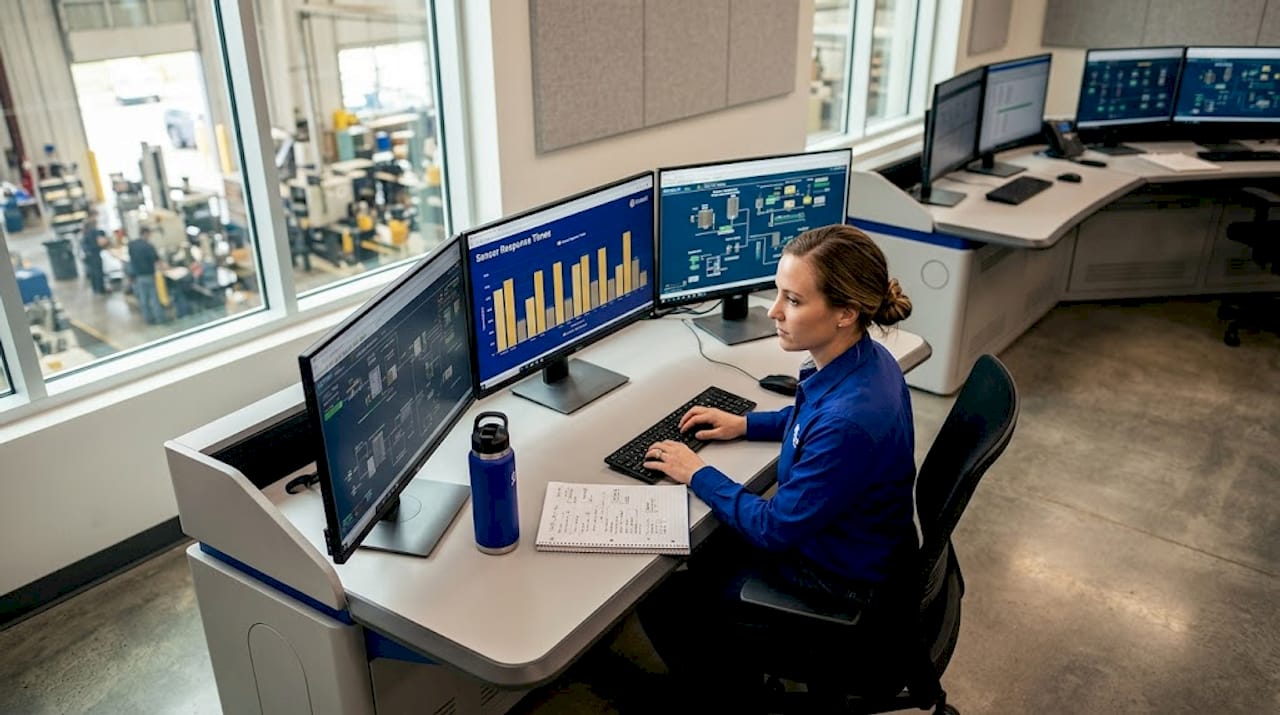
The importance of sensors in automation becomes obvious when you map how sensor data flows into control logic. A single faulty pressure reading from a worn transducer can cause a cascade of bad decisions downstream, including unnecessary e-stops, product rejects, and alarms that mask the real fault. Getting the sensor selection right is not a commissioning detail. It’s a system architecture decision.
Intelligent sensors and edge AI integration
The evolution from passive sensors to intelligent sensing with diagnostics marks the biggest shift in automation sensor technology in the past decade. Modern intelligent sensors embed microprocessors that perform local signal conditioning, self-calibration, and diagnostic checks before passing data to the control system. They don’t just report a value. They report a value and flag whether that value is trustworthy.
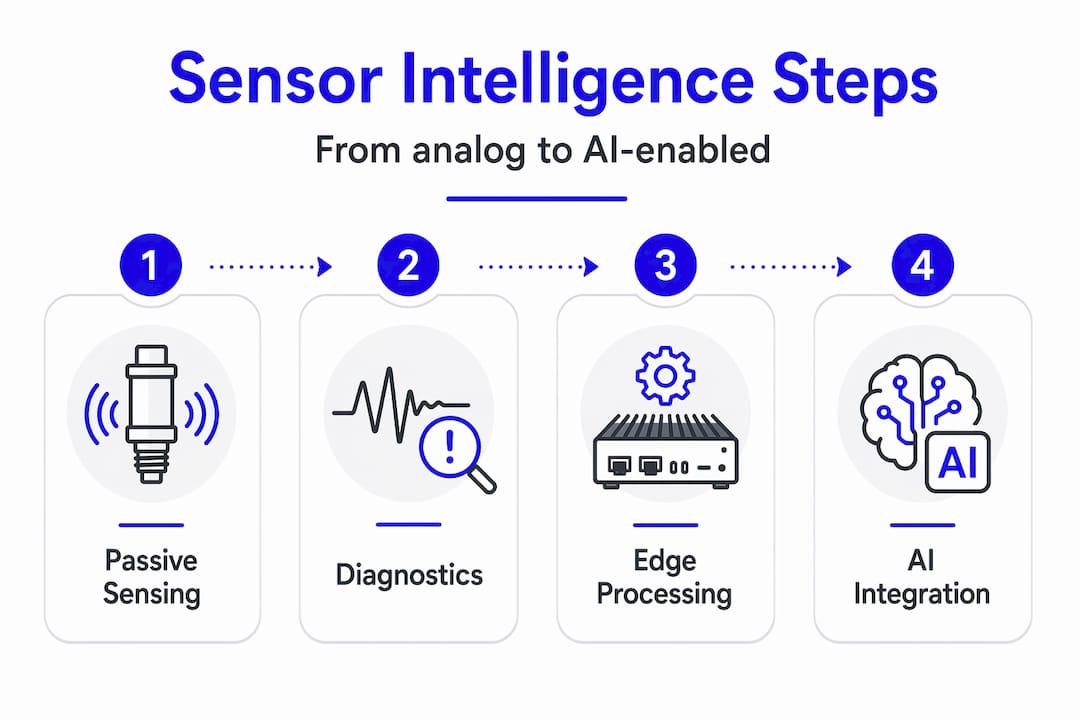
When you pair intelligent sensors with edge AI, the capability expands further. Edge AI processes sensor data locally, at the machine or line level, rather than sending raw streams to a central server or cloud platform. This matters because latency kills real-time control. A vision system identifying a defect must make that call in milliseconds, not after a round-trip to a cloud analytics platform.
The practical benefits of this architecture include:
- Predictive maintenance: Vibration sensors with embedded FFT analysis detect bearing wear weeks before failure
- Adaptive thresholds: AI models adjust sensor alarm limits based on environmental conditions, not fixed setpoints
- Reduced network load: Local processing filters irrelevant data before transmission, protecting bandwidth
- Faster fault isolation: Intelligent sensors narrow down root causes rather than flooding operators with raw data alerts
AI integrated with sensing allows robots to predict sensory input patterns and manage data efficiently without overwhelming processing systems. Tactile and flexible sensors now let robotic grippers handle delicate components by “feeling” grip force in real time, a capability that was purely theoretical fifteen years ago.
Pro Tip: Use sensor fusion when a single sensor type can’t give you the full picture. Combining vibration, temperature, and current draw sensors on a motor gives you a much stronger predictive maintenance signal than any one measurement alone. The redundancy also catches sensor failures that would otherwise go unnoticed.
The applications of sensors in automation at this intelligent level extend beyond manufacturing. Autonomous guided vehicles (AGVs) in warehouses combine LiDAR, ultrasonic, and camera sensors to navigate safely around human workers. Process industries use multi-variable smart transmitters that simultaneously measure pressure, temperature, and flow, then apply compensations on-board. These aren’t future-state concepts. They’re production-ready technology available today.
Sensors in safety and operational efficiency
Safety is where the impact of sensors on automation gets measurable in the most direct terms: injuries prevented, incidents avoided, and production minutes saved. Safety sensing technologies such as light curtains, area scanners, and emergency stop systems form a detection layer that protects workers while keeping machines running as much as possible.
The critical distinction in modern safety sensing is the concept of warning zones versus stop zones. A safety area scanner doesn’t treat every human approach as an emergency stop trigger. It establishes graduated response zones: a worker entering the outer warning zone might slow the machine; only breaking the inner stop zone triggers a full halt. This matters because unnecessary stops erode OEE and train operators to ignore or defeat safety systems over time.
Monitoring machine health through hybrid sensing solutions for accuracy and speed has become standard practice in facilities serious about uptime. Consider what a comprehensive sensor health monitoring approach looks like in practice:
- Vibration sensors on motor housings catch bearing degradation 4 to 6 weeks early
- Thermal imaging sensors on electrical panels detect hot spots before insulation fails
- Current sensors on conveyor drives identify belt tension problems through load pattern changes
- Ultrasonic sensors on pneumatic systems detect air leaks that waste energy and reduce actuator force
For a production line running three shifts, catching one motor failure early through vibration sensing can prevent 8 to 12 hours of unplanned downtime. The math on ROI is straightforward once you know your hourly production loss cost. For a deeper look at how these components fit into a full production line, the automation components guide at Industrialpartsusa covers the integration points in detail.
Pro Tip: Place safety sensors conservatively on first installation, then tighten zone boundaries after observing actual operator workflows. Starting with zones that are too tight creates constant nuisance stops and pressure to defeat the system. Start wider, observe, adjust.
Emerging trends and market outlook
The market data on sensors and automation technologies tells a clear story about where the industry is heading. The global shutter sensor market is projected to grow from USD 3.1 billion in 2025 to USD 6.8 billion by 2035, driven by demand for precision motion detection in industrial automation and machine vision. That’s an 8.2% compound annual growth rate sustained over a decade, which reflects structural adoption rather than a short-term hype cycle.
Wireless connectivity is another trend reshaping automation sensor systems. Improved industrial Ethernet protocols and wireless sensor networks are enabling machine-to-machine communication that supports machine learning applications at scale. IO-Link, in particular, has become the practical standard for connecting intelligent sensors to control systems without custom wiring schemes.
| Technology trend | Impact on automation | Adoption stage |
|---|---|---|
| IO-Link sensor communication | Standardizes data exchange, enables remote parameterization | Mainstream |
| Wireless industrial sensors | Reduces installation cost in retrofit applications | Growing |
| LiDAR for mobile robotics | Enables precise spatial mapping for AGVs and AMRs | Established |
| Tactile/flexible sensors | Allows robotic manipulation of irregular objects | Emerging |
| On-sensor AI inference | Reduces latency, eliminates cloud dependency for decisions | Early adoption |
The precision automation enabled by sensors is increasingly reaching into tight spaces and complex mechanical assemblies that previously required human handling. For automation engineers, tracking these trends isn’t optional. Sensor technology now cycles faster than most PLC platforms, which means your sensing layer may need upgrading before your control hardware does.
Implementing sensors for peak system performance
How sensors improve automation in practice depends less on the sensor itself and more on how it’s integrated. The selection criteria that matter most are: operating environment compatibility (temperature, humidity, vibration, IP rating), output signal type (analog 4-20mA, digital, IO-Link, fieldbus), response time relative to process speed, and long-term drift characteristics.
Here’s a structured approach to sensor implementation that avoids the most common failures:
- Define the measurement requirement precisely. Know whether you need a point measurement or a continuous profile, a presence detection or a dimensional measurement. The requirement drives the sensor category before you look at any product.
- Map the environmental conditions at the mounting location. Vibration near a press is different from vibration near a conveyor motor. Temperature near a furnace door is different from the ambient plant temperature. Spec for actual conditions, not ideal ones.
- Verify protocol compatibility before ordering. A sensor with IO-Link output connected to a controller without an IO-Link master requires an adapter that adds cost, latency, and a failure point. Integration challenges around compatibility are among the most common reasons sensor implementations underperform.
- Plan your maintenance access. A sensor mounted in a location that requires production shutdown to access will never get the maintenance attention it needs. Design mounting positions with calibration and replacement access in mind.
- Establish a sensor health monitoring baseline. Record sensor output characteristics during commissioning. Drift from that baseline is your earliest warning of sensor degradation, before any alarm threshold is reached.
Pro Tip: Don’t specify sensors based purely on catalog accuracy specs. Request actual accuracy data at your operating temperature, not just room temperature specs. Many sensors that claim ±0.1% accuracy at 25°C perform at ±0.5% or worse at 70°C, which is common near motors and drives.
My take on where sensor intelligence is actually heading
I’ve worked with sensor systems across enough legacy installations and greenfield builds to have a clear opinion on where the field is going, and where it’s being oversold.
The move from reactive to proactive sensing is real and it’s genuinely useful. Seeing a vibration sensor catch a failing bearing 30 days before it would have caused a line shutdown is the kind of outcome that justifies the investment immediately. What concerns me is the growing assumption that more sensor data automatically means better automation. I’ve seen facilities drowning in sensor data they have no capacity to analyze, act on, or even store properly. The volume of data is mistaken for intelligence.
The actual lesson I’ve taken from field experience is this: sensor quality and processing logic matter far more than sensor quantity. AI and sensing integration works when the underlying sensors are accurate, well-maintained, and correctly placed. Layering AI on top of a poorly calibrated or incorrectly specified sensor doesn’t fix the problem. It amplifies it.
My advice to automation engineers: get the fundamentals right first. Know your sensor, know its limitations, and know what question you’re actually trying to answer with the data it produces. The engineers who will get the most from the next wave of on-sensor AI inference are the ones who already understand what the sensor is measuring and why.
— Monica
How Industrialpartsusa supports your sensor and automation needs
When a sensor fails on a legacy line, the challenge is rarely understanding what you need. It’s finding it quickly without paying OEM lead times that stretch into weeks.

Industrialpartsusa stocks a broad catalog of automation components including sensors, PLCs, drives, HMIs, and motion controllers, with a strong focus on hard-to-find and legacy parts. Whether you’re sourcing a replacement proximity sensor for a GE Fanuc Genius I/O rack or looking for compatible components for an older Allen-Bradley system, Industrialpartsusa provides tested, warranted parts with same-day shipping on in-stock items. The production line automation components catalog is a practical starting point for identifying compatible sensor and safety device options. For systems that need repair rather than replacement, the repair services team handles sensor modules and automation components with in-house testing before return.
FAQ
What is the role of sensors in automation?
Sensors provide the data that automation systems use to make decisions. They detect, measure, and convert physical conditions into signals that control logic can act on, making them the primary connection between the physical process and the digital control layer.
What types of sensors are most common in industrial automation?
Temperature, pressure, flow, proximity, motion, and image sensors are the most widely deployed types. Pressure sensors currently hold the largest market share among IoT sensor categories used in industrial settings.
How do sensors improve automation performance?
Sensors improve automation by enabling real-time monitoring, early fault detection, and adaptive control. When paired with edge AI, they shift systems from reactive to predictive operation, reducing unplanned downtime and improving product consistency.
What are the biggest challenges in automation sensor integration?
Protocol compatibility, environmental specification mismatches, and poor maintenance access are the three most common integration failures. Selecting a sensor with the right output protocol for your existing control hardware prevents the majority of wiring and data communication problems.
How are AI and sensors changing industrial automation?
Intelligent sensors with embedded diagnostics and on-device AI inference are reducing dependence on centralized processing. This allows faster local decision-making, reduces network load, and enables predictive maintenance without cloud infrastructure.