
ABB Trio Inverter Guide for Industrial Maintenance Teams
The ABB Trio is a legacy series of three-phase string inverters designed for commercial and industrial solar installations, distinguished by proprietary Modbus register maps that differ fundamentally from the SunSpec standard used in modern equipment. Maintenance teams managing these units in 2026 face a specific set of integration, sourcing, and migration challenges that generic inverter guides do not address. This article covers the full picture: model specifications, communication protocols, troubleshooting practices, and migration strategies, written specifically for automation professionals keeping legacy solar assets operational.
What are the ABB Trio inverter specifications and models?
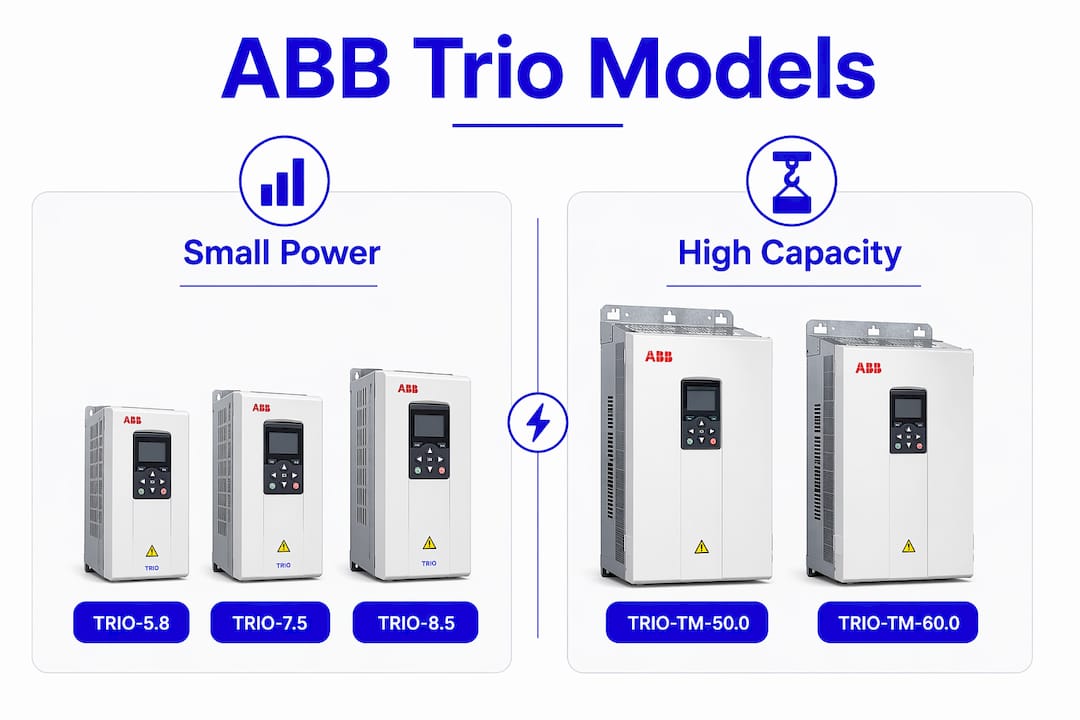
The ABB Trio series covers multiple three-phase string inverter models including the TRIO-5.8, TRIO-7.5, TRIO-8.5, TRIO-20.0, TRIO-27.6, and the larger Trio-TM-50.0 and Trio-TM-60.0. Power output across the broader ABB string inverter catalog spans from 1.2 kW to 120 kW. That range makes the Trio line a fit for mid-size commercial rooftops up through larger industrial ground-mount installations.
The TRIO-27.6-TL-OUTD-S2-400 is one of the most commonly encountered field units. It weighs approximately 118 kg and measures 120 x 80 x 75 cm, making physical handling and cabinet placement a real logistical consideration during installation or replacement. The 20.0 kW and 27.6 kW models are modular by design, meaning multiple units can be combined as building blocks for larger systems where panel arrays face varying orientations.

The table below summarizes the key models and their characteristics for quick reference.
| Model | Power Rating | Form Factor | Typical Application |
|---|---|---|---|
| TRIO-5.8 | 5.8 kW | Compact wall-mount | Small commercial rooftop |
| TRIO-7.5 | 7.5 kW | Compact wall-mount | Small commercial rooftop |
| TRIO-8.5 | 8.5 kW | Compact wall-mount | Mid-size commercial |
| TRIO-20.0 | 20.0 kW | Mid-size outdoor | Industrial modular builds |
| TRIO-27.6 | 27.6 kW | Large outdoor | Industrial modular builds |
| Trio-TM-50.0 | 50.0 kW | Large cabinet | Central commercial/industrial |
| Trio-TM-60.0 | 60.0 kW | Large cabinet | Central commercial/industrial |
The Trio-TM-50.0 and Trio-TM-60.0 are the units most likely to appear in SCADA-integrated industrial sites. They are also the models where communication protocol differences create the most friction during integration or replacement.
How do ABB Trio inverters communicate with SCADA and control systems?
The ABB Trio 50 and Trio 60 models use proprietary Modbus register maps that are static and fixed. This is the single most important technical fact for any automation engineer integrating these units into a SCADA or DCS environment. Static register maps mean every data point lives at a predetermined address, and your polling software must be configured to match that exact map.
Newer inverter generations, including FIMER’s PVS series that replaced the ABB Trio line after the FIMER acquisition, use SunSpec-compliant Modbus. SunSpec devices use dynamic model discovery, where the device announces its data structure at startup using standardized blocks such as Model 103 and Model 113. That architectural difference is not a minor configuration detail. It means the two device types require entirely different integration approaches.
The practical consequences are significant:
- Using ABB Trio register addresses against a PVS-50 or PVS-60 unit causes SCADA exception errors and data misinterpretation.
- The Trio 50 and Trio 60 register maps remain proprietary as of june 2026, with no published SunSpec equivalent for those legacy units.
- FIMER’s PVS series requires SunSpec-compatible configuration software, not the legacy ABB Trio toolchain.
- Integrators must use ABB Trio documentation for legacy Trio units and SunSpec standard documentation for PVS units to avoid communication faults.
Industry forums consistently flag this as the most common source of integration errors when sites mix old and new inverter generations on the same Modbus network. The confusion is understandable because the physical connectors and communication ports look similar. The register maps are not.
Pro Tip: Before connecting any ABB Trio unit to a SCADA system, confirm the exact model number and cross-reference it against the vendor-specific register map. A TRIO-27.6 and a PVS-50 are not interchangeable in software, even if they occupy the same physical slot in a switchboard.
For teams working with legacy Modbus interfaces, verifying protocol compatibility before integration saves hours of fault-tracing after the fact.
What are the maintenance and troubleshooting practices for legacy ABB Trio systems?
Legacy ABB Trio units are durable, but they require disciplined maintenance practices to stay operational as parts and documentation become harder to source. The first rule is documentation. Product manuals must accompany any equipment transfer, and the TRIO-20.0/27.6-TL series documentation includes safety and operation instructions that are not easily reconstructed from memory or generic guides.
Common failure modes in field-aged Trio units include:
- DC capacitor degradation: Electrolytic capacitors in the DC link degrade over time, causing voltage ripple and reduced efficiency. Replacement requires model-specific capacitor ratings.
- IGBT module failure: Insulated gate bipolar transistors (IGBTs) are the switching components most likely to fail under thermal stress. Sourcing authentic replacements matters because counterfeit IGBTs fail faster and can damage surrounding circuitry.
- Communication board faults: The Modbus communication card in Trio-TM-50.0 and 60.0 units can develop firmware corruption or physical damage. A failed communication board produces no data output but does not necessarily stop power conversion.
- Fan and thermal management issues: Cooling fans in outdoor-rated enclosures accumulate debris. A blocked fan causes thermal shutdown before any other fault appears.
Pro Tip: When a Trio unit shows intermittent SCADA data loss but continues generating power, check the communication board and Modbus cable shielding before assuming inverter failure. Communication faults and power faults are separate subsystems.
Sourcing authentic spare parts is the other half of legacy maintenance. Counterfeit or mismatched components are a real risk with discontinued product lines. Teams should verify part numbers against the original ABB documentation and source from suppliers who test and certify used components. A PLC maintenance schedule that includes inverter communication checks quarterly catches most issues before they become failures.
What are the best strategies for migrating from ABB Trio to modern inverters?
The industry trend is clear: consolidating smaller string inverters into fewer, larger high-capacity units reduces balance-of-system costs and simplifies maintenance. Models like the PVS-100 and PVS-120 are designed to replace multiple legacy Trio units, offering six MPPTs, integrated datalogging, and improved installation efficiency. That consolidation makes financial sense, but the integration work is substantial.
Legacy ABB Trio units will become progressively harder to service as parts and firmware support disappear. Monitoring infrastructure and control software must be updated to maintain site performance after any replacement. The migration is not just a hardware swap.
A structured migration approach reduces risk:
- Audit existing register maps. Document every Modbus address your SCADA system currently polls from Trio units. This list becomes your integration checklist for the replacement device.
- Identify SunSpec equivalents. Map each legacy register to its SunSpec block equivalent in the replacement inverter’s documentation. Model 103 covers AC measurements; Model 113 covers three-phase specifics.
- Update SCADA configuration in a test environment. Never push new register maps to a live production SCADA without staging the changes first. Use a test PLC or simulation environment to validate data integrity.
- Run parallel monitoring during cutover. Keep the legacy Trio unit online and monitored alongside the new inverter for at least one full production cycle before decommissioning.
- Update all site documentation. Replace Trio-specific wiring diagrams, register maps, and maintenance procedures with the new unit’s documentation before the legacy unit leaves the site.
Pro Tip: The biggest migration mistake is treating the SCADA update as an afterthought. Budget at least as much time for software reconfiguration as for physical installation. A well-documented migration from obsolete controls cuts commissioning time significantly.
Key Takeaways
The ABB Trio series requires model-specific documentation, proprietary Modbus register maps, and a deliberate migration strategy to manage effectively in 2026 industrial environments.
| Point | Details |
|---|---|
| Proprietary Modbus maps | ABB Trio 50 and 60 units use static, fixed register maps incompatible with SunSpec-compliant replacements. |
| Model range spans 5.8–60 kW | Trio units from 5.8 kW to 60 kW serve different applications; confirm the exact model before sourcing parts or configuring SCADA. |
| Documentation is non-negotiable | Product manuals must travel with the equipment; losing them makes safe maintenance significantly harder. |
| Migration requires SCADA planning | Replacing Trio units with PVS-series inverters demands a full register map audit and SCADA reconfiguration before cutover. |
| Source parts from tested suppliers | Counterfeit components are a real risk for discontinued lines; verify part numbers and use suppliers who test used inventory. |
What I’ve learned from years of managing legacy inverter systems
The teams that struggle most with ABB Trio systems are not the ones with the oldest equipment. They are the ones who never built a proper documentation library when the units were new. I have seen sites where the only surviving register map was a printout taped inside a cabinet door, faded to the point of being unreadable. That is not a hardware problem. It is a knowledge management problem.
The other pattern I see repeatedly is the assumption that a physical replacement is also a software replacement. When a Trio-TM-60.0 fails and a PVS-60 arrives as the replacement, the site team celebrates getting power back online. Then three weeks later, the SCADA historian shows gaps, alarms are misfiring, and nobody can explain why. The answer is always the same: the register map was never updated.
My honest advice is to treat every legacy Trio unit as a documentation project, not just a maintenance task. Build a site-specific integration file that includes the register map, the SCADA polling configuration, the firmware version, and the last calibration date. When the unit eventually fails or gets replaced, that file is worth more than the hardware itself. Teams that do this work proactively spend far less time in crisis mode when something breaks.
— Monica
Where to find ABB Trio parts and support for your maintenance team
Maintenance teams managing legacy ABB Trio inverter systems need a supplier who stocks tested components, not one who ships whatever is in a warehouse without verification.

Industrialpartsusa stocks surplus, used, and remanufactured industrial automation parts with a focus on legacy and hard-to-find equipment. Every item ships with a one-year warranty backed by in-house testing and repair capabilities. Same-day shipping is available on in-stock items, which matters when a failed inverter communication board is holding up production. For teams weighing their sourcing options, the secondary market buyer’s guide at Industrialpartsusa covers what to verify before purchasing used automation components. You can also browse the full catalog at Industrialpartsusa.com for ABB parts, Modbus interface modules, and related legacy automation equipment.
FAQ
What is the ABB Trio inverter used for?
The ABB Trio is a three-phase string inverter designed for commercial and industrial solar installations. Models range from 5.8 kW to 60 kW and are commonly found in mid-size to large rooftop and ground-mount systems.
Are ABB Trio inverters compatible with SunSpec Modbus?
No. The ABB Trio 50 and 60 models use proprietary Modbus register maps that are not SunSpec-compliant. Using Trio register addresses with SunSpec devices like the FIMER PVS series causes SCADA exception errors and data faults.
How do I troubleshoot communication loss on a Trio-TM-60.0?
Check the Modbus communication board and cable shielding first. A failed communication card produces no data output while the inverter continues generating power, making it easy to misdiagnose as a power fault.
Can ABB Trio units be replaced directly with FIMER PVS models?
Physically, yes. From a control and monitoring perspective, no. The PVS series uses SunSpec dynamic model discovery, which requires a full SCADA register map audit and reconfiguration before the replacement unit will report data correctly.
Where can I source spare parts for discontinued ABB Trio inverters?
Surplus and remanufactured parts suppliers who test inventory before shipping are the most reliable option. Verify part numbers against original ABB documentation and confirm the supplier provides a warranty on used components.
Recommended
- ABB 6240BP10432 Terminal Assembly for Taylor Mod 300 – Global Electrical and Industrial
- GE Emerson IC693MDL648 48V DC Input Module – Series 90-30 – Global Electrical and Industrial
- ABB Terminal Assembly for Taylor Mod 300 – Part Number 6236BP10830 – Global Electrical and Industrial
- GE Emerson Genius I/O IC660TBA103 Industrial Automation Part – Global Electrical and Industrial