
GE FANUC: Legacy PLC Systems and Sourcing Guide
GE FANUC is the combined brand name of a joint venture between General Electric and FANUC that produced programmable logic controllers, automation software, and industrial control systems for global manufacturing. The brand no longer exists as a standalone entity. Its technologies and products now live on through Emerson Electric’s Discrete Automation division, which handles legacy support for the full product catalog. For maintenance professionals running Series 90-30 PLCs, Genius I/O systems, or PACSystems controllers, understanding this corporate history is the first step toward keeping those assets running in 2026.
What is the history and corporate evolution of GE FANUC?
GE FANUC was jointly established in 1986 by General Electric and FANUC to combine American and Japanese industrial automation expertise. The partnership created three operating companies across the US, Europe, and Japan between 1986 and 1987. That structure gave the brand immediate global reach and positioned it as a serious competitor in the PLC and motion control markets.
The joint venture ran for over two decades before both partners decided to go separate ways. In 2009, GE and FANUC dissolved the partnership, and the software and controls businesses were folded into a new entity called GE Intelligent Platforms. The FANUC name dropped off entirely. That transition confused many maintenance teams who had built their facilities around GE FANUC hardware and suddenly faced a rebranded support structure.
The next major shift came a decade later. Emerson Electric acquired GE Intelligent Platforms in 2019 and absorbed its automation assets into the Discrete Automation business unit. Here is what that corporate timeline means in practice:
- 1986: GE and FANUC form the joint venture across three global operating companies
- 1987: Full operations launch in the US, Europe, and Japan
- 2009: Joint venture dissolves; brand becomes GE Intelligent Platforms
- 2019: Emerson Electric acquires GE Intelligent Platforms
- 2026: Legacy GE FANUC support sits under Emerson’s Discrete Automation division
Each ownership change affected product naming, firmware support timelines, and parts availability. Maintenance teams who track these transitions avoid the frustration of chasing support through the wrong channels.
What were the key GE FANUC automation products and technologies?
The Series 90-30 PLC and PACSystems controllers were the flagship product lines under the GE FANUC brand. Both supported modular design, meaning facilities could expand I/O capacity without replacing the entire control rack. That modularity made them attractive for large manufacturing operations with evolving process requirements.
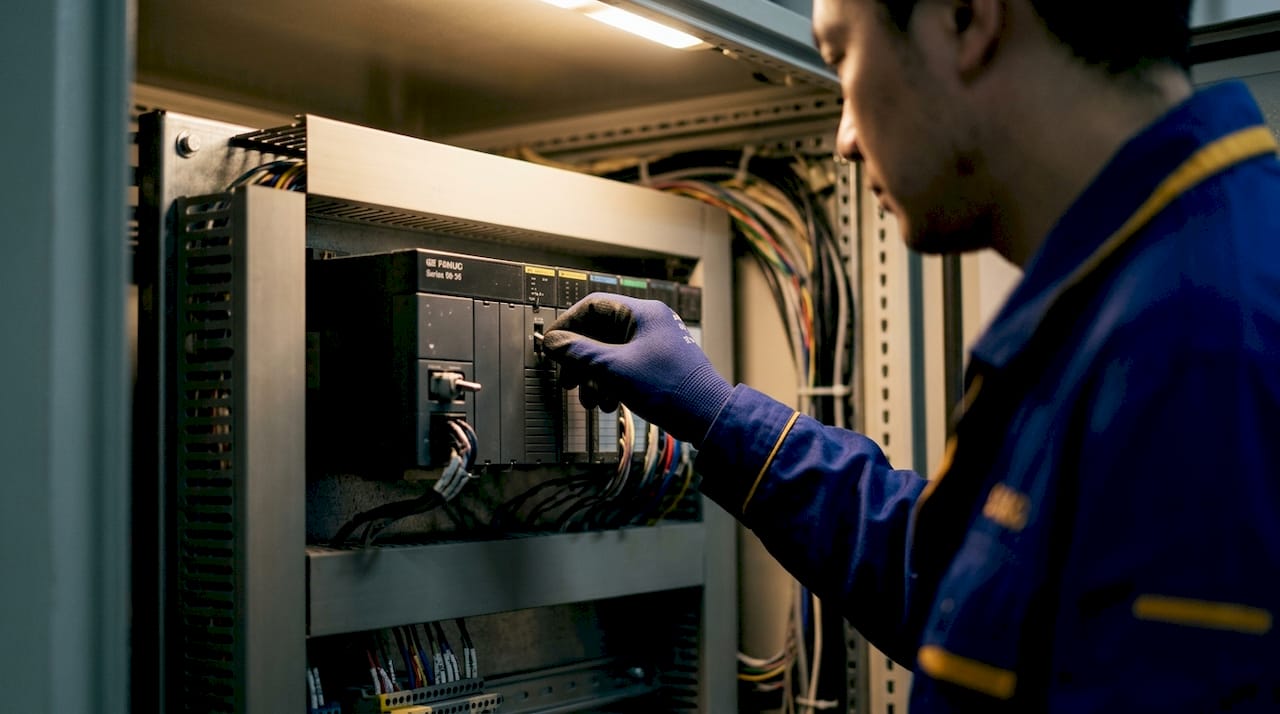
| Product Line | Primary Use | Key Feature |
|---|---|---|
| Series 90-30 PLC | Discrete and process manufacturing | Modular rack design, wide I/O support |
| PACSystems RX3i | Advanced process control | High-speed processing, Ethernet connectivity |
| PACSystems RX7i | Large-scale plant automation | Expanded memory, redundancy options |
| Genius I/O | Distributed I/O networks | Serial bus communication, field-level control |
| QuickPanel | Operator interface terminals | Integrated HMI with PLC functionality |
GE FANUC robotics added another dimension to the brand’s reach. GE accelerated industrial automation by integrating FANUC robotics technology with its own controls platform, particularly in aerospace and heavy manufacturing environments. That combination gave system integrators a single vendor relationship for both motion control and robot coordination.
Proficy Machine Edition is the primary programming environment for GE FANUC systems, including the Series 90-30 family. It handles ladder logic, function block diagrams, and structured text programming within one interface. Most facilities that still run GE FANUC hardware also run Proficy Machine Edition on their engineering workstations.
Pro Tip: Before decommissioning any GE FANUC controller, export and archive the full program from Proficy Machine Edition. Replacement CPUs like the IC693CPU364 require a clean program load, and a missing backup can cost days of downtime.
How can manufacturing professionals source legacy GE FANUC PLC components today?
Sourcing legacy GE FANUC parts requires a clear strategy because OEM lead times for discontinued components can stretch from weeks to months, or the parts simply are not available at all. Surplus and aftermarket markets fill that gap, with multiple vendors specializing in processors, I/O racks, power supplies, and communication modules. The challenge is verifying that what you receive is functional and compatible.
Hardware like the IC693CPU331 and IC693CHS397 are still widely deployed across North American manufacturing plants. Emerson and aftermarket suppliers both carry these components, but availability varies by part number and condition. Knowing exactly which revision of a module your system requires prevents costly compatibility mismatches.
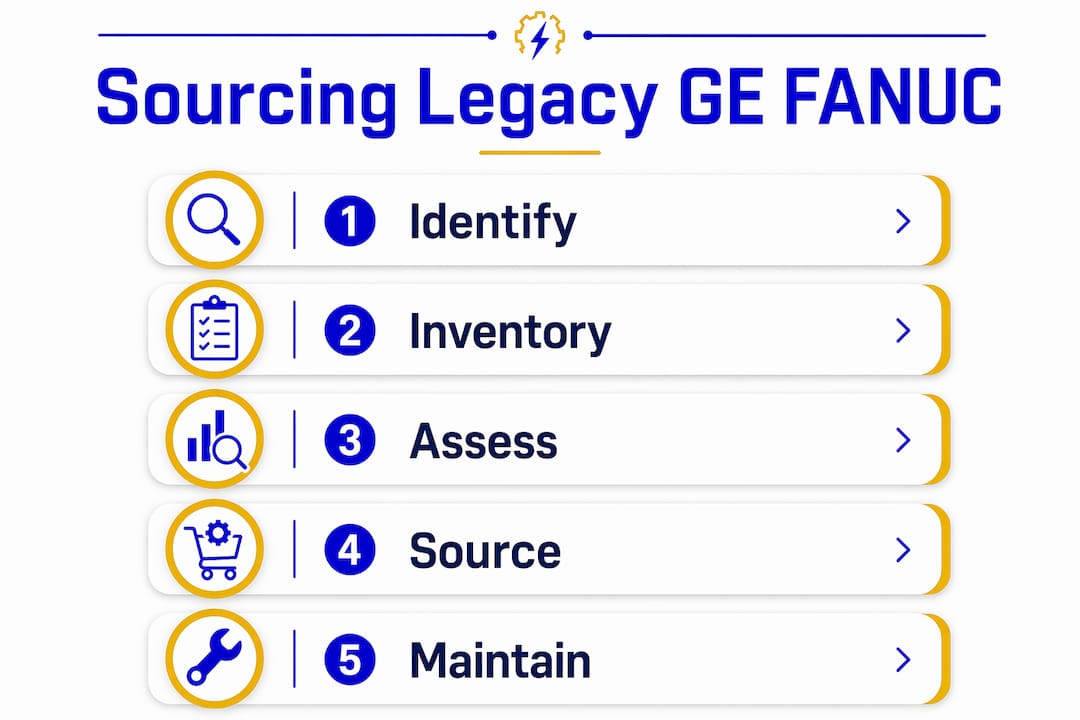
Follow these steps when sourcing legacy GE FANUC components:
- Confirm the exact part number and revision. Many Series 90-30 modules have multiple hardware revisions with different firmware requirements. A wrong revision can prevent the CPU from recognizing the module.
- Request test documentation. Reputable surplus suppliers test components before shipping. Ask for a test report or confirmation that the unit was powered and verified.
- Check warranty terms. Aftermarket suppliers typically offer their own warranty rather than a manufacturer warranty. Confirm the coverage period and what it includes.
- Verify software compatibility. Some modules require specific versions of Proficy Machine Edition or legacy programming software to configure correctly.
- Evaluate repair as an alternative. A failed module from your existing system may be repairable at lower cost than sourcing a replacement. Industrial repair services for GE FANUC hardware are available through specialized vendors.
Pro Tip: Keep a running inventory of every GE FANUC module in your facility, including part numbers, revisions, and firmware versions. When a failure happens at 2 a.m., that list cuts your sourcing time from hours to minutes.
The repair vs. replace decision depends on the module type and failure mode. Power supplies and CPU modules are often worth repairing when the failure is a known component like a capacitor or battery. I/O modules with physical damage to the backplane connector are typically better replaced.
What software and programming resources are available for GE FANUC systems?
Software support for legacy GE FANUC systems is more accessible than most maintenance teams expect. The key is knowing where to look and which tools apply to which hardware generation.
-
Proficy Machine Edition is the current programming environment for Series 90-30, RX3i, and RX7i controllers. Emerson continues to maintain it under the GE Intelligent Platforms software portfolio. Proper software licensing and firmware updates remain critical for maintaining operational integrity. Running unlicensed or outdated versions creates security gaps and can cause unexpected behavior during program edits.
-
Legacy programming environments such as Logicmaster 90 were the original tools for Series 90-30 PLCs before Proficy Machine Edition replaced them. Some facilities still use Logicmaster 90 on dedicated engineering PCs because their programs were never migrated. These environments run on older Windows versions and require careful management of the host machine.
-
Training tutorials and video resources exist for GE FANUC Series 90-30 programming and maintenance.
How-to programming tutorials for the Series 90-30 are available on community platforms and cover ladder logic basics through advanced PID configuration. These resources are especially useful for newer technicians inheriting legacy systems they did not originally commission.
-
Community support forums and vendor knowledge bases provide troubleshooting guidance for common GE FANUC faults. Emerson’s support portal carries documentation for hardware that predates the 2019 acquisition. Third-party automation communities also maintain active threads on Series 90-30 and Genius I/O diagnostics.
-
Firmware updates for supported GE FANUC hardware are available through Emerson’s Discrete Automation support channels. Not all legacy hardware receives ongoing firmware updates, but checking the current release against your installed version is worth doing annually. An outdated firmware version on a CPU module can cause communication errors with newer I/O modules added during system expansions.
Software compatibility after the corporate transitions from GE FANUC to GE Intelligent Platforms to Emerson is generally maintained for existing hardware. New installations on unsupported hardware are a different matter. If your facility is running hardware that predates PACSystems, confirm with Emerson’s support team which software version is the last validated release for your specific CPU.
Key Takeaways
GE FANUC automation assets are fully maintainable in 2026 through Emerson Electric’s Discrete Automation division and a well-vetted network of surplus and aftermarket suppliers.
| Point | Details |
|---|---|
| Corporate lineage matters | GE FANUC became GE Intelligent Platforms in 2009, then moved to Emerson Electric in 2019. |
| Key hardware still in service | Series 90-30, PACSystems RX3i, RX7i, and Genius I/O systems remain active in manufacturing plants. |
| Proficy Machine Edition is the primary tool | Use it for programming and configuring all current GE FANUC compatible controllers. |
| Verify parts before purchasing | Confirm part number, revision, and test documentation from any surplus supplier. |
| Repair is a viable option | Failed GE FANUC modules can often be repaired at lower cost than sourcing replacements. |
Working with legacy GE FANUC systems: what I’ve learned
Running legacy GE FANUC systems in a modern plant is not a problem. It is a management challenge, and there is a real difference. The mistake I see most often is treating these systems as ticking clocks rather than assets worth maintaining deliberately.
The corporate transitions from GE FANUC to GE Intelligent Platforms to Emerson created a lot of confusion, and that confusion pushed some facilities toward premature upgrades they could not afford. The reality is that a well-maintained Series 90-30 system with a solid parts inventory and a current Proficy Machine Edition license can run reliably for years. The hardware was built to industrial standards that most modern budget-tier PLCs do not match.
Where I see maintenance teams get into trouble is parts sourcing. The surplus market for GE FANUC components is active, but not every supplier tests what they sell. I have seen facilities receive modules that failed on first power-up because the supplier skipped functional testing. The fix is simple: only buy from suppliers who provide documented test results and back their inventory with a real warranty.
The other pitfall is software neglect. A facility that has not touched its Proficy Machine Edition installation in five years is running on borrowed time. License expirations, Windows compatibility issues, and missing firmware files all create problems at the worst possible moment. Treat your programming software with the same maintenance discipline you apply to the hardware.
— Monica
Where to find GE FANUC parts and automation components
Maintenance professionals who need GE FANUC components quickly have a reliable option in Industrialpartsusa, a surplus and aftermarket supplier based in Raleigh, NC that stocks new, used, and remanufactured automation parts with same-day shipping on in-stock items.

Industrialpartsusa carries high-demand GE FANUC parts including the IC693PRG300 hand-held programmer, the IC693MDL753 DC output module, and a wide range of Genius I/O components like the IC660TSD020. Every unit comes with a one-year warranty backed by in-house testing and repair capabilities. For facilities that need a broader view of what automation components belong in a production line, the top 10 production line components guide covers the full picture.
FAQ
What does GE FANUC stand for?
GE FANUC is the brand name of a joint venture formed in 1986 between General Electric and FANUC, a Japanese robotics and automation company. The venture combined both companies’ expertise to produce PLCs, motion controllers, and automation software.
Is GE FANUC still in business?
The GE FANUC brand no longer exists as a standalone entity. After the joint venture dissolved in 2009, the business became GE Intelligent Platforms, which Emerson Electric then acquired in 2019 and folded into its Discrete Automation division.
What replaced GE FANUC PLCs?
PACSystems RX3i and RX7i controllers are the direct successors to the Series 90-30 PLC line. Emerson continues to support these platforms and provides migration paths for facilities moving off older GE FANUC hardware.
Where can I find GE FANUC Series 90-30 parts?
Emerson’s Discrete Automation division carries some legacy parts, but surplus and aftermarket suppliers like Industrialpartsusa stock a broader range of hard-to-find components including CPU modules and I/O racks with same-day shipping.
What software do I need to program a GE FANUC PLC?
Proficy Machine Edition is the primary programming environment for Series 90-30 and PACSystems controllers. Older Series 90-30 systems may also have programs written in Logicmaster 90, which requires a separate legacy software installation.
Recommended
- GE Fanuc IC693CPU351 Series 90-30 CPU Controller Module – Global Electrical and Industrial
- GE Fanuc IC693CPU364 Industrial Automation Controller Module – Global Electrical and Industrial
- GE Fanuc IC693CPU341 Industrial Automation Control System Module – Global Electrical and Industrial
- GE Fanuc IC693CPU370 Industrial Automation CPU Module – Global Electrical and Industrial