
DVT Cognex Vision Systems: A 2026 Plant Engineer’s Guide
DVT Cognex vision systems are AI-enabled modular machine vision solutions built for industrial inspection, quality control, and manufacturing automation. The term “DVT Cognex” reflects the industry’s shorthand for the product line that emerged after Cognex acquired DVT, with the current standard being the Cognex In-Sight platform. These systems now combine transformer-based AI models, modular hardware, and industrial communication protocols to handle inspection tasks that scripted systems could never manage reliably. For plant engineers sourcing or upgrading vision equipment, understanding what separates legacy DVT hardware from modern Cognex In-Sight platforms is the difference between a system that works and one that fails at scale. Industrialpartsusa stocks both legacy DVT units and related automation components for engineers navigating that transition.
What are DVT Cognex vision systems and how have they evolved?
DVT Cognex vision systems originated with Digital Vision Tools (DVT), a machine vision company whose product line Cognex absorbed and eventually replaced with the In-Sight series. Legacy DVT 600 series units are largely superseded by newer Cognex In-Sight platforms, with older DVT units priced in the $1,500–$3,000 range versus premium AI-capable In-Sight systems. That price gap reflects a genuine capability gap, not just branding. Legacy DVT hardware relied on hard-coded scripts and fixed inspection rules. Modern Cognex In-Sight systems use transformer-based AI models that learn from examples rather than explicit programming.
The Cognex In-Sight 6900, released in april 2026, represents the current peak of this evolution. It brings higher AI classification capability to the In-Sight form factor, making it the reference point for new deployments. Engineers still running DVT 600 series hardware face a real decision: maintain aging equipment or migrate to a platform with active development and support. Both paths have legitimate use cases depending on production requirements and budget constraints.

Core features and capabilities of Cognex In-Sight platforms
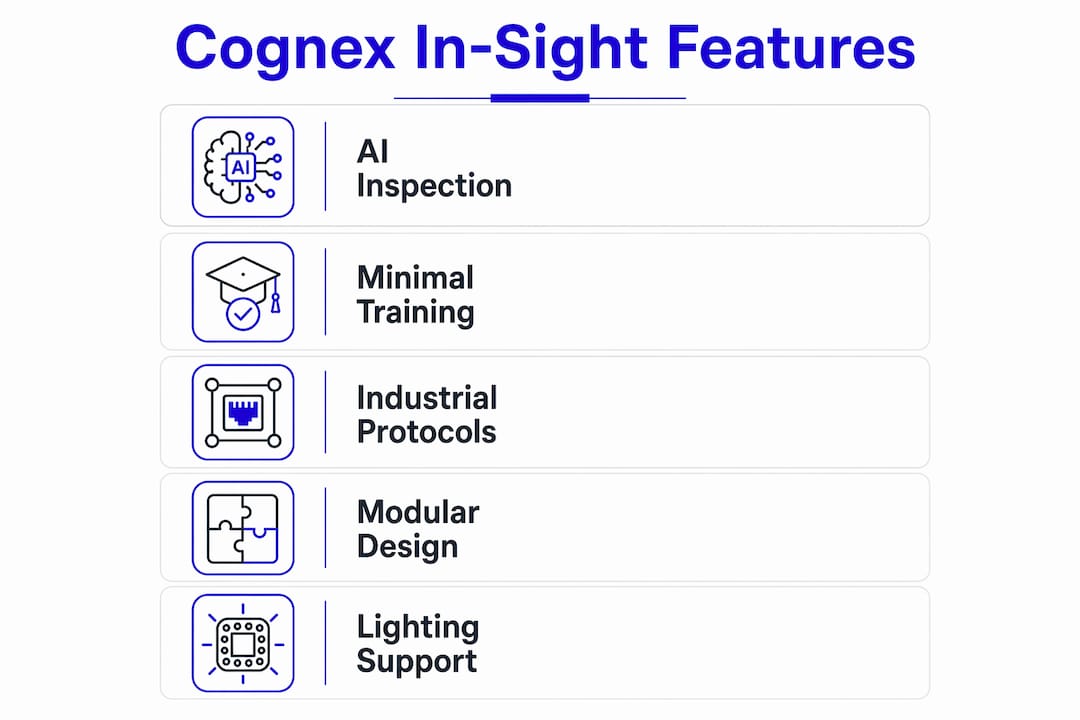
Modern Cognex machine vision systems deliver four capabilities that legacy DVT hardware cannot match: AI-based classification, modular hardware design, dual-environment software, and broad industrial protocol support.
AI-powered inspection with minimal training data is the most significant advancement. The In-Sight 6900 requires only 10–20 training images for AI classification tasks. That dramatically reduces setup time compared to older systems that required engineers to manually define every inspection variable.
Modular hardware covers cameras, optics, and lighting as separate, configurable components. This matters because no single lens or light source works for every application. Engineers select components based on the specific inspection geometry, part surface, and ambient conditions of each line.
Software environments split into two tiers:
- EasyBuilder: A guided, icon-based interface suited for straightforward inspections like presence/absence checks and basic barcode reading. New users reach a working program faster with EasyBuilder.
- In-Sight Spreadsheet: A cell-based environment where experienced integrators build complex logic by combining tool results across rows and columns. Experienced integrators prefer the Spreadsheet interface for advanced logic control and troubleshooting because it exposes every calculation and makes debugging direct.
Industrial protocol support includes EtherNet/IP, PROFINET, and Modbus, covering the major PLC ecosystems in use across North American and European plants. Understanding industrial Ethernet fundamentals is worth reviewing before configuring any of these connections.
Pro Tip: Budget $200–$400 or more per inspection head for lighting alone. Skipping quality lighting to save cost is the fastest way to create a vision system that fails in production.
What industrial applications benefit most from DVT Cognex systems?
Cognex In-Sight systems handle three broad application categories better than any scripted alternative: defect detection, presence/absence inspection, and code or label reading.
-
Defect detection on variable surfaces. AI training handles surface variation, color inconsistency, and texture differences that hard-coded rules cannot define. A stamped metal part with natural surface variation is a classic example where rule-based systems generate excessive false rejects.
-
Presence/absence inspection. Verifying that a gasket, label, or fastener is present before a part moves to the next station is one of the most common vision tasks on assembly lines. Cognex In-Sight handles this reliably at high line speeds with minimal false triggers.
-
Label and barcode reading. Reading 1D barcodes, 2D Data Matrix codes, and OCR strings on packaging or components is a core In-Sight strength. The system reads codes at angles and under variable lighting conditions that fixed scanners miss.
The shift from hard-coded scripts to training by example enables inspection of complex variable defects previously impractical to define manually. That means a single trained model can cover an entire shift’s worth of natural part variation without fatigue or drift. Equipment reliability improves because the vision system stops generating false rejects that trigger unnecessary line stops. Reduced downtime from false rejects is often the fastest measurable return on a vision system investment.
Budgeting for a full DVT Cognex application requires accounting for more than the camera. Lighting, mechanical mounting hardware, cabling, and integration engineering time all add to the total cost. Plants that budget only for the camera unit routinely underestimate total project cost by a wide margin.
Implementation considerations for plant engineers
Selecting and deploying a Cognex vision system involves decisions that go well beyond picking a camera model. Selecting vision systems should focus first on support availability and integration protocols before emphasizing software features. A system with excellent AI capability but no local support or incompatible PLC protocols will underperform a simpler system with solid integration.
Key implementation factors to address before purchasing:
- PLC integration protocol. Confirm whether your PLC uses EtherNet/IP, PROFINET, or Modbus before selecting a Cognex model. Reliable PLC integration is a critical selection criterion, not an afterthought.
- Network infrastructure. Legacy DVT systems used serial or specific proprietary protocols; modern Cognex uses dual Ethernet ports with implicit messaging. Network switch quality and bandwidth are common causes of communication dropouts on production lines.
- Mechanical mounting design. Fixed or poorly calibrated optics cause system failure despite expensive vision hardware. Design mounts with adjustable focal length and lighting angle from the start.
- Lighting specification. IP67-rated lighting and strobes are the standard for harsh production environments. Strobed lighting also freezes motion on fast-moving lines, which continuous lighting cannot do reliably.
- Training and certification. Cognex offers formal training programs. Engineers who complete structured training deploy systems faster and troubleshoot more effectively than those who self-teach from documentation alone.
The table below summarizes the most common implementation pitfalls and the corresponding corrective action.
| Pitfall | Corrective action |
|---|---|
| Communication dropouts | Use managed switches with adequate bandwidth; verify dual Ethernet port configuration |
| Lighting misconfiguration | Specify IP67-rated strobed lights; test under actual production ambient conditions |
| Rigid mechanical mounts | Design adjustable mounts for focal length and lighting angle from day one |
| Protocol mismatch with PLC | Confirm EtherNet/IP, PROFINET, or Modbus compatibility before purchasing |
| Undertrained engineering staff | Complete Cognex-certified training before commissioning |
Pro Tip: When migrating from a legacy DVT system, map your existing inspection logic as a flow chart before touching the new software. Practitioners who do this reduce rework significantly during the transition to Cognex In-Sight Spreadsheet.
How to use DVT Cognex software for optimal inspection results
Cognex DVT programming splits into two distinct workflows depending on inspection complexity. EasyBuilder works well for engineers deploying their first vision system or handling straightforward tasks. The In-Sight Spreadsheet is the right tool for anything involving multi-step logic, conditional branching, or combining results from several vision tools into a single pass/fail output.
The most effective approach to Cognex DVT programming follows this sequence:
- Map inspection logic first. Write out every condition the system must evaluate before opening the software. Practitioners recommend mapping legacy inspection logic in flow charts before recreating it in the Spreadsheet environment. This prevents logic gaps that only appear during production runs.
- Combine AI training with rule-based checks. AI handles variable defects. Rule-based tools handle fixed geometry checks like edge location or dimension measurement. Using both together produces more reliable results than relying on either alone.
- Train AI models with representative images. Include images of good parts, defective parts, and borderline cases in your training set. A model trained only on perfect parts will struggle with real production variation.
- Test under production conditions. Lighting, vibration, and part presentation on the actual line differ from bench testing. Always validate the program under live conditions before signing off on deployment.
- Use the Spreadsheet’s cell references for troubleshooting. When a program fails, the Spreadsheet environment lets you trace exactly which cell produced an unexpected result. That directness makes root cause analysis faster than any black-box approach.
The transition from hard-coded programming to AI training allows inspection of previously impossible variability in manufacturing defects. That capability is now accessible to engineers without deep computer vision backgrounds, which changes who can deploy these systems effectively. Reviewing production line automation components alongside vision system planning helps engineers see where vision fits within a broader automation architecture.
Key Takeaways
Cognex In-Sight vision systems deliver reliable manufacturing inspection when engineers prioritize integration, lighting, and training alongside camera selection.
| Point | Details |
|---|---|
| AI reduces setup complexity | The In-Sight 6900 needs only 10–20 training images, cutting deployment time versus scripted systems. |
| Lighting budget is non-negotiable | Plan $200–$400 or more per inspection head; poor lighting causes more failures than poor cameras. |
| Protocol compatibility comes first | Confirm EtherNet/IP, PROFINET, or Modbus support before selecting any Cognex model. |
| Map logic before programming | Flow-charting inspection logic before opening In-Sight Spreadsheet prevents costly rework. |
| Network infrastructure matters | Managed switches with adequate bandwidth prevent communication dropouts on dual Ethernet Cognex systems. |
The part engineers consistently underestimate
I have watched plant engineers spend months selecting the right Cognex camera and then deploy it on a line with a $40 unmanaged switch, fluorescent ambient lighting, and a rigid welded mount. The camera performs exactly as specified. The system fails anyway. That pattern repeats more often than anyone in this industry wants to admit.
The real shift in DVT Cognex deployments over the past few years is not the AI capability, though that is genuinely impressive. The shift is that the camera is now the easiest part of the project. Getting 10–20 training images and running an AI classification model is straightforward. Getting the network, the lighting, the mechanical design, and the PLC integration right is where projects succeed or fail.
My honest recommendation: treat the camera selection as the last decision, not the first. Lock in your PLC protocol, your network infrastructure, your lighting specification, and your mechanical mounting approach before you open a Cognex catalog. Engineers who do this deploy faster, troubleshoot less, and get better inspection results from day one. The AI in these systems is powerful enough that it will work if you give it a stable physical and network environment to operate in.
— Monica
Sourcing DVT Cognex components and automation parts
Industrialpartsusa stocks DVT and Cognex vision system components alongside a broad catalog of industrial automation parts, including PLCs, I/O modules, HMIs, and communication interfaces. For engineers integrating Cognex vision systems with existing PLC infrastructure, Industrialpartsusa carries automation parts and modules that support EtherNet/IP and Modbus connectivity. The team ships in-stock items the same day and backs every product with a one-year warranty through Global Electrical and Industrial. Whether you are replacing a legacy DVT unit or sourcing components for a new Cognex deployment, Industrialpartsusa’s full catalog covers the automation hardware you need without the long lead times from original manufacturers.
FAQ
What is the difference between DVT and Cognex In-Sight?
DVT refers to the legacy Digital Vision Tools camera line that Cognex acquired and eventually replaced with the In-Sight series. Modern Cognex In-Sight systems use AI-based inspection and industrial Ethernet protocols that legacy DVT hardware does not support.
How many training images does Cognex In-Sight AI require?
The Cognex In-Sight 6900 requires as few as 10–20 training images for AI classification tasks. That is significantly fewer than traditional machine learning approaches, which reduces setup time for new inspection programs.
What PLC protocols do Cognex vision systems support?
Cognex In-Sight systems support EtherNet/IP, PROFINET, and Modbus, covering the major PLC ecosystems used in North American and European manufacturing plants.
Which Cognex software environment should plant engineers use?
EasyBuilder suits straightforward inspections and first-time users. Experienced integrators use the In-Sight Spreadsheet for complex logic because it exposes every calculation and makes troubleshooting direct.
What causes the most common Cognex vision system failures?
Poor lighting specification, inadequate network infrastructure, and rigid mechanical mounts are the leading causes of Cognex system failures in production. These factors cause more failures than camera selection or software configuration errors.