
How to Source Discontinued Automation Parts Fast
When a critical PLC module fails and the OEM no longer makes it, your production line doesn’t care about lead times. The pressure to source discontinued automation parts quickly is one of the most stressful situations a maintenance team faces, and it’s happening more often as manufacturers accelerate product discontinuation cycles. This guide walks you through exactly how to find, evaluate, and secure obsolete automation components before a single-part failure turns into a multi-day shutdown.
Table of Contents
- Key takeaways
- How to source discontinued automation parts: know the lifecycle first
- Top sources for finding obsolete automation parts
- Alternative approaches when the original part is truly gone
- A step-by-step process for sourcing discontinued parts
- Common challenges when sourcing obsolete parts
- My take: why proactive sourcing is the only strategy that works
- Get your discontinued parts from Industrialpartsusa
- FAQ
Key takeaways
| Point | Details |
|---|---|
| Act before failure | Monitor OEM lifecycle notices and build a spare parts buffer for critical legacy components. |
| Use catalog number prefixes | Enter the first 4 digits of a part number in manufacturer tools to audit an entire product family’s status. |
| Specialty suppliers beat OEMs | Legacy automation parts suppliers carry tested, refurbished stock that OEMs stopped stocking years ago. |
| Alternatives exist | Retrofitting, reverse engineering, and open-source controllers can extend legacy equipment life when parts are gone. |
| Verify before you install | Inspect and bench-test every refurbished part on arrival to catch counterfeits and hidden damage. |
How to source discontinued automation parts: know the lifecycle first
Before you can find what you need, you have to know what you’re dealing with. OEM product lifecycles move through active, mature, end-of-life, and discontinued stages. Most manufacturers provide parts and service for only about 1 year after a product is discontinued, with limited exceptions for shared components. That window closes faster than most maintenance teams expect.
The practical problem is that EOL notices are routinely missed by plant-floor teams buried in daily operations. By the time someone notices the notice, the last batch of OEM stock is already gone. Signing up for manufacturer service bulletins and setting calendar reminders to audit your critical parts list twice a year is not glamorous work, but it is exactly what separates teams that manage obsolescence from teams that panic through it.
One underused trick: checking the first 4 digits of a catalog number in the manufacturer’s product selection tool reveals the lifecycle status of the entire product family, not just the specific variant you searched. A variant might still show as “active” while the parent family is already in end-of-life. That distinction matters when you’re deciding whether to stock up now or start evaluating alternatives.
Pro Tip: Build a simple spreadsheet that lists every automation part number on your critical path, its OEM lifecycle status, your current on-hand quantity, and the date you last checked. Review it quarterly. Thirty minutes of admin work can prevent a 48-hour unplanned shutdown.
A common misconception is that “discontinued” means “impossible to find.” It doesn’t. It means the OEM has stopped manufacturing and selling it. The secondary market, specialty resellers, and refurbishment shops often carry stock for years or even decades after official discontinuation.
Top sources for finding obsolete automation parts
Knowing where to look is half the battle. The good news is that the market for legacy automation parts has matured significantly, and you have more options than ever. Here is a ranked approach based on speed, reliability, and cost.
-
Specialty legacy parts suppliers. These are companies that specifically stock surplus, refurbished, and tested automation components that OEMs no longer carry. They know the product lines deeply, they test what they sell, and they can ship fast. This is your first call when you need something yesterday. Industrialpartsusa, for example, stocks a deep catalog of GE Emerson Genius I/O modules, Allen-Bradley PLCs, and other legacy platforms with same-day shipping on in-stock items.
-
Exchange and refurbishment services. Several specialty resellers offer exchange programs where you send in your defective unit and receive a tested replacement without waiting for a full repair cycle. This is one of the fastest ways to get back online when you have a failed unit in hand.
-
Verified online reseller networks. Platforms that aggregate surplus industrial inventory from multiple sources can surface stock you would never find through a single supplier. The key word is “verified.” Stick to sellers with documented testing procedures and a real warranty, not just a listing.
-
Global distribution networks. Some parts are sitting in warehouses in Europe, Asia, or South America because a plant there upgraded and sold off its spares. Reputable international suppliers can access this inventory. Just factor in lead time and import logistics.
-
OEM repair depots and authorized service centers. Even when a part is discontinued, some OEM-authorized repair shops can still rebuild failed units using stockpiled components. This is slower and often more expensive, but it is worth checking when the part is truly rare.
Pro Tip: Always ask a supplier directly: “Was this unit tested, and what is your warranty?” A legitimate supplier will give you a specific answer. Vague responses like “we inspect all inventory” without details on test procedures are a red flag.
When you evaluate a supplier, look for three things: documented testing or refurbishment process, a meaningful warranty (at least 90 days, ideally 12 months), and a track record with your specific product family. A supplier who specializes in GE Fanuc Series 90-30 or Allen-Bradley SLC 500 will know things about those platforms that a general surplus dealer won’t.
Alternative approaches when the original part is truly gone
Sometimes a part is simply not available anywhere at any price. That is rare, but it happens. When it does, you have three realistic paths forward.
Reverse engineering and custom reproduction. If you have the failed part in hand, a precision reverse engineering firm can 3D scan it and reproduce it. One large automotive supplier saved tens of thousands of euros by reproducing unique components rather than replacing entire machines. This works best for mechanical and electromechanical parts, though some electronic boards can be reproduced as well.
Retrofitting with compatible newer components. Many newer automation modules are designed with backward compatibility in mind, but discontinued products often lack direct drop-in replacements and require resizing and re-selection using catalogs and technical manuals. This means you need an engineer to verify electrical and mechanical compatibility, not just a matching footprint.
Open-source hardware and software controllers. Some engineering teams have replaced proprietary controllers entirely using open-source solutions like LinuxCNC to extend the life of mechanical assets indefinitely. This is a significant project, but for a machine that runs a critical process and cannot be replaced, it is a legitimate option.
Here is a quick comparison to help you decide which path fits your situation:
| Approach | Best for | Typical cost | Time to implement |
|---|---|---|---|
| Specialty supplier (used/refurb) | Electronic modules, PLCs, drives | Low to medium | Hours to days |
| Exchange/refurbishment service | Failed units you already have | Medium | Days to 1 week |
| Reverse engineering | Mechanical or custom parts | Medium to high | Weeks to months |
| Retrofit with newer component | Partial compatibility exists | Medium to high | Days to weeks |
| Open-source controller replacement | Proprietary controllers, long-term fix | High (engineering time) | Months |
The cost-benefit calculus always comes back to the same question: what does one hour of downtime actually cost your facility? If the answer is $5,000 or more, even an expensive alternative looks cheap.
A step-by-step process for sourcing discontinued parts
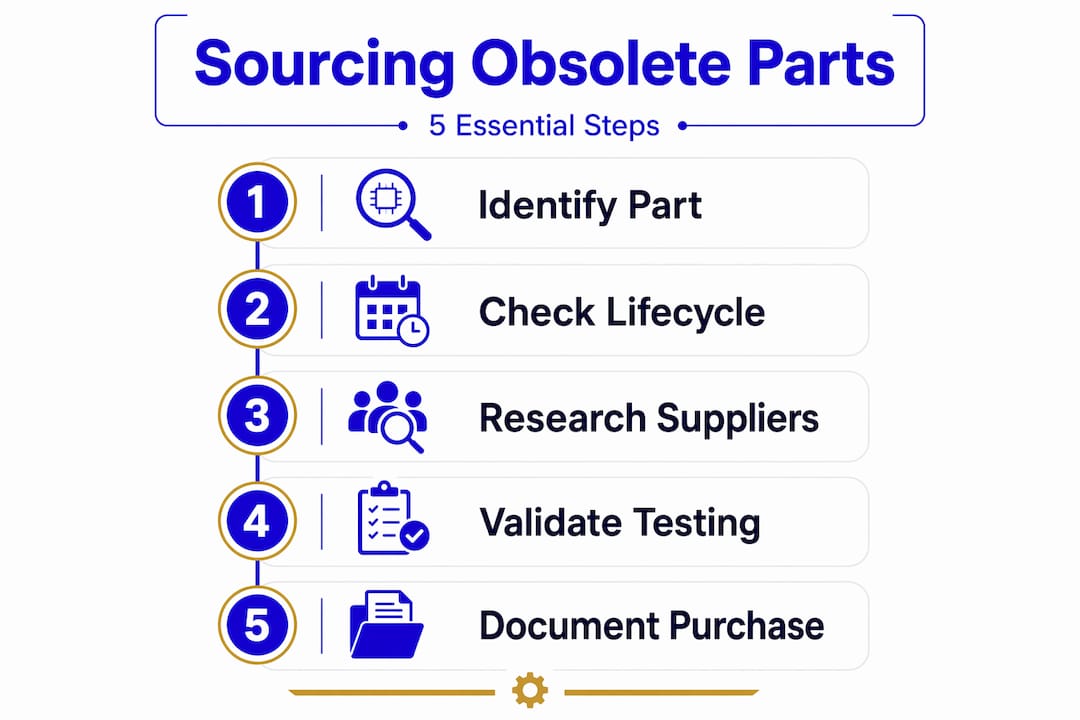
Having a repeatable process prevents the panic that drives bad decisions. Here is what a disciplined sourcing workflow looks like:
-
Verify lifecycle status first. Before spending time searching, confirm the part is actually discontinued and not just temporarily out of stock at your usual distributor. Use the OEM’s product lifecycle tool and check the catalog number prefix.
-
Define your urgency tier. Is this a production-down emergency, a planned maintenance need, or a proactive stock-up? Your urgency tier determines which sourcing channel to hit first. Production-down goes straight to specialty suppliers with same-day shipping. Planned maintenance gives you time to compare pricing across multiple sources.
-
Contact specialty legacy suppliers directly. Call or email with the exact part number, revision level if known, and your required quantity. A knowledgeable supplier will tell you immediately whether they have it in stock, what condition it is in, and what testing it has gone through.
-
Inspect and test on arrival. When refurbished or used parts arrive, do not install them directly into production. Bench-test them first using a test fixture or a non-critical machine. Check for physical damage, verify firmware versions if applicable, and confirm the unit powers up and responds correctly.
-
Build a preventive inventory buffer. Once you have sourced what you need, order one or two additional units for critical legacy systems. Proactive inventory planning is the single most effective way to eliminate emergency downtime from part failures.
Pro Tip: Document every obsolete part you source, including the supplier, price, condition, and test results. Over time, this log becomes a sourcing map that saves hours the next time the same part fails.
The most expensive mistake maintenance teams make is waiting until failure before sourcing. By that point, you are negotiating from a position of desperation, and suppliers know it.
Common challenges when sourcing obsolete parts
Even with a solid process, you will run into obstacles. Here is what to watch for:
- Counterfeit parts. The gray market for automation components has a counterfeiting problem, particularly for high-demand PLCs and drive modules. Always buy from suppliers who can document the part’s origin and provide test records. A suspiciously low price is the most reliable warning sign.
- Compatibility surprises. A successor or retrofit part that looks compatible on paper may have different firmware behavior, different I/O timing, or different communication protocols. Verify compatibility with your system integrator or the OEM’s technical support line before committing to a large purchase.
- Documentation gaps. Legacy systems often have incomplete or missing technical documentation. Specialty suppliers who work with these platforms daily frequently have access to archived manuals, wiring diagrams, and configuration guides that are no longer on the OEM’s website. Ask.
- Overseas supplier delays. International shipping for industrial parts can hit customs holds, especially for items with dual-use classifications. Build buffer time into your planning when sourcing from outside North America.
- Warranty and legal considerations. Refurbished and reverse-engineered parts typically carry the supplier’s warranty, not the OEM’s. Understand what that warranty covers, what the return process looks like, and whether your facility’s insurance or compliance requirements have any restrictions on non-OEM sourced components.
My take: why proactive sourcing is the only strategy that works
I’ve watched maintenance teams operate in two completely different modes. The first group treats obsolescence as someone else’s problem until a machine goes down at 2 a.m. on a Sunday. The second group treats it as a risk management exercise, the same way they treat fire suppression or backup power.
In my experience, the teams that get burned worst are the ones who assumed “the part is still available” because they found it on a distributor’s website three years ago. Availability changes fast. I’ve seen a GE Fanuc Genius I/O module go from “easy to find” to “nowhere in North America” in under six months after a plant liquidation absorbed most of the remaining surplus stock.
What actually works is treating your critical legacy parts list as a living document. The exchange services from specialty suppliers have genuinely changed the calculus for a lot of facilities. You don’t have to own a warehouse full of spares if you have a supplier relationship where you can swap a failed unit for a tested replacement within 24 hours.
My honest opinion on modernization: upgrade when it makes financial sense, not because someone told you legacy systems are a liability. A well-maintained legacy PLC running a stable process is not a problem. A legacy PLC with no sourcing plan for its critical modules is a ticking clock.
— Monica
Get your discontinued parts from Industrialpartsusa
Industrialpartsusa specializes in exactly the parts that are hardest to find. Their inventory covers GE Emerson Genius I/O modules like the IC660TBA101 and IC660ELB931, along with Allen-Bradley PLCs, variable frequency drives, HMIs, servo motors, and dozens of other legacy platforms. Every unit goes through testing, cleaning, and inspection before it ships, and all products come with a one-year warranty backed by their own team. Same-day shipping is available on in-stock items, which matters when your line is down. Whether you need a single module or want to build a preventive spare parts buffer, visit Industrialpartsusa to check current inventory and get a quote from a team that knows legacy automation hardware inside and out.
FAQ
What does it mean when an automation part is discontinued?
A discontinued automation part is one the original manufacturer no longer produces or actively sells. It may still be available through specialty suppliers, surplus dealers, or refurbishment services, often for years after the OEM stops stocking it.
How do I check if my automation part is discontinued?
Enter the first 4 digits of your catalog number into the manufacturer’s product lifecycle or selection tool to check the status of the entire product family. You can also contact the OEM directly or consult a specialty legacy parts supplier who tracks obsolescence across multiple brands.
Are refurbished automation parts reliable?
Yes, when sourced from a reputable supplier who documents their testing process and backs the unit with a real warranty. A tested and cleaned refurbished module from a specialist supplier is far more reliable than an untested unit from an unknown gray market listing.
How long do manufacturers support discontinued automation parts?
Parts and service are typically available for about 1 year after a product is officially discontinued, though some shared components may remain available longer. After that window, the secondary market becomes your primary option.
What should I do if no supplier has the part I need?
Evaluate three alternatives: reverse engineering the failed component for reproduction, retrofitting with a compatible newer module, or replacing the proprietary controller with an open-source solution. Each option has different cost and implementation timelines, so match the approach to your urgency and budget.
Recommended
- Global Electrical and Industrial – Your Partner in Automation
- GE Emerson IC660BPM100 Genius I/O Industrial Automation Part – Global Electrical and Industrial
- GE Emerson Genius I/O IC660TSA100 Industrial Automation Part – Global Electrical and Industrial
- GE Emerson Genius I/O IC660EBA021 Industrial Automation Part – Global Electrical and Industrial